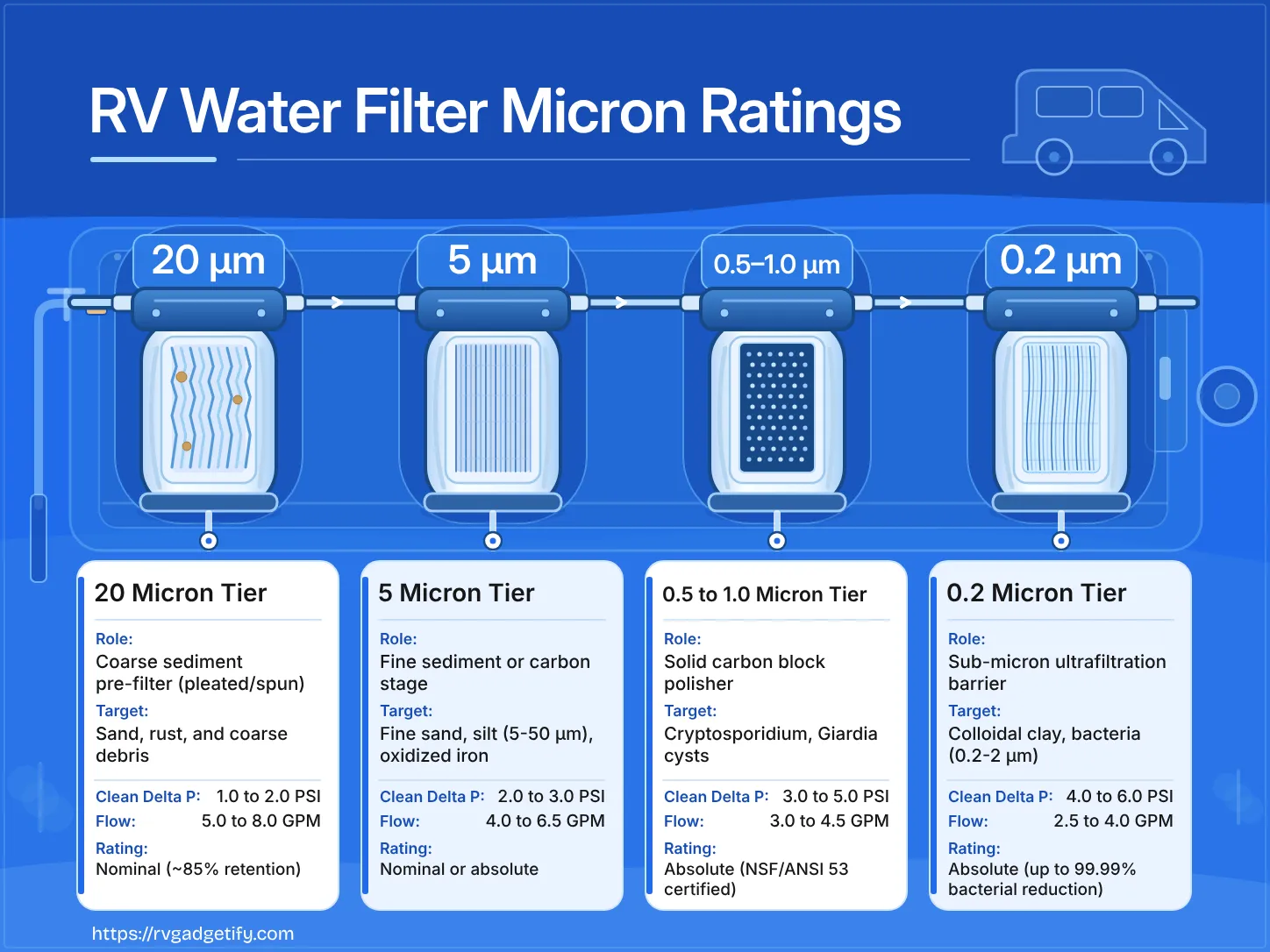

RV water filter micron ratings describe the pore-opening diameter of a filter cartridge, ranging from coarse 20-micron sediment pre-filters down to 0.2-micron sub-micron barriers. Choosing the right rating requires balancing particle removal against water pressure loss, especially when a campsite supplies silty river water, well water, or agricultural runoff.
Micron ratings work best as a stepped sequence rather than a single super-fine cartridge. A coarser upstream pre-filter protects finer downstream media from rapid surface clogging, while an absolute-rated 0.5 to 1.0 micron solid carbon block certified under NSF/ANSI Standard 53 is the appropriate stage for reducing protozoan cysts in drinking water.
Key Takeaways
- Scale and meaning: One micron (micrometer, µm) equals 1/1,000,000 of a meter; for comparison, a human hair measures approximately 70 microns across.
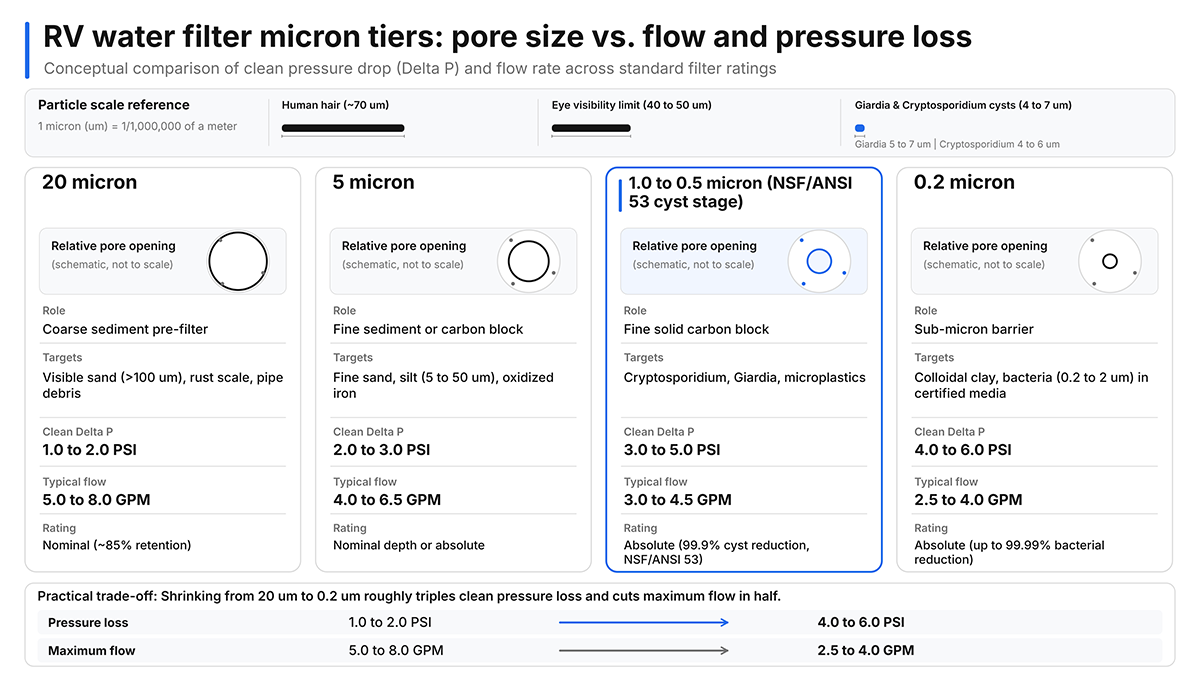
- Stage pressure loss (clean Delta P): Typical clean pressure drops run 1.0 to 2.0 PSI for a 20-micron sediment filter, 2.0 to 3.0 PSI for a 5-micron filter, 3.0 to 5.0 PSI for a 0.5 to 1.0 micron solid carbon block, and 4.0 to 6.0 PSI for a 0.2-micron barrier.
- Nominal vs. absolute ratings: Nominal filters retain approximately 85% of particles at the rated size, whereas absolute filters retain 99.9%. Rely on an absolute-rated 0.5 to 1.0 micron cartridge certified under NSF/ANSI Standard 53 when targeting Giardia or Cryptosporidium cysts.
- Cumulative pressure calculation: Add the clean pressure drop of each stage and subtract that sum from your regulated supply pressure. A stepped three-stage system (20, 5, and 0.5 micron) typically produces 6.0 to 9.0 PSI of clean pressure drop at 4 GPM (and up to 10.0 PSI at the top of each stage’s individual loss range).
- Flow and service triggers: Whole-RV plumbing needs at least 3.0 to 4.0 GPM to run multiple fixtures at once. Inspect or replace cartridges when cumulative pressure loss exceeds 15 PSI or when multi-fixture flow falters.
What Do RV Water Filter Micron Ratings Mean?
A micron, also called a micrometer and written as µm, is a unit of length equal to one millionth of a meter (1/1,000,000 m). In RV water filtration, the micron rating indicates the pore-opening diameter of the cartridge media, which governs the size of suspended particles the barrier is built to trap.
Because a human hair measures roughly 70 microns in diameter, any particle smaller than 40 to 50 microns is difficult to see with the naked eye. A 20-micron cartridge therefore has much larger passages than a 0.2-micron barrier, allowing higher water flow with less resistance while letting finer silt pass through.
A micron number alone does not tell you everything a filter will remove. You must read the micron size alongside two other specifications: the media type (such as pleated polyester sediment, spun polypropylene, or activated carbon block) and the efficiency classification (nominal versus absolute).
How Do 20, 5, 1, and 0.2 Micron Filters Compare?
A 20-micron cartridge captures coarse sand, rust scale, and pipe debris with minimal restriction, while a 5-micron cartridge captures finer silt and oxidized iron. Moving down to a 0.5 to 1.0 micron solid carbon block or a 0.2-micron sub-micron barrier targets microscopic cysts and fine colloidal particulates at the cost of higher pressure drop and lower maximum flow.
| Micron Rating | Typical Filter Role | Target Contaminants | Clean Pressure Drop (Delta P) | Typical Flow Rate | Rating Type & Certification Scope | Recommended Stage Position |
|---|---|---|---|---|---|---|
| 20 micron | Coarse sediment pre-filter (pleated or spun) | Visible sand (including grains over 100 µm), rust scale, pipe debris, coarse sediment | 1.0 to 2.0 PSI | 5.0 to 8.0 GPM | Nominal (~85% retention) | Stage 1 in high-silt or well water |
| 5 micron | Fine sediment pre-filter or standard carbon block | Fine sand, silt (5 to 50 µm), oxidized iron; chlorine taste/odor only if carbon media is used | 2.0 to 3.0 PSI | 4.0 to 6.5 GPM | Nominal depth or absolute | Stage 1 on clean city water, or Stage 2 after a 20-micron pre-filter |
| 1.0 to 0.5 micron | Fine solid carbon block / drinking-water polisher | Cryptosporidium, Giardia, microplastics; lead and VOCs when specifically certified | 3.0 to 5.0 PSI | 3.0 to 4.5 GPM | Absolute (99.9% cyst reduction when certified to NSF/ANSI Standard 53) | Stage 2 in a dual-canister setup or Stage 3 in a triple-canister setup |
| 0.2 micron | Sub-micron ultrafiltration or electropositive nanofiber barrier | Colloidal clay and sub-micron particulates; bacteria (0.2 to 2 µm) or charge-trapped viruses only in certified microbiological cartridges | 4.0 to 6.0 PSI | 2.5 to 4.0 GPM | Absolute (up to 99.99% bacterial reduction on certified media) | Final Stage 3, protected by 5-micron sediment and 1-micron carbon pre-filters |
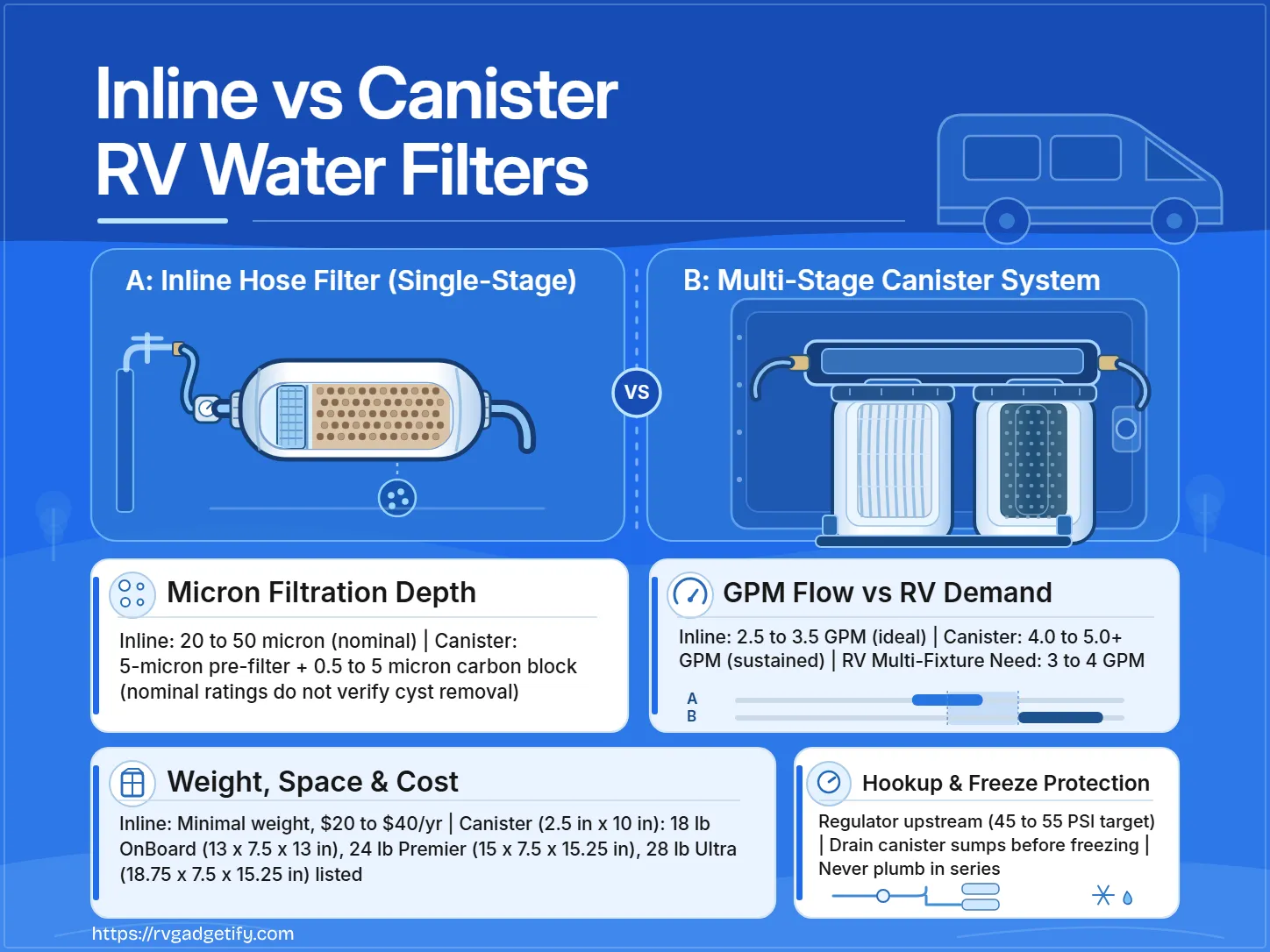
The practical trade-off across these four tiers is flow versus filtration depth. As pore diameter shrinks from 20 microns to 0.2 microns, clean pressure loss roughly triples and maximum flow drops by half. Choosing between a single inline hose filter and a multi-stage canister system comes down to whether you only need basic coarse sediment and chlorine reduction or need separate sumps to step down gradually to 0.5 or 0.2 microns without starving your fixtures.
That tripling pressure loss is also why a fine cartridge can look like a plumbing fault, and troubleshooting sulfur odors and restricted flow separates the two in our guide to RV water filter odors and low pressure.
What Is the Difference Between Nominal and Absolute Micron Ratings?
A nominal micron rating indicates that a cartridge captures approximately 85% of particles at the stated micron size, whereas an absolute micron rating indicates 99.9% particle retention at or above that pore diameter. Because of that gap, a nominal 1-micron or 0.2-micron cartridge does not perform like an absolute cartridge of the same size.
Nominal sediment filters contain irregular, winding pore paths. Under campground water pressure, soft or flexible particles can deform and push through channels that average 5 or 20 microns across. For that reason, a nominal 5-micron or 20-micron filter cannot be relied upon to block protozoan cysts.
Giardia cysts measure approximately 5 to 7 microns across, and Cryptosporidium oocysts measure approximately 4 to 6 microns. Although those biological cysts are larger than 1 micron, trapping them reliably requires an absolute-rated 0.5 to 1.0 micron solid carbon block or membrane. When buying a cartridge for cyst protection, verify that the specific model is tested and certified under NSF/ANSI Standard 53 rather than relying on the micron number printed on the label.
How Do You Calculate Pressure Drop Across RV Filter Stages?
Calculate cumulative clean pressure drop by adding the individual clean pressure loss (Delta P) of each filter stage in series, then subtracting that total from your regulated campsite water pressure.
Required Inputs and Definitions
Before running the calculation, gather four values:
- Regulated supply pressure (PSI): The starting water pressure exiting your campground pressure regulator upstream of the filters (commonly set between 45 and 55 PSI).
- Stage clean Delta P (PSI): The pressure loss across each new, unclogged cartridge at a stated flow rate, taken from the manufacturer’s spec sheet.
- Number and sequence of stages: Every housing connected in series adds its own resistance to the total pressure loss, while overall system flow is capped by the most restrictive cartridge in the chain.
- Minimum RV operating thresholds: Whole-RV plumbing requires at least 3.0 to 4.0 GPM to supply two fixtures at once, and most RV shower mixers and tankless water heaters need at least 35.0 PSI of inlet pressure to operate properly.
Pressure-Drop Formula
RV Inlet Pressure (PSI) = Regulated Supply Pressure (PSI) – (Stage 1 Delta P + Stage 2 Delta P + Stage 3 Delta P)
A stepped three-stage canister system combining a 20-micron pre-filter (1.0 to 2.0 PSI), a 5-micron carbon stage (2.0 to 3.0 PSI), and a 0.5-micron carbon block (3.0 to 5.0 PSI) produces approximately 6.0 to 9.0 PSI of cumulative clean pressure drop at 4 GPM (or up to 10.0 PSI if all three cartridges sit at the upper limit of their individual ranges). While a two-stage 20-micron and 5-micron setup can flow 4.0 to 6.5 GPM, adding a 0.5-micron cyst block narrows total flow to 3.0 to 4.5 GPM. Always use the clean Delta P published for your exact cartridge models, as wall thickness and carbon density vary by brand.
What Is a Worked Example for a Three-Stage RV Filter System?
Suppose a campsite water regulator is set to 50.0 PSI and feeds a clean three-stage canister system consisting of a 20-micron pleated sediment pre-filter (1.5 PSI clean loss), a 5-micron carbon stage (2.5 PSI clean loss), and a 0.5-micron cyst-rated carbon block (3.5 PSI clean loss). Subtracting the 7.5 PSI cumulative filter loss leaves 42.5 PSI at the RV water inlet.
| Calculation Component | Value | Unit | Basis / Formula |
|---|---|---|---|
| Regulated campsite supply pressure | 50.0 | PSI | Assumed regulator output before filtration |
| Stage 1 clean Delta P (20-micron pleated sediment) | 1.5 | PSI | Midpoint of 1.0 to 2.0 PSI stage range |
| Stage 2 clean Delta P (5-micron carbon stage) | 2.5 | PSI | Midpoint of 2.0 to 3.0 PSI stage range |
| Stage 3 clean Delta P (0.5-micron cyst carbon block) | 3.5 | PSI | Within 3.0 to 5.0 PSI stage range at 4 GPM |
| Cumulative clean filter Delta P | 7.5 | PSI | 1.5 + 2.5 + 3.5 |
| RV inlet pressure after filtration | 42.5 | PSI | 50.0 – 7.5 |
In this clean-cartridge scenario:
- Sum the stage losses: 1.5 PSI + 2.5 PSI + 3.5 PSI = 7.5 PSI cumulative clean Delta P.
- Subtract from regulated pressure: 50.0 PSI – 7.5 PSI = 42.5 PSI delivered to the RV inlet.
Because 42.5 PSI stays well above the 35.0 PSI minimum required by typical RV shower valves and tankless water heaters, the system begins with a 7.5 PSI operating margin to absorb gradual sediment loading. These figures apply only to clean cartridges at the stated assumptions; lower campground water pressure or partially loaded media will reduce inlet pressure further.
RVGadgetify / RV Water Systems
RV Water Filter Stage Pressure Drop & Inlet Pressure Calculator
Estimate the clean-cartridge pressure lost through one, two, or three filter stages in series, then compare the remaining RV inlet pressure and most restrictive flow range with shower and tankless-heater needs.
Estimated RV Inlet Pressure
Cumulative Clean Filter Delta P
Estimated System Flow Cap
Operating Margin Above 35.0 PSI
Whole-RV pressure target is at least 35.0 PSI under load.
Stage-by-Stage Pressure Breakdown
Each stage’s pressure loss is subtracted in series from the regulated supply.
| Location | Stage Clean Delta P | Cumulative Loss | Pressure After |
|---|
Verification test cases
Run the article examples, input boundaries, and staging checks. Your current form entries are not changed.
Which Micron Sequence Works Best for High-Silt Campgrounds?
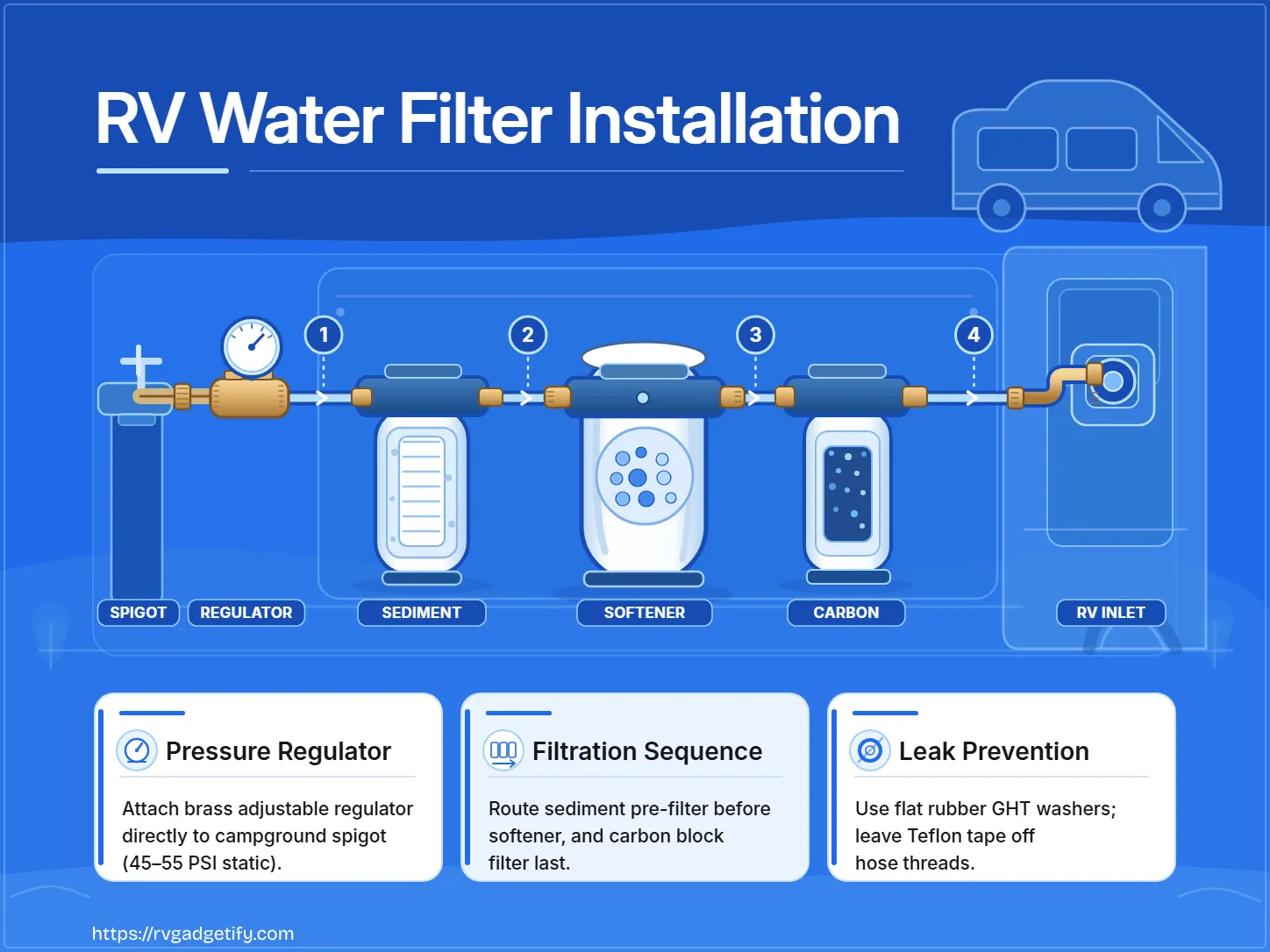
For high-silt campgrounds, rusty well hookups, or surface-water sources, place a 20-micron pleated pre-filter in Stage 1, followed by a 5-micron cartridge in Stage 2, and reserve any 0.5-micron or 0.2-micron barrier for the final stage.
Each micron tier protects the next smaller pore structure downstream:
- Stage 1 (20-micron pleated sediment): Stops coarse sand, pipe scale, and heavy suspended grit before it can reach denser media.
- Stage 2 (5-micron sediment or carbon block): Captures fine silt (5 to 50 microns) and oxidized iron, and reduces chlorine taste and odor when a carbon cartridge is used.
- Stage 3 (0.5-micron carbon block or 0.2-micron barrier): Polishes the pre-filtered water for cysts or sub-micron particulates without being immediately blinded by raw mud or sand.
Never place an unshielded 0.5-micron or 0.2-micron cartridge directly on a silty water source in a single housing. Without upstream 5-micron and 1-micron pre-filtration, coarse sediment packs onto the outer surface of a sub-micron barrier and can drive pressure loss past 15 PSI within days or even hours.

How Do Pleated and Spun Sediment Cartridges Differ?
Pleated polyester sediment cartridges provide up to 4 to 8 times more filtration surface area than spun polypropylene depth cartridges and can often be rinsed clean when loaded with coarse grit. Spun depth filters instead trap particles throughout the thickness of the wound or melt-blown fiber wall.
Because pleated media folds a wide sheet of polyester fabric accordion-style around the core, it excels as a Stage 1 pre-filter (typically at 20 microns) in turbid well or river water. Dirt collects on the outer pleats rather than embedding deep inside the cartridge, lowering initial pressure drop and allowing you to hose off heavy surface mud if the manufacturer approves rinsing.
Spun polypropylene depth media works well at 5 microns when you want graduated density that traps fine silt and oxidized iron through the body of the cartridge wall. Check the manufacturer’s specification sheet to confirm whether a specific cartridge is rinseable and to verify its rated flow and clean pressure drop.
How Do You Verify Flow, Pressure, and Filter Limits?
Verify your setup by checking both inlet pressure (PSI) and simultaneous multi-fixture water delivery (3.0 to 4.0 GPM) under load, since static pressure gauges alone cannot reveal a flow bottleneck.
When all faucets are closed, water pressure equalizes across the filter sumps, so an inline gauge downstream of the filters can read 50 PSI even when a cartridge is 90% clogged. Only when you open two fixtures at once, such as running the kitchen faucet while someone steps into the shower, does dynamic pressure drop appear. If the kitchen stream runs normally by itself but sputters or drops to a trickle when the shower turns on, your filter chain is restricting flow below the 3.0 to 4.0 GPM whole-RV threshold.
Keep filtration limits in mind during testing:
- Plain sediment cartridges do not remove chlorine or sulfur odors: Removing chemical tastes and odors requires activated carbon or specialized catalytic/KDF media.
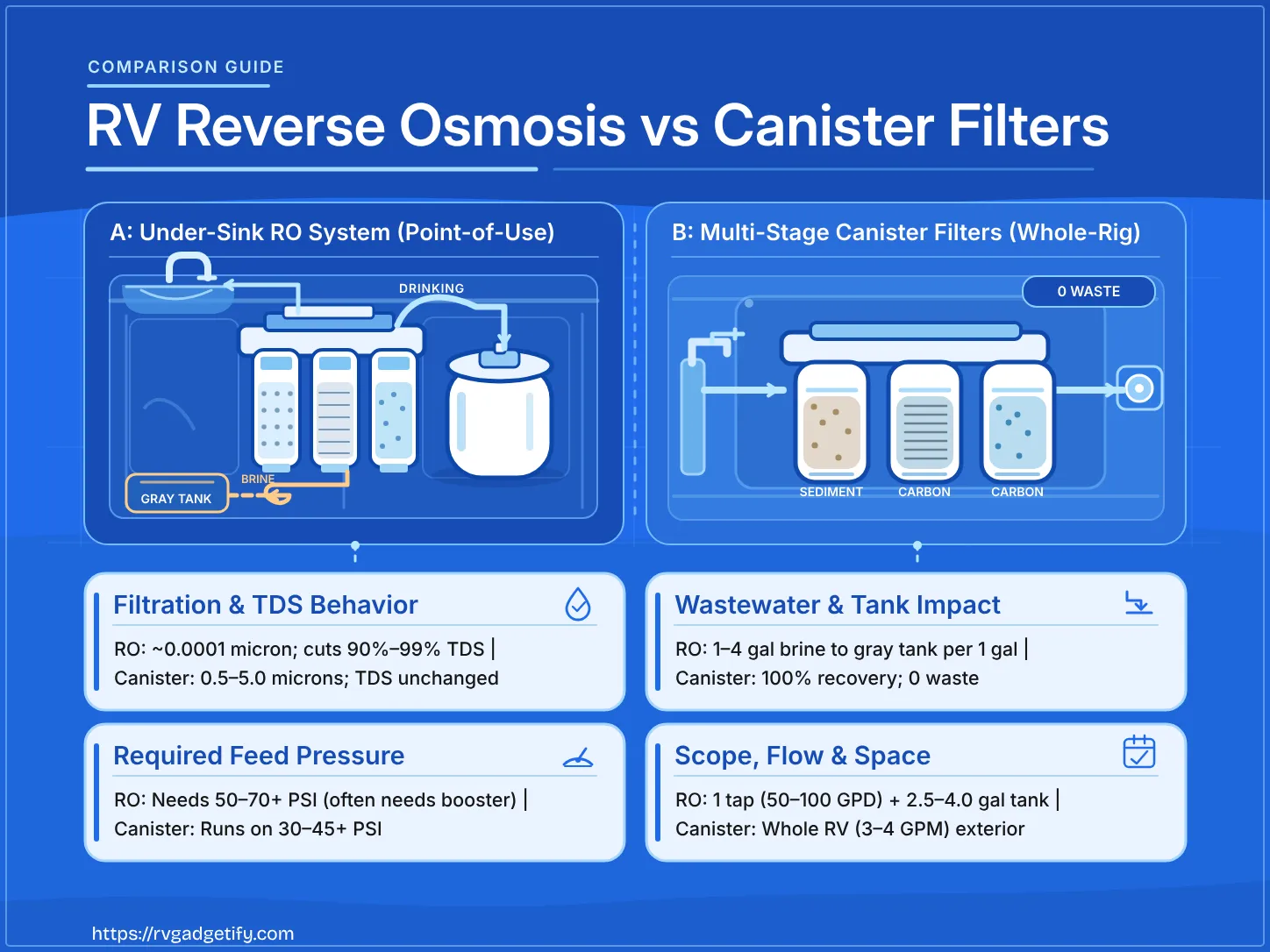
- Sub-micron filters do not soften water or lower TDS: Even an absolute 0.2-micron barrier cannot remove dissolved calcium, magnesium, or total dissolved solids. Softening requires an ion-exchange water softener, and demineralization requires reverse osmosis.
When Should You Inspect or Replace an RV Water Filter Cartridge?
Inspect or replace your cartridges when cumulative pressure loss across the system exceeds 15 PSI, when multi-fixture flow drops noticeably, or when taste and odor return.
A 15 PSI pressure-drop limit has a direct mechanical consequence inside your coach: if your regulator supplies 50.0 PSI at the spigot, losing 15.0 PSI across dirty filters drops RV inlet pressure to 35.0 PSI, which sits right on the minimum operating threshold for many tankless water heaters and shower mixers.
When flow slows down in a staged canister system, inspect the upstream 20-micron or 5-micron sediment pre-filter first rather than immediately discarding your expensive 0.5-micron or 0.2-micron final cartridge. Because the first stage absorbs the brunt of campground silt and rust scale, swapping or rinsing a clogged pre-filter often restores full system flow while preserving the downstream carbon block.
Frequently Asked Questions
What does a 5-micron rating mean on an RV water filter?
A 5-micron rating means the cartridge’s pores measure approximately five millionths of a meter across, targeting fine sand, silt between 5 and 50 microns, and oxidized iron particles.
Does a 5-micron filter remove Giardia or Cryptosporidium?
A standard 5-micron or 20-micron nominal filter does not reliably remove Giardia or Cryptosporidium. For protozoan cyst protection, use an absolute-rated 0.5 to 1.0 micron solid carbon block tested and certified under NSF/ANSI Standard 53.
What micron size is best for heavy campground sediment?
Use a 20-micron pleated pre-filter in Stage 1 to catch visible sand, rust scale, and coarse debris, followed by a 5-micron cartridge in Stage 2 to trap finer silt before water reaches your coach or a finer drinking-water stage.
What is the difference between a nominal and an absolute micron rating?
An absolute micron rating indicates 99.9% retention of particles at or above the stated pore size, whereas a nominal rating indicates approximately 85% retention. The two ratings are not interchangeable when filtering biological cysts.
How much water pressure do RV filters lose when clean?
Typical clean pressure drops are 1.0 to 2.0 PSI for a 20-micron cartridge, 2.0 to 3.0 PSI for a 5-micron cartridge, 3.0 to 5.0 PSI for a 0.5 to 1.0 micron carbon block, and 4.0 to 6.0 PSI for a 0.2-micron barrier. A stepped three-stage setup typically loses 6.0 to 9.0 PSI at 4 GPM.
Why does a fine RV water filter clog so quickly?
When raw campground water hits a 0.5-micron or 0.2-micron cartridge without pre-filtration, coarse sand and silt rapidly blind the tiny surface pores. Placing a 20-micron and 5-micron pre-filter upstream spreads out the dirt load and prevents premature clogging.
Should I run a 0.2-micron filter by itself in a single housing?
No. Running a 0.2-micron or 0.5-micron cartridge alone in a single-canister setup exposes it to raw sediment, causing rapid clogging and pressure loss exceeding 15 PSI. Always protect a 0.2-micron final barrier with upstream 5-micron sediment and 1-micron carbon pre-filters.
Do sediment filters remove chlorine taste and odor?
No. Plain polypropylene or polyester sediment cartridges only trap solid particles. Removing chlorine and chemical odors requires activated carbon media.
How many gallons per minute (GPM) does an RV water system need?
Most RVs need at least 3.0 to 4.0 GPM of sustained water flow to run multiple plumbing fixtures at the same time without sputtering or pressure loss.
Can a 0.2-micron filter remove hard water minerals or lower TDS?
No. Dissolved minerals and total dissolved solids (TDS) pass right through sub-micron mechanical and electropositive filters. Removing hardness ions requires an ion-exchange water softener, and lowering TDS requires reverse osmosis.
Actionable Next Step
Before buying replacement cartridges, match your staging sequence to your campground water quality and check your pressure margin:
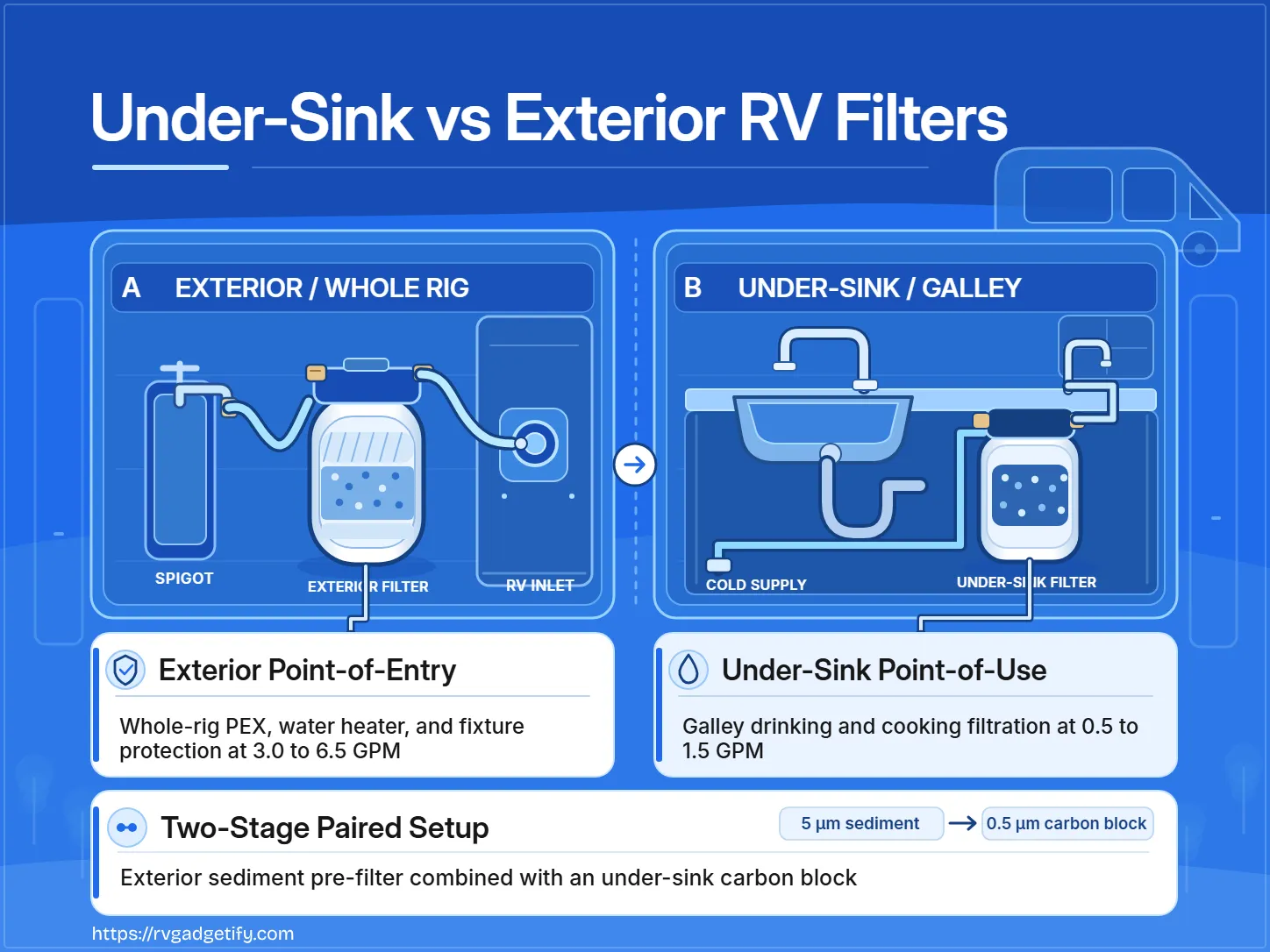
- Stage from coarse to fine: Pair a 20-micron pleated pre-filter with a 5-micron carbon block for high-silt campgrounds, adding an NSF/ANSI 53 certified 0.5 to 1.0 micron final stage when cyst protection is needed.
- Check your pressure budget: Add the clean Delta P values of your chosen cartridges and subtract the sum from your regulated supply pressure (45 to 55 PSI) to confirm at least 35.0 PSI remains at the RV inlet.
- Test under multi-fixture load: Run the shower and galley faucet together after installation to verify the system sustains 3.0 to 4.0 GPM, and inspect the first-stage sediment cartridge whenever cumulative pressure loss reaches 15 PSI.
Sources:
- Use of Lead Free Pipes, Fittings, Fixtures, Solder, and Flux for Drinking Water – U.S. Environmental Protection Agency, Safe Drinking Water Act Lead-Free Rule and 0.25% weighted average lead statutory requirement.
- How to Identify Lead Free Certified Drinking Water Products – U.S. Environmental Protection Agency Office of Ground Water and Drinking Water, PDF guidance on third-party certification marks, NSF/ANSI 372 testing, and plumbing product labeling.
- ASSE International Plumbing Product Standards – ASSE International, performance requirements and test methods for backflow prevention and water filtration system assemblies.
- Home Water Systems: Backflow Prevention Devices – Colorado State University Extension, technical guidance on cross-connection control, plumbing backflow protection, and filtration system integrity.