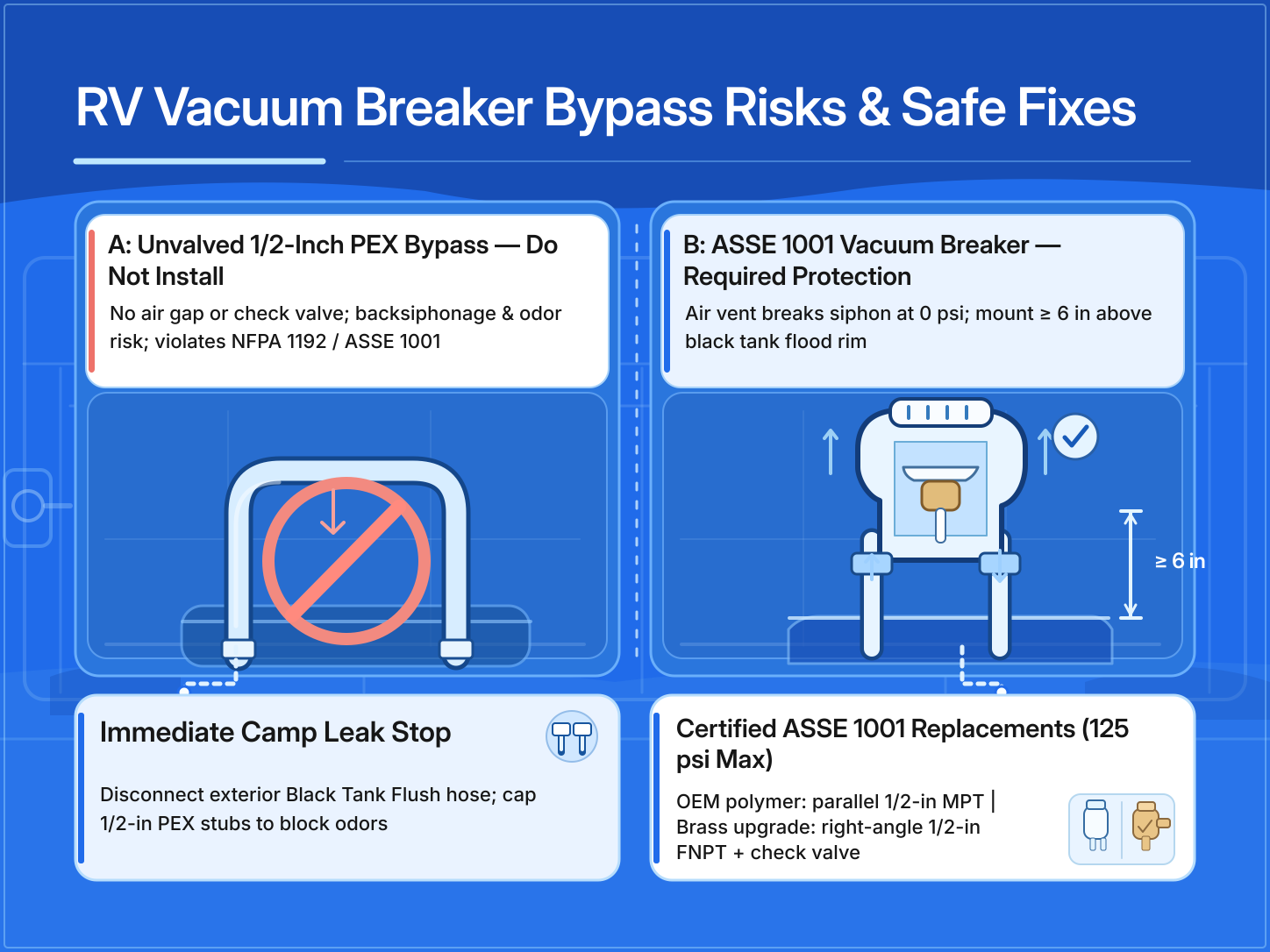

No. Bridging the two 1/2-inch PEX lines of an RV black tank flusher with a straight coupling or 90-degree elbow removes the atmospheric air gap and one-way check valve that separate black tank sewage from your external water supply. Permanently deleting that valve creates an unvalved cross-connection that violates RV plumbing standards and exposes the supply hose and campground water system to backsiphonage.
Even when a plastic vacuum breaker cracks and leaks inside a bathroom vanity or utility bay, you do not need to install a PEX bypass to stop flooding at camp. On standard RVs, the black tank flush line is an isolated pipe circuit between the exterior tank-flush inlet and the holding tank sprayer nozzle; it is not connected to your pressurized city-water hookup or onboard fresh water pump. Shutting off the outside faucet and disconnecting the flush hose immediately stops the leak while leaving your sinks, shower, and toilet fully usable until you install a certified replacement valve.
Key Takeaways
- Do not replace a leaking vacuum breaker with a straight PEX coupling or elbow. Removing the valve eliminates the atmospheric air gap that prevents black water from siphoning backward during a supply pressure drop.
- Disconnect the exterior flush hose to stop a camp leak immediately. Because the black tank flush circuit is separate from your fresh water plumbing, leaving the exterior flush port disconnected stops interior leaks without requiring a live bypass.
- Cap open lines rather than bridging them if you must wait for parts. If a shattered valve lets holding-tank odors into the cabinet, cap the disconnected 1/2-inch PEX ends instead of splicing them together for active flushing.
- Replace failed valves with an ASSE 1001 compliant vacuum breaker. Choose either a direct-fit OEM RV vacuum breaker and check valve assembly (such as the B&B Molders / JR Products 571-VAC-CHK-A or Camco 40395) or a lead-free brass ASSE 1001 valve (such as the Watts LF288A or Cash Acme V-101) with matching thread adapters.
- Pair internal protection with an exterior ASSE 1011 spigot breaker and a dedicated non-potable hose. Never reuse a black tank flush hose for drinking water.
- Winterize the black tank flush loop separately each autumn. Water stays trapped in the vertical cabinet loop unless you blow it out with regulated compressed air or purge it with non-toxic RV plumbing antifreeze through the exterior flush inlet.
How an RV Black Tank Flush Vacuum Breaker Works (and Why It Sits Under the Sink)
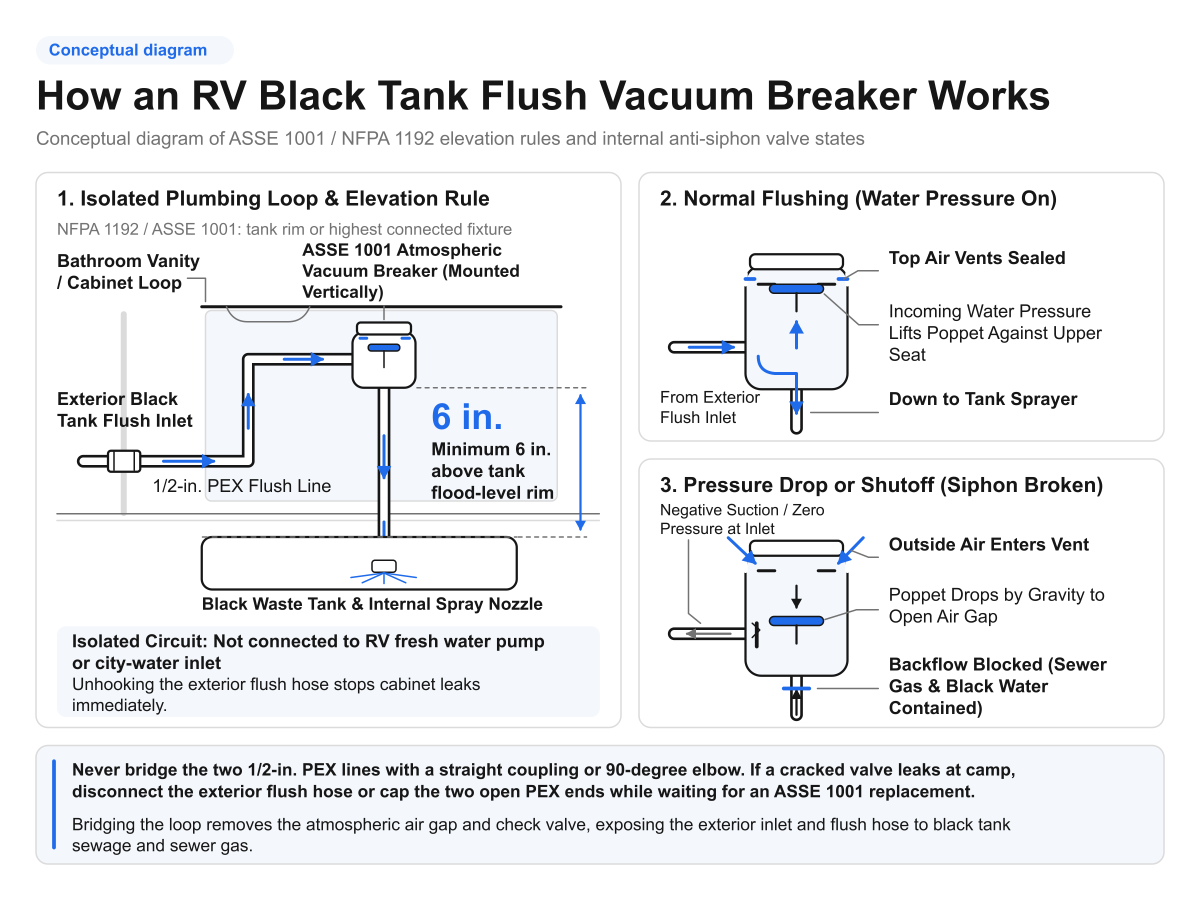
An RV black tank flush system routes water from a dedicated exterior hose inlet to a high-velocity spray nozzle mounted inside the wall of the black waste tank. Without a backflow preventer in that line, two hazards arise: sewer gases can migrate backward from the holding tank toward the exterior inlet, and liquid waste can be pulled backward into the supply hose if water pressure drops while the tank is full or backed up.
To block both hazards, RV manufacturers install an inline atmospheric vacuum breaker (often combined with an internal check valve) compliant with ASSE 1001 and IAPMO standards, as required under NFPA 1192 recreational vehicle plumbing rules. During normal flushing, incoming water pressure lifts an internal float or poppet against an upper vent seat, sealing the top air vents while water flows downward into the tank sprayer. The moment water flow stops, or if a sudden drop in campground water-main pressure creates negative suction (backsiphonage), the poppet drops by gravity and opens the atmospheric air vents. Outside air rushes into the line, breaking the vacuum siphon before contaminated water can travel backward.
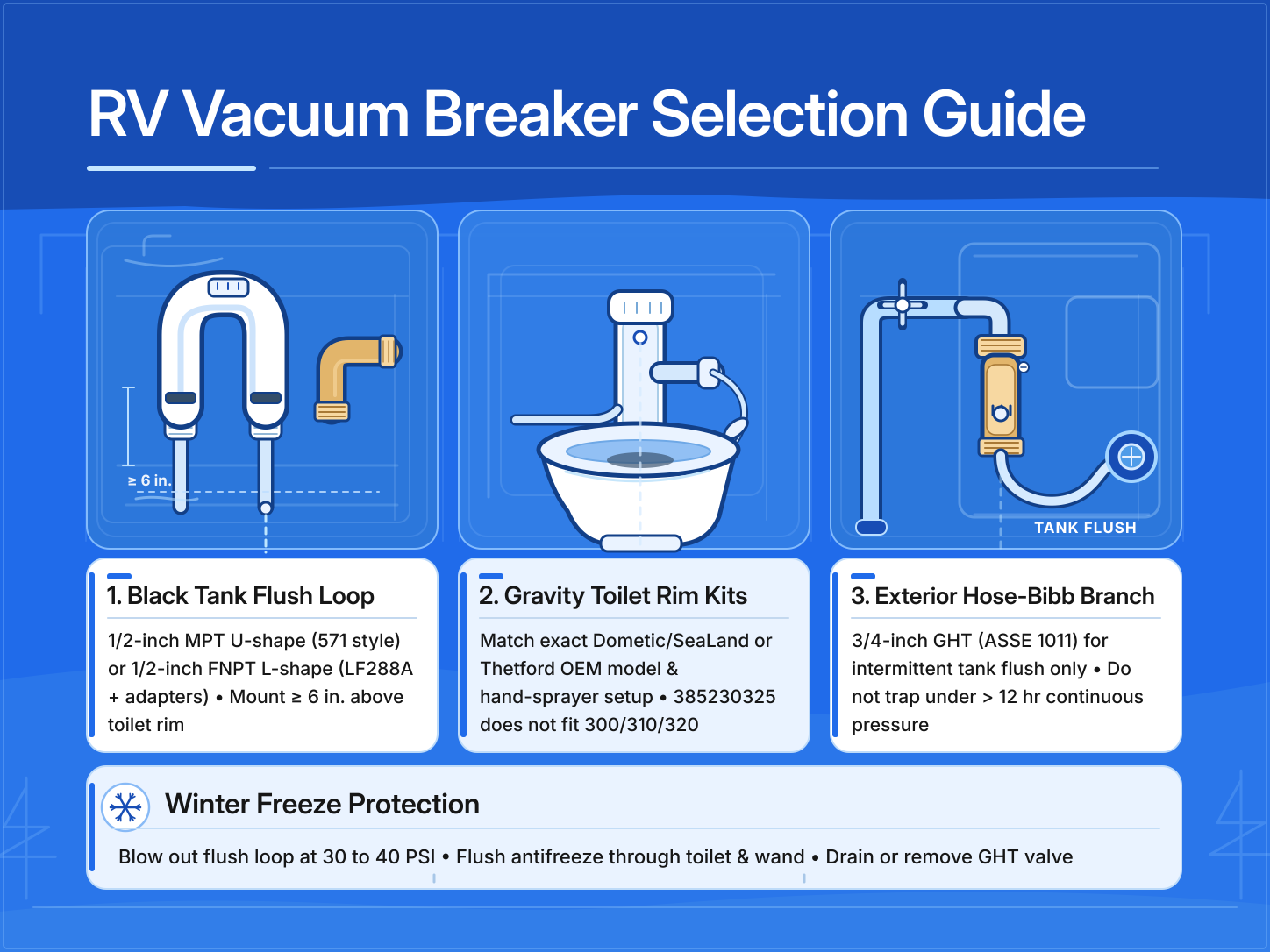
Many RV owners wonder why manufacturers route black tank flush PEX lines up into a bathroom sink cabinet, behind a toilet access panel, or behind a shower wall instead of running them straight across the underbelly. Under ASSE 1001 and NFPA 1192 installation rules, an atmospheric vacuum breaker must be mounted vertically at least 6 inches above the highest point (flood-level rim) of the waste tank or highest connected fixture. Placing the loop high inside the bathroom cabinet keeps the valve above the maximum possible liquid level of the black tank so gravity cannot push waste into the valve body before the air vent opens.
PEX Bypass vs. Certified Backflow Protection: Side-by-Side Comparison
When a freeze-damaged vacuum breaker sprays water inside a cabinet during tank flushing, owners typically consider three setups: bridging the PEX lines with a hardware-store barb fitting, replacing the internal ASSE 1001 vacuum breaker, or relying solely on a screw-on vacuum breaker at the campground spigot.
| Decision Attribute | Unvalved 1/2-Inch PEX Bypass (Coupling or Elbow) | Internal ASSE 1001 Atmospheric Vacuum Breaker | Exterior ASSE 1011 Hose-Bibb Vacuum Breaker |
|---|---|---|---|
| Typical hardware | 1/2-inch barbed or push-to-connect PEX coupling or 90-degree elbow | OEM RV polymer valve (e.g., B&B 571-VAC-CHK-A, Camco 40395) or commercial lead-free brass valve (e.g., Watts LF288A, Cash Acme V-101) | 3/4-inch GHT brass hose-connection vacuum breaker threaded onto the campground faucet |
| Backflow mechanism | None; zero check valve and zero atmospheric air gap | Gravity-actuated poppet or float disc opens an atmospheric air vent when pressure drops to zero | Single diaphragm or piston check valve with exterior atmospheric vent slots |
| What it protects | Nothing; creates a direct pipe path between the black tank sprayer and the exterior flush inlet | Protects the exterior flush inlet, the connected garden hose, and the upstream water supply | Protects the campground water main at the spigot, but does not protect the garden hose downstream of the faucet |
| Holding-tank odor control | None; allows black tank odors to reach the exterior inlet cap | Internal check-valve seal blocks sewer gas when the flusher is not in use | Does not block odors inside the RV plumbing once the hose is disconnected |
| Standards and code status | Non-compliant; removes backflow protection mandated by NFPA 1192, IAPMO, and ASSE 1001 | Compliant permanent protection when mounted vertically at least 6 inches above the tank | Compliant secondary protection under ASSE 1011 / CSA B64.2 for hose connections |
| Recommended role | Do not install for active flushing; cap disconnected lines instead if waiting for a replacement valve | Required primary protection inside the RV black tank flush loop | Secondary backup barrier at the campground water pedestal |
Why Even a “Temporary” Live PEX Bypass Is the Wrong Field Fix
Online RV forums frequently suggest splicing the two 1/2-inch PEX tubes together with a barbed elbow as a quick “24-to-48-hour emergency fix” when a vacuum breaker splits on a trip. Looking closely at how the plumbing is routed shows why a live bypass is both unnecessary and unsafe:
- Disconnecting the exterior flush hose stops the leak immediately: Because the black tank flusher is completely independent of your city-water inlet and fresh water tank pump, water never enters the vacuum breaker unless you attach a hose to the outside “Black Tank Flush” port and turn on the hydrant. If the valve leaks while you are dumping the tanks, simply turn off the hydrant and unhook the flush hose. You can finish rinsing the black tank from inside the RV by pouring water down the toilet bowl or using a handheld toilet spray wand until you replace the broken valve.
- Capping open PEX lines blocks odors without creating a cross-connection: If your old plastic vacuum breaker has cracked wide open and is letting holding-tank odors drift into the bathroom vanity, remove the broken valve and cap the two 1/2-inch PEX stubs with 1/2-inch PEX plugs or push-to-connect end caps. Capping the lines seals off tank fumes and physically prevents anyone from using the exterior flush port until the new vacuum breaker arrives.
- An exterior spigot breaker cannot protect your flush hose if the internal valve is bypassed: Screwing an ASSE 1011 vacuum breaker onto the campground hose bibb protects the park’s underground piping, because any vacuum at the hydrant vents at the spigot. However, the entire length of garden hose between the spigot and the side of your RV sits downstream of that exterior breaker. If the internal RV valve has been bypassed with a PEX elbow, contaminated moisture and bacteria from the black tank can still migrate backward into your flush hose and coat the inside of the RV’s exterior inlet fitting.
Safe Replacement Options: Direct OEM Valves vs. Heavy-Duty Brass Upgrades
When replacing a failed internal vacuum breaker, you can either install a direct-replacement OEM polymer valve or adapt the cabinet loop to accept a commercial lead-free brass atmospheric vacuum breaker.
Comparing a direct OEM polymer part with lead-free brass RV check valves is the core of that decision, and our guide to the 10 best RV backflow preventers sets the options side by side.
Option 1: Direct-Fit OEM Polymer Vacuum Breaker and Check Valve
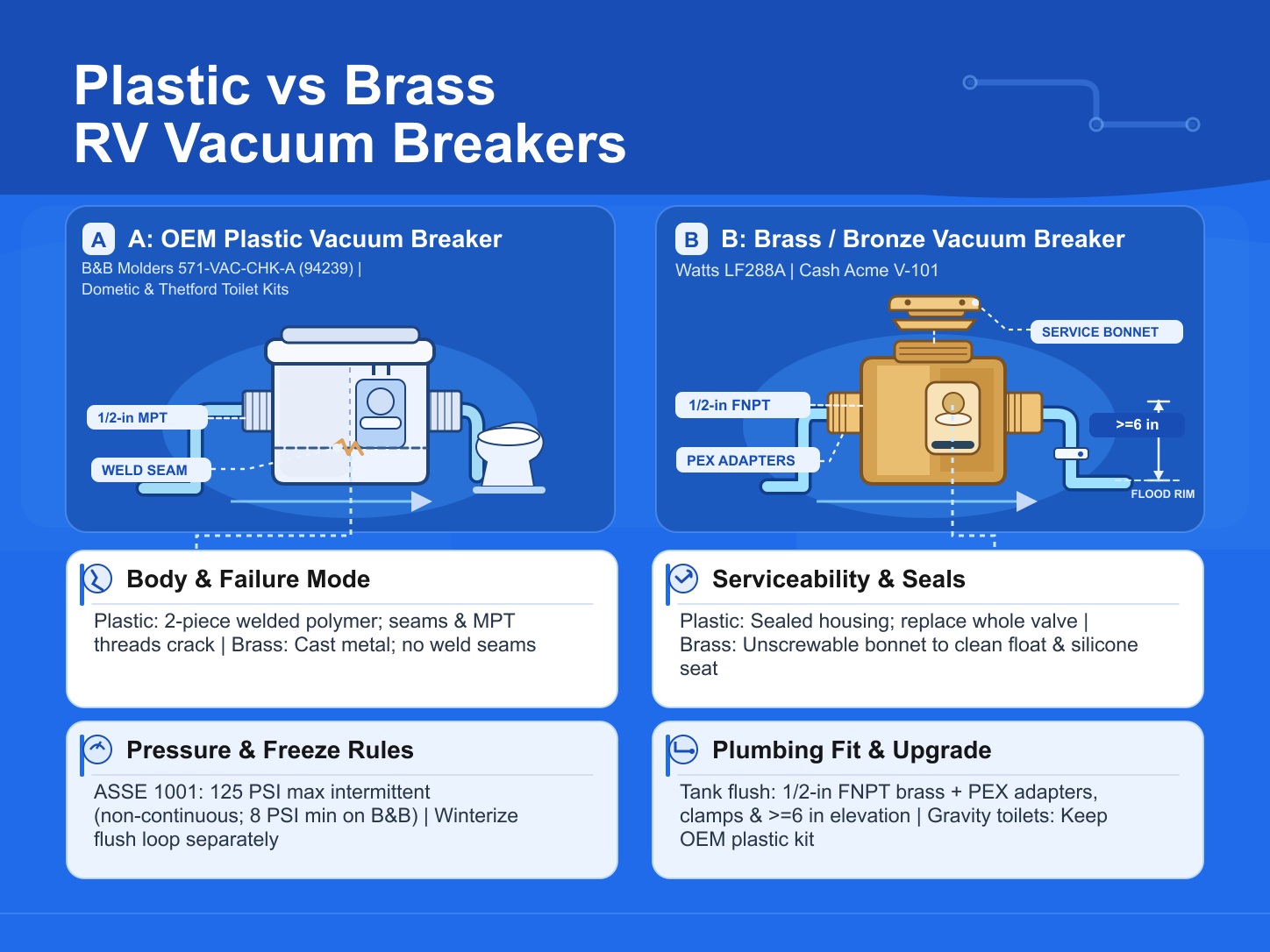
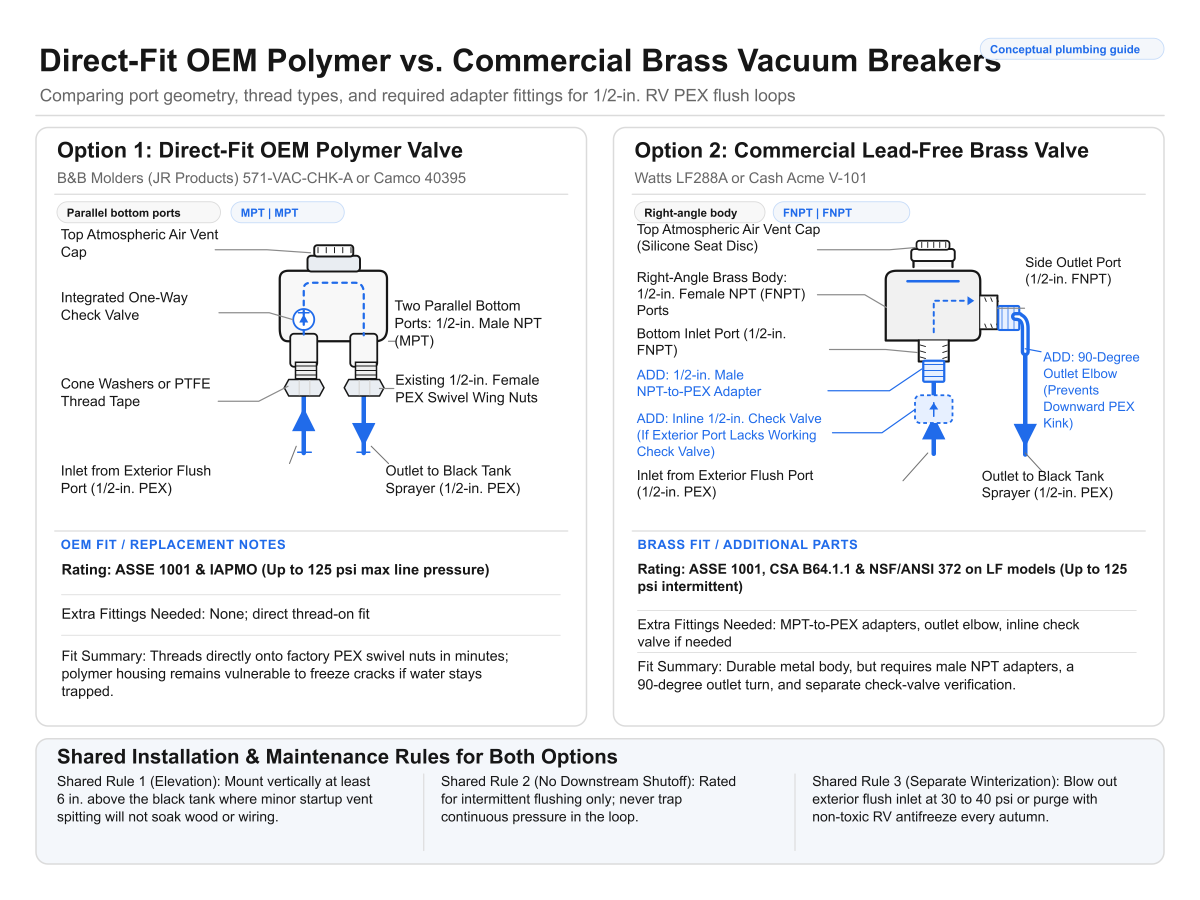
Most factory RV black tank flush loops use a one-piece thermoplastic vacuum breaker and check valve assembly, such as the B&B Molders (JR Products) 571-VAC-CHK-A or the Camco 40395.
- Certifications and ratings: Meets ASSE 1001 and IAPMO standards, rated up to 125 psi maximum line pressure.
- Plumbing fit: Features two parallel 1/2-inch male NPT (MPT) threaded ports on the bottom of the housing. It threads directly onto the existing 1/2-inch female PEX swivel wing nuts inside your cabinet using standard cone washers or PTFE thread tape (depending on whether your factory PEX fittings use swivel cone seals or tapered pipe threads).
- Trade-offs: Installation takes only a few minutes in tight cabinet spaces, but the plastic body remains vulnerable to freeze splitting if water is left inside over winter, and the top atmospheric vent cap can occasionally spit a few drops of water as the internal poppet seats when water is first turned on.
Option 2: Commercial Lead-Free Brass ASSE 1001 Vacuum Breaker
RV owners who want a metal body often upgrade to a commercial plumbing atmospheric vacuum breaker certified to ASSE 1001, such as the Watts LF288A (lead-free brass) or the Cash Acme V-101 (lead-free bronze/brass).
- Certifications and ratings: Certified to ASSE 1001 and CSA B64.1.1 (and NSF/ANSI 372 lead-free requirements on LF models), rated up to 125 psi intermittent pressure with a heat-resistant silicone seat disc.
- Plumbing fit differences to verify before buying: Unlike the OEM plastic RV valve, commercial ASSE 1001 brass valves use 1/2-inch female NPT (FNPT) threads arranged in a right-angle body (water enters the bottom port and exits the side port) and do not always include a separate spring-loaded check valve inside the body. To install a Watts LF288A or Cash Acme V-101 in an RV cabinet, you will need 1/2-inch male NPT-to-PEX adapters (and often a 90-degree elbow on the outlet side so the downward PEX tube does not kink), plus an inline 1/2-inch check valve on the inlet side if your exterior flush port does not already contain a working check valve.
- Mounting requirements: Just like the OEM unit, a brass ASSE 1001 valve must be mounted vertically with its atmospheric vent cap at the top, at least 6 inches above the highest point of the black tank, and in an accessible cabinet space where minor air-vent spitting will not soak unprotected wood or wiring.
Adding Redundant Exterior Protection (ASSE 1011 + Dedicated Hose)
For complete defense at the campsite, combine your working internal ASSE 1001 vacuum breaker with two external precautions:
- Thread a 3/4-inch GHT hose-connection vacuum breaker certified to ASSE 1011 onto the campground spigot (or onto the branch of your hose splitter dedicated to flushing) if the campground hydrant does not already have an integral anti-siphon breaker.
- Use a separate, color-coded garden hose exclusively for black tank flushing and sewer-hose rinsing. Never connect your white or blue potable drinking-water hose to the black tank flush inlet, and never use a flush hose to fill your fresh water tank.
How to Prevent Freeze Cracks in Your RV Vacuum Breaker
The number-one reason RV owners find a leaking vacuum breaker in the spring is an overlooked winterization step. Because the black tank flush pipe is completely isolated from the RV’s fresh water tank and city-water lines, pumping pink antifreeze through your kitchen and bathroom faucets or blowing out the city-water inlet does not winterize the black tank flush loop. Clear water from your last dump-station rinse stays trapped inside the check valve and vacuum breaker body, where it freezes, expands, and cracks the housing.
Always winterize the black tank flush circuit as its own step before freezing weather arrives:
- Compressed-air blowout: Thread a brass blowout plug into the exterior Black Tank Flush inlet, connect an oil-free air compressor regulated down to low pressure (typically 30 to 40 psi, and never exceeding the tubing or valve pressure rating), and blow air through the line for 30 to 60 seconds until all standing water is pushed out of the vertical cabinet loop and into the black tank.
- Non-toxic RV antifreeze purge: Using a hand pump or a winterizing pump connected to a short hose on the exterior Black Tank Flush inlet, pump a cup or two of non-toxic propylene glycol RV plumbing antifreeze through the inlet until pink fluid runs into the black tank. This displaces any residual droplets sitting around the check valve spring and vacuum breaker seal.
Frequently Asked Questions
Does a leaking black tank vacuum breaker stop me from using my RV’s city water or fresh water pump?
No. The black tank flush line is a standalone pipe run from the exterior flush port to the black tank. As long as no hose is running into the exterior Black Tank Flush inlet, you can use your RV’s city-water hookup, fresh water holding tank, water pump, sinks, shower, and toilet without any water passing through the black tank vacuum breaker.
Why does my RV vacuum breaker spit a few drops of water when I turn the flush hose on or off?
A brief spit of water from the top cap when you first open or close the outside faucet is normal for an atmospheric vacuum breaker. The internal poppet relies on water pressure to lift it tightly against the upper vent seal; at very low pressure during startup or shutdown, a few drops can escape before the disc seats or drops. Open the outside spigot briskly rather than barely cracking it open, and place a small plastic catch tray or absorbent pad beneath the valve inside the cabinet. If water pours continuously out of the vent while under full pressure, the internal seat is fouled with grit or damaged and the valve must be replaced.
Can I replace the vacuum breaker with a simple inline check valve instead?
No. A standard spring check valve only blocks reverse flow as long as its internal rubber seal closes cleanly. A single grain of sand, rust flake, or mineral deposit can hold a check valve slightly open without any visible sign from the outside. An ASSE 1001 atmospheric vacuum breaker physically opens an air vent to the room whenever line pressure drops, breaking a siphon even if an internal check valve leaks slightly.
Why can’t an atmospheric vacuum breaker stay under continuous water pressure?
Atmospheric vacuum breakers certified to ASSE 1001 (and hose-bibb breakers certified to ASSE 1011) are rated for intermittent flow only, not continuous static pressure (typically defined in plumbing codes as no more than 12 hours of continuous pressurization). Never install a shutoff valve downstream of the vacuum breaker and leave the outside spigot turned on; constant pressure can cause the internal float disc to stick against the upper vent seat so it fails to drop when a vacuum occurs.
Can a black tank flush hose ever be sanitized and reused for drinking water?
No. Even with working backflow preventers in place, a hose used at dump stations and connected to black tank flush inlets is exposed to fecal bacteria and protozoa (including E. coli, Giardia, and Cryptosporidium). Keep a distinctly colored hose strictly for waste flushing and never connect it to a potable water inlet.
Sources:
- Use of Lead Free Pipes, Fittings, Fixtures, Solder, and Flux for Drinking Water – U.S. Environmental Protection Agency, Safe Drinking Water Act Lead-Free Rule and 0.25% weighted average lead statutory requirement.
- How to Identify Lead Free Certified Drinking Water Products – U.S. Environmental Protection Agency Office of Ground Water and Drinking Water, PDF guidance on third-party certification marks, NSF/ANSI 372 testing, and plumbing product labeling.
- ASSE International Plumbing Product Standards – ASSE International, performance requirements and test methods for ASSE 1011 hose connection vacuum breakers and backflow protection.
- Home Water Systems: Backflow Prevention Devices – Colorado State University Extension, technical guidance on cross-connection control, hose-end vacuum breakers, and plumbing backflow protection.