
Inline hose filters are compact, single-cartridge units typically rated from 20 to 50 microns nominal, while multi-stage canister systems use 0.5 to 5 micron cartridges and support higher water flow. Choosing the right setup depends on your water source, how many plumbing fixtures you run at once, and how much storage bay space and payload capacity your RV can spare.
Inline and canister RV water filters solve different problems at the campground spigot. Inline filters prioritize fast hookup, low upfront cost, and minimal weight, whereas canister systems prioritize higher sustained flow, finer particle filtration, and replaceable stage media. This guide compares both architectures across micron ratings, gallons-per-minute (GPM) flow, physical footprint, weight, and operating rules so you can match the hardware to how you camp.
For a broader look at specific models and use cases, see our guide to top-rated RV water filter systems.
Key Takeaways
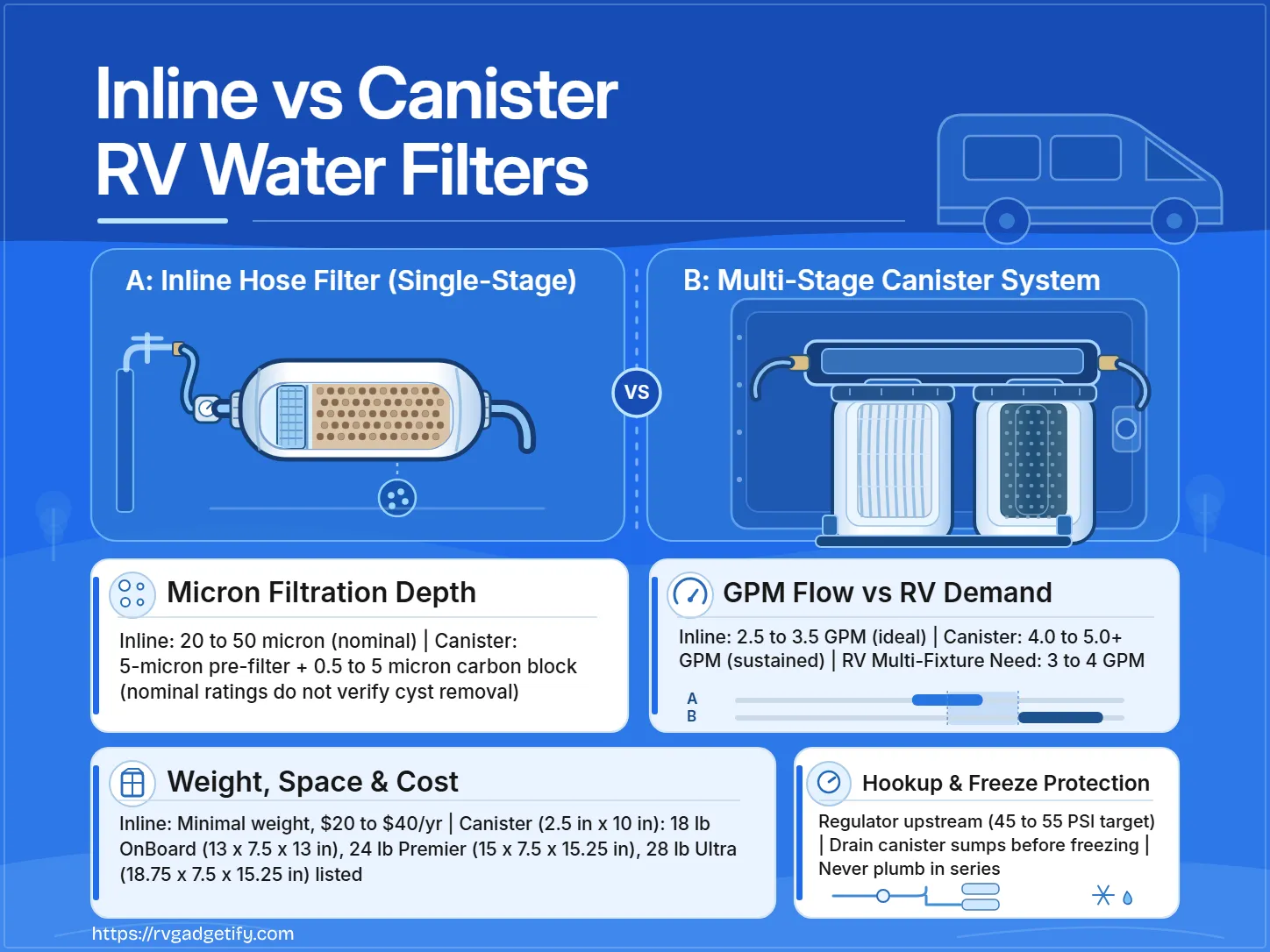
- Flow rate vs. coach demand: Standard inline filters are rated for 2.5 to 3.5 GPM under ideal clean-cartridge conditions, while multi-stage canister systems sustain 4.0 to 5.0+ GPM. Most RVs require at least 3 to 4 GPM to run multiple fixtures without a noticeable pressure drop.
- Filtration depth: Inline RV filters typically use a 20 to 50 micron nominal pore size, whereas standard canister systems combine a 5-micron sediment pre-filter with a 0.5 to 5 micron solid carbon block.
- Micron rating limits: A nominal micron rating measures physical particle size only and does not verify microbial or cyst removal unless the filter carries independent certification.
- Weight and bay footprint: Disposable inline cylinders add minimal weight at the spigot, while multi-stage canister stands such as the ClearsourceOnBoard, Premier, and Ultra have manufacturer-listed weights of 18, 24, and 28 lb and require dedicated compartment space.
- Hookup and freeze protection: Always install a pressure regulator upstream of the filter (targeting 45 to 55 PSI inside the coach) and drain canister sumps before sub-freezing storage.
What Is the Core Difference Between Inline and Canister RV Filters?
Inline filters are sealed, single-stage cylinders that thread directly between the campground spigot and your fresh water hose, while canister systems are multi-stage manifolds that house replaceable drop-in cartridges. The two designs represent different filtration architectures rather than interchangeable accessories.
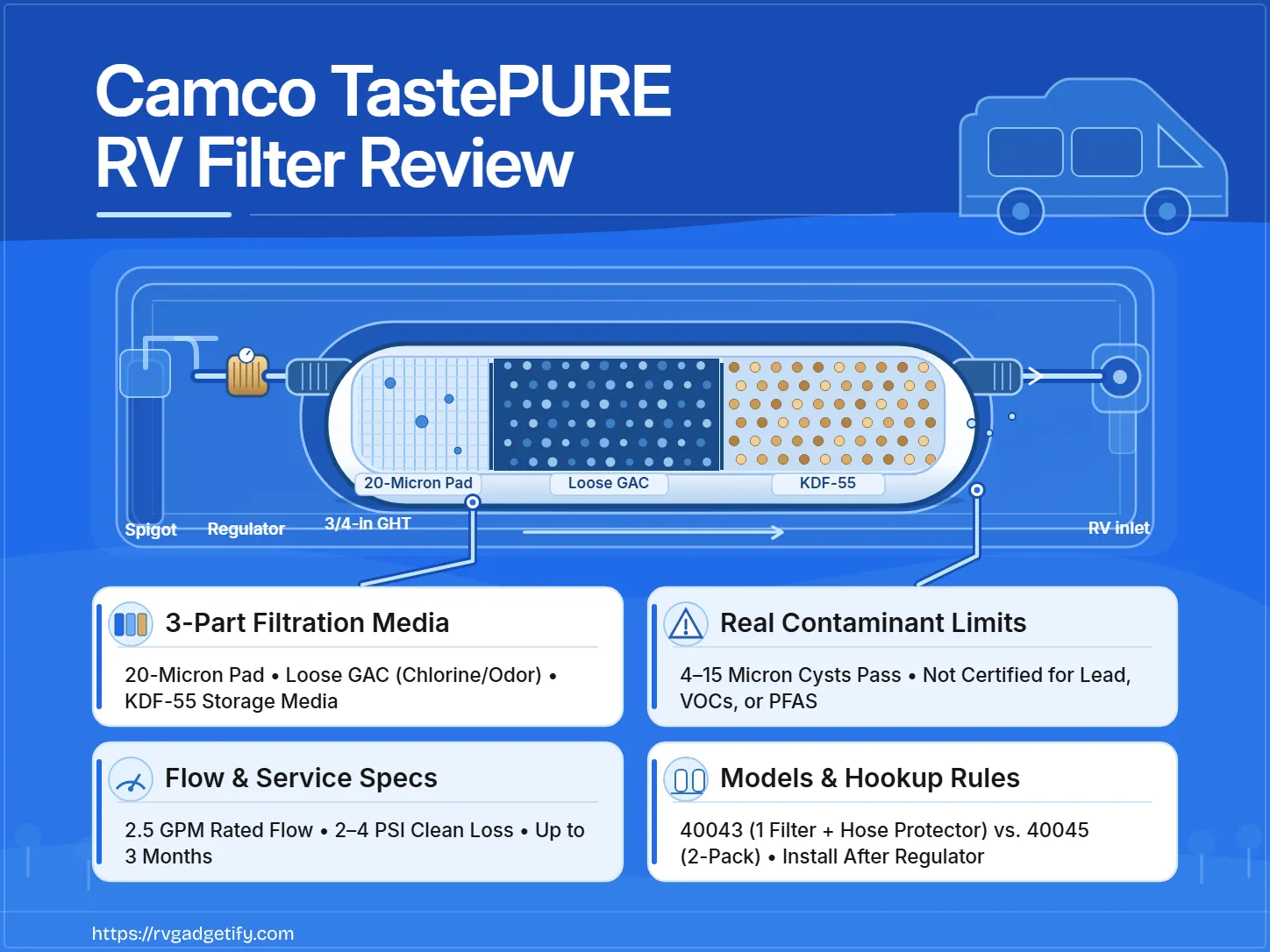
An inline hose filter packages a coarse sediment disc and granular activated carbon (GAC) inside one disposable plastic housing. When the media clogs or reaches the end of its service life, you discard the entire cylinder. Canister systems mount two or three Twist-off sumps to a freestanding metal cage or an interior utility-bay bracket. Water passes sequentially through separate 2.5 in x 10 in cartridges, typically pairing a spun polypropylene sediment pre-filter with a denser solid carbon block.
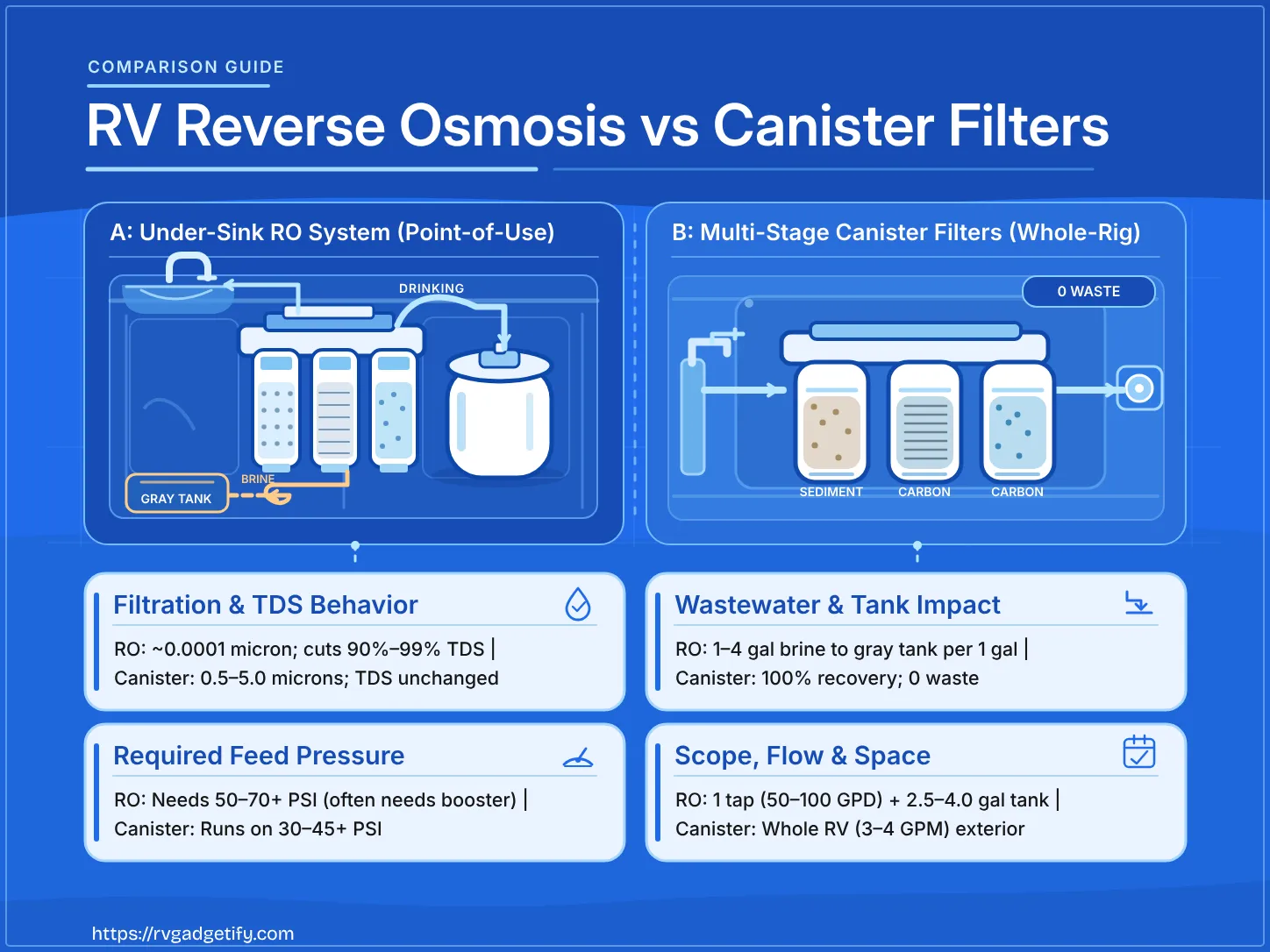
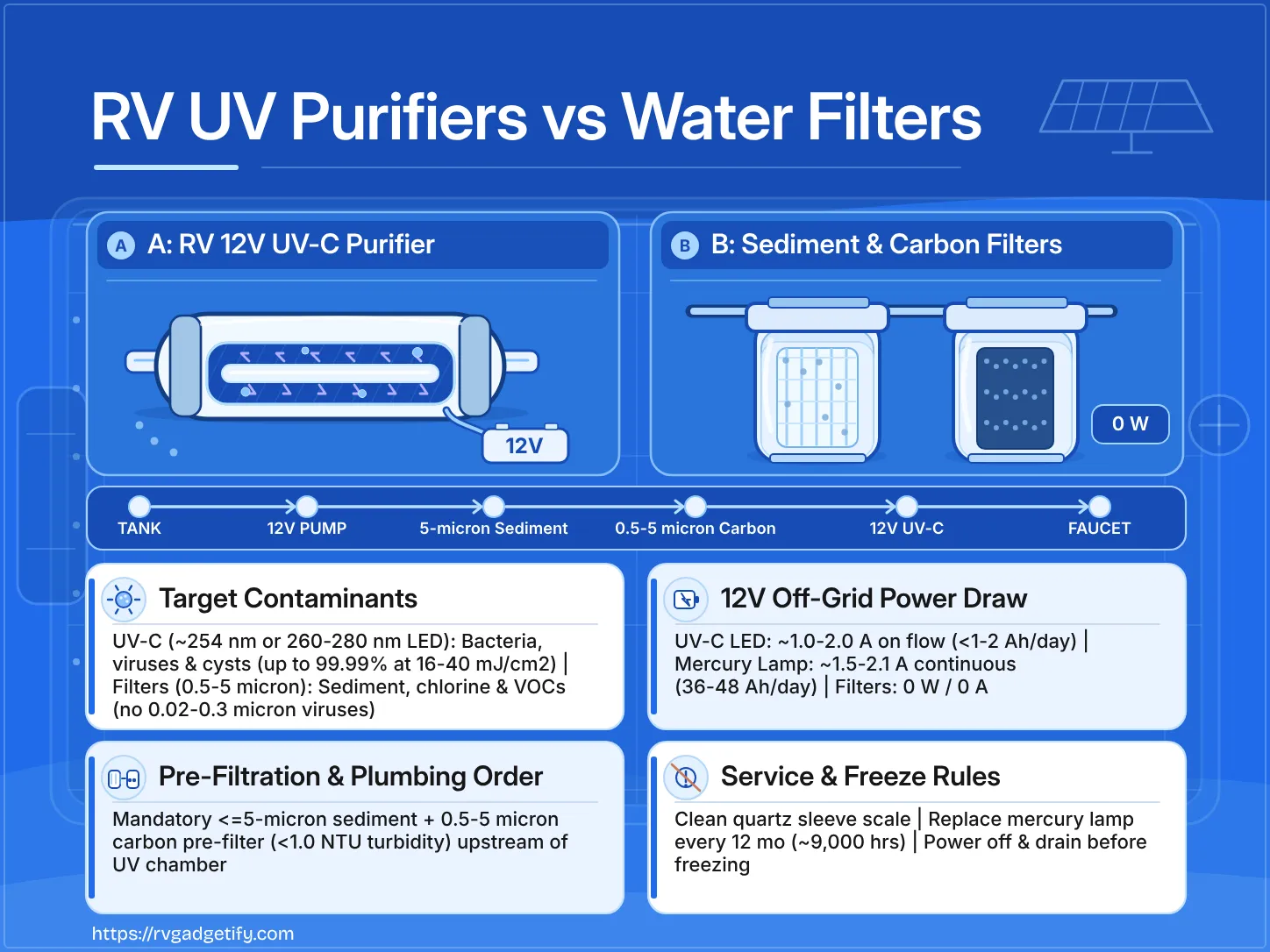
Neither architecture softens hard water or reduces total dissolved solids (TDS). Removing dissolved calcium and magnesium requires an ion-exchange RV water softener, while TDS reduction and microbiological sterilization require reverse osmosis units, UV systems, or certified point-of-use drinking water systems that sit outside this comparison.
How Do Micron Ratings Compare?
Standard inline filters use a 20 to 50 micron nominal rating, while multi-stage canister systems use a 0.5 to 5 micron range across staged cartridges. That difference determines how much fine silt reaches your RV plumbing and how quickly the filter clogs.
Inline water filters rely on a 20 to 50 micron nominal pore size to trap visible rust flakes, coarse sand, and pipe scale while reducing basic chlorine taste and odor through granular carbon. Because all filtration happens in a single small chamber, fine silt passes through or packs against the intake screen.
Multi-stage canister systems divide the workload across progressive pore sizes. A 5-micron spun polypropylene pre-filter captures rust and suspended sediment in the first sump, protecting the denser 0.5 to 5 micron solid carbon block in the second sump from premature surface clogging.

Protozoan cysts such as Giardia and Cryptosporidium measure 4 to 15 microns. That size sits well below the 20 to 50 micron inline range and overlaps the 0.5 to 5 micron canister range. However, a nominal micron rating only describes average particle retention, not verified biological protection. Do not rely on a micron number alone for cyst or pathogen removal unless the specific cartridge is independently tested and certified for microbial reduction. For a detailed breakdown of pore ratings, see our guide on matching filter micron ratings to campground water.
How Do GPM Flow Rates Compare With RV Demand?
Inline filters are rated for 2.5 to 3.5 GPM under ideal conditions, whereas multi-stage canister systems sustain 4.0 to 5.0+ GPM. Because most RVs need at least 3 to 4 GPM under realistic operating conditions, an inline filter operates right at the threshold of noticeable flow restriction.
A new inline filter can supply a single faucet without obvious trouble, but running the shower and galley sink at the same time often exposes the 2.5 to 3.5 GPM ceiling. Worse, inline housings have limited surface area and suffer rapid flow loss when blinded by campground sediment. Some RV tankless water heaters also require a minimum water flow rate to keep the burner lit, meaning a partially clogged inline filter can cause the water heater to shut down mid-shower. Check your water heater manual for its exact minimum activation flow.
Canister systems route water across dual or triple 2.5 in x 10 in drop-in cartridges. That larger media surface area sustains 4.0 to 5.0+ GPM, keeping delivery above the 3 to 4 GPM whole-coach threshold even when two fixtures are open.
| Comparison Attribute | Inline Hose Filter | Multi-Stage Canister System | Practical Consequence for RV Owners |
|---|---|---|---|
| Micron range | 20 to 50 micron (nominal) | 0.5 to 5 micron (staged) | Canisters trap finer silt and protect carbon media with a pre-filter |
| Rated / sustained flow | 2.5 to 3.5 GPM (ideal conditions) | 4.0 to 5.0+ GPM (sustained) | Canisters stay above the 3 to 4 GPM minimum needed for multi-fixture use |
| Media format | Sealed single cylinder (sediment + GAC) | Replaceable 2.5 in x 10 in cartridges | Canisters allow swapping a dirty sediment pre-filter without discarding the carbon stage |
| Hard water & TDS | Does not soften or reduce TDS | Does not soften or reduce TDS | Both require a separate ion-exchange softener for hard water scale |
How Do Weight, Space, and Cost Compare?
Inline filters add negligible weight and store inside a hose bag, while canister systems weigh 18 to 28 lb as listed by manufacturers and require dedicated compartment clearance. Annual cartridge replacement for an inline filter runs $20 to $40, whereas canister systems trade higher upfront and multi-cartridge costs for modular servicing.
To gauge the physical footprint of a canister setup, compare three common Clearsource configurations:
- Clearsource Premier (2-Canister External): Measures 15 in W x 7.5 in D x 15.25 in H with a manufacturer-listed weight of 24 lb.
- Clearsource Ultra (3-Canister External): Measures 18.75 in W x 7.5 in D x 15.25 in H with a manufacturer-listed weight of 28 lb.
- Clearsource 2-Canister OnBoard: Measures 13 in W x 7.5 in D x 13 in H with a manufacturer-listed weight of 18 lb.
Clearsource’s published specifications list 18, 24, and 28 lb without stating whether those figures represent dry unit weight or wet operating weight; any water left inside the sumps during travel adds payload to your wet bay or exterior storage locker. By contrast, an inline filter is a compact cylinder that hangs from the spigot or hose connection and takes up almost no cargo space.
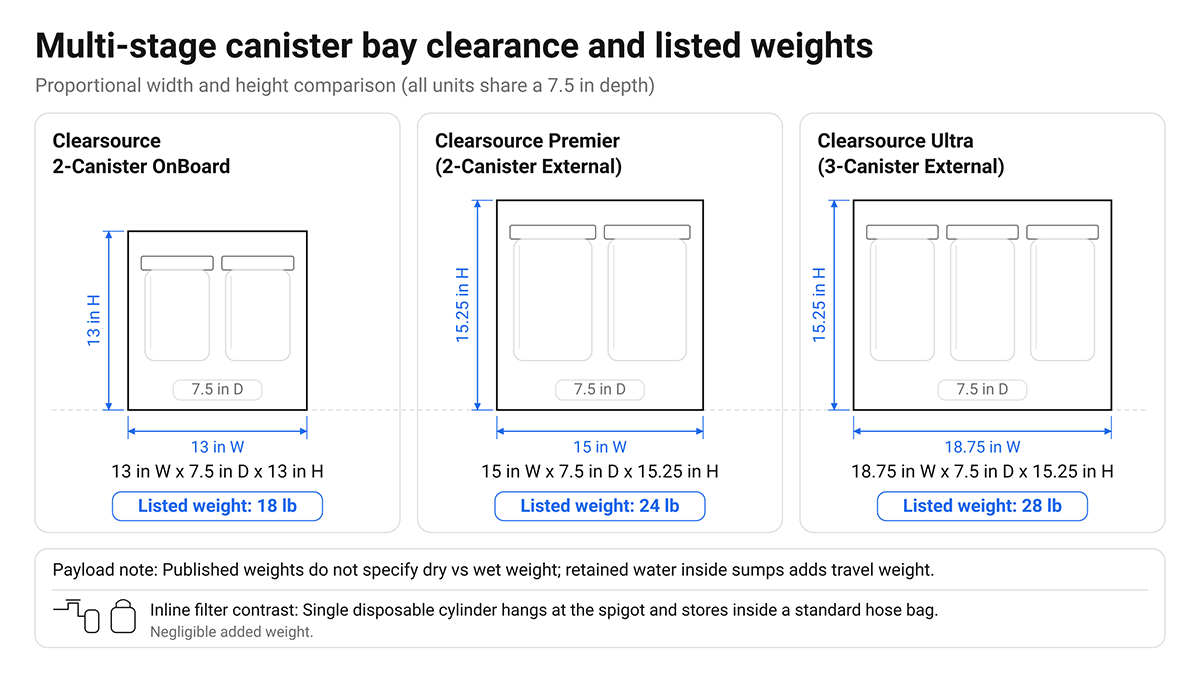
On the cost side, replacing disposable inline filters typically costs $20 to $40 per year for seasonal campers. Multi-stage canister systems require a larger upfront hardware investment plus multi-pack cartridge replacements, though you can replace an inexpensive first-stage sediment cartridge early if a single campground has silty water. Because actual filter life depends on local sediment load and chlorine levels rather than a fixed gallon rating, cost per gallon varies by campground water quality.
| Physical & Cost Attribute | Inline Hose Filter | Multi-Stage Canister System (Clearsource Examples) |
|---|---|---|
| Physical form | Single disposable cylinder | 2- or 3-stage freestanding or onboard manifold |
| Dimensions (W x D x H) | Compact hose-end cylinder | 13 x 7.5 x 13 in (OnBoard) to 18.75 x 7.5 x 15.25 in (Ultra) |
| Listed hardware weight | Minimal (single plastic cylinder) | 18 lb (OnBoard), 24 lb (Premier), 28 lb (Ultra), plus any retained water |
| Annual replacement spend | $20 to $40 per year | Varies by stage count and sediment-driven pre-filter changes |
Which Filter Fits Which Camping Scenario?
Inline filters fit short trips on treated municipal hookups and rigs with tight storage or payload limits, while canister systems fit extended stays, high-sediment campgrounds, and unchlorinated well water. Specialized media is required when camping on heavy sulfur water.
- Weekend camping at state or commercial parks with chlorinated city water: A 20-micron inline hose filter fits best when fast pack-up, minimal storage space, and basic chlorine taste reduction matter more than high multi-fixture flow.
- Extended stays or rustic parks on unchlorinated well water: A multi-stage canister system with a 5-micron sediment pre-filter and 0.5-micron solid carbon block handles heavier silt without rapid blinding. If untreated well water presents a biological risk, confirm that your chosen cartridge carries specific certification for cyst or pathogen reduction.
- Full-time travel with strict gross vehicle weight rating (GVWR) limits: Carrying 18 to 28+ lb of canister hardware eats into tight cargo capacity. Weight-restricted rigs can use an inline filter at the spigot or mount a compact 2-canister onboard bracket inside the utility bay to save exterior locker space.
- Campgrounds with heavy sulfur well water: Hydrogen sulfide (“rotten egg” odor) saturates standard carbon blocks rapidly. If you frequently camp on sulfur well water, look for catalytic carbon or KDF-85 media cartridges and verify expected service life for your water conditions.
| Camping Scenario | Typical Water Source | Primary Constraint | Best-Fit Architecture |
|---|---|---|---|
| Weekend trips | Chlorinated municipal water | Fast setup and minimal bay space | 20-micron inline hose filter |
| Rustic parks / extended stays | Well water or high-sediment lines | Fine silt load and sustained GPM flow | Multi-stage canister system (0.5 to 5 micron) |
| Full-time travel on tight payload | Mixed campground sources | Strict GVWR and storage limits | Inline filter or compact 18 lb onboard canister |
| Sulfur well hookups | High hydrogen sulfide water | Rapid saturation of standard carbon | Canister with catalytic carbon or KDF-85 media |
What Hookup and Winterization Rules Apply?
Every RV water filter requires an upstream water pressure regulator set for 45 to 55 PSI inside the coach, and canister sumps must be drained before freezing temperatures arrive.
Install your water pressure regulator at the campground spigot before the filtration system so both the filter housing and your RV plumbing receive controlled pressure. Unregulated municipal water spikes can crack plastic inline cylinders or rupture canister sumps. Before storing the RV in sub-freezing weather, unscrew canister sumps, remove the cartridges, and drain all standing water. Water trapped inside a sealed housing expands as it freezes and cracks the sump body.
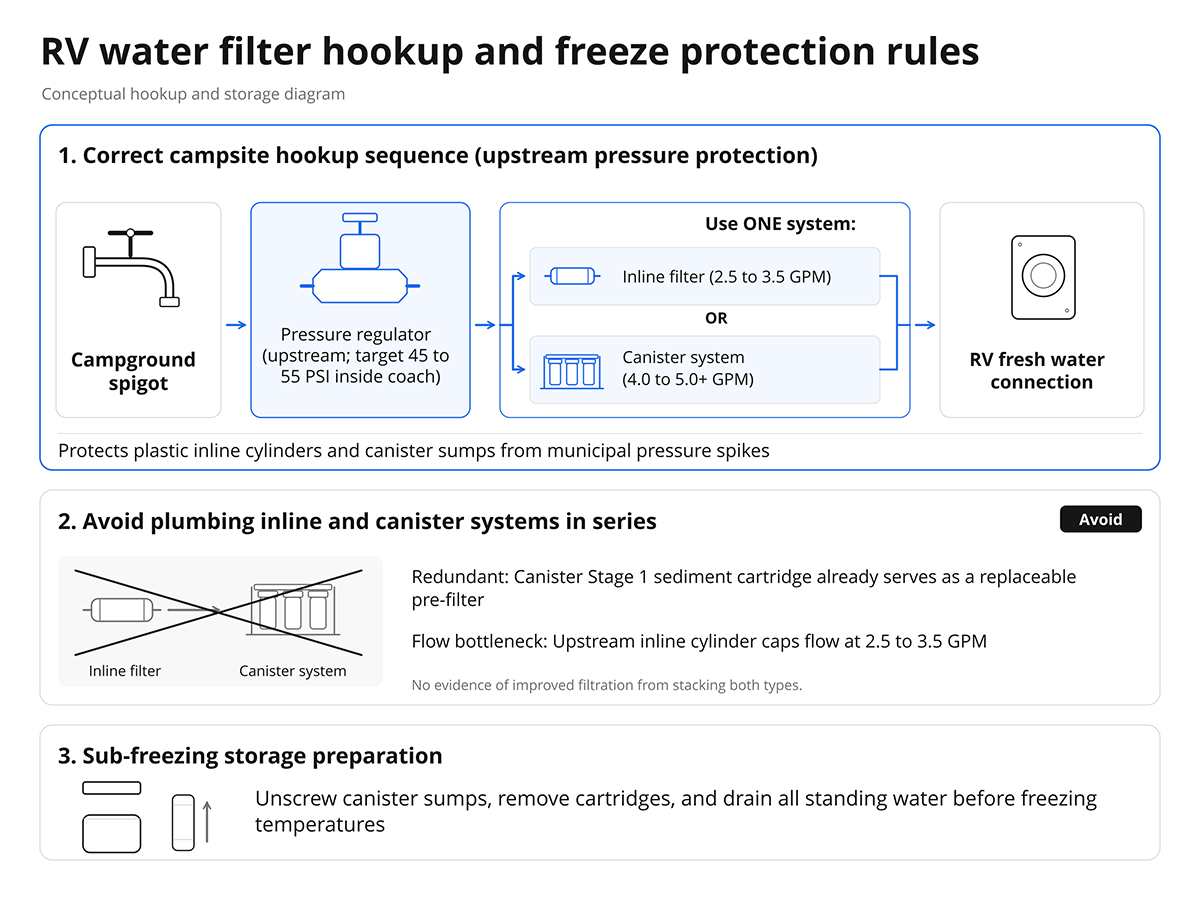
There is no need to plumb an inline filter and a multi-stage canister system together in series. A canister system’s first-stage sediment cartridge already serves as a replaceable pre-filter, and adding an inline cylinder upstream only introduces a 2.5 to 3.5 GPM flow bottleneck without evidence of improved filtration. For a step-by-step hookup walkthrough, see our guide on connecting inline filters in the proper campsite sequence.
How to Decide Before You Buy
Before buying a filter, check your coach’s flow requirement and measure your available utility bay space and payload margin.
- Check your fixture and water heater flow demand: If you regularly run two fixtures at once or use a tankless water heater with a sensitive minimum flow threshold, choose a canister system that sustains 4.0 to 5.0+ GPM rather than an inline filter rated at 2.5 to 3.5 GPM.
- Measure compartment clearance and cargo capacity: Verify that your storage bay can accommodate a 13 to 18.75 in wide frame and 18 to 28 lb of listed hardware weight (plus retained water) before ordering a multi-stage canister stand.
- Match the media to your water sources: Stick with a $20 to $40 annual inline filter setup for occasional weekend trips on treated city water, or step up to replaceable 2.5 in x 10 in canister cartridges if variable sediment would quickly blind a single-stage cylinder.
Frequently Asked Questions
Does an inline filter reduce water pressure at RV fixtures?
Inline filters are rated for 2.5 to 3.5 GPM under ideal conditions, which sits below or at the low end of the 3 to 4 GPM most RVs need to run multiple fixtures. When two faucets open at once or sediment partially blinds the media, that flow restriction shows up as a noticeable pressure drop at the shower or sink.
Will a 20-micron filter remove Giardia or Cryptosporidium?
No. Giardia and Cryptosporidium cysts measure 4 to 15 microns, which is smaller than a 20 to 50 micron nominal inline pore size. Even when using a 0.5 to 5 micron canister filter, a nominal micron rating indicates particle size only and is not proof of microbial removal without independent certification.
How much does a Clearsource canister system weigh?
Clearsource lists weights of 24 lb for the Premier 2-Canister External, 28 lb for the Ultra 3-Canister External, and 18 lb for the 2-Canister OnBoard. Any water left inside the sumps during transit adds to the total weight carried in your bay.
How much do inline filter replacements cost per year?
Replacing disposable inline RV water filters typically costs $20 to $40 per year, depending on how often you camp and how much sediment is in the local water supply.
Can an RV water filter soften hard water?
Neither inline nor canister carbon/sediment filters soften hard water or reduce total dissolved solids (TDS). True water softening requires an ion-exchange RV water softener.
Should the pressure regulator go before or after the filter?
Install the pressure regulator before (upstream of) the filtration system, targeting 45 to 55 PSI inside the coach, so the filter housing is protected from campground pressure spikes.
Do canister sumps need draining before freezing weather?
Yes. Canister sumps must be drained before sub-freezing storage because trapped water expands when frozen and cracks the housing.
What cartridge size do Clearsource canister systems use?
Clearsource canister systems use standard 2.5 in x 10 in drop-in replacement cartridges.
Sources:
- Use of Lead Free Pipes, Fittings, Fixtures, Solder, and Flux for Drinking Water – U.S. Environmental Protection Agency, Safe Drinking Water Act Lead-Free Rule and 0.25% weighted average lead statutory requirement.
- How to Identify Lead Free Certified Drinking Water Products – U.S. Environmental Protection Agency Office of Ground Water and Drinking Water, PDF guidance on third-party certification marks, NSF/ANSI 372 testing, and plumbing product labeling.
- ASSE International Plumbing Product Standards – ASSE International, performance requirements and test methods for backflow prevention and water filtration system assemblies.
- Home Water Systems: Backflow Prevention Devices – Colorado State University Extension, technical guidance on cross-connection control, plumbing backflow protection, and filtration system integrity.