
RV reverse osmosis (RO) systems strip dissolved minerals and other dissolved solids at a single drinking-water tap, while multi-stage sediment and carbon block canister filters treat the RV’s incoming water supply without generating filtration wastewater. Choosing between them comes down to whether your priority is low-mineral drinking water at one faucet or zero-waste filtration across the entire rig.
For most RV owners, the decision hinges on camping style and plumbing limits. Reverse osmosis targets total dissolved solids (TDS) through a semi-permeable membrane, but it sends reject brine into the gray water tank and requires higher feed pressure than many RV water pumps deliver. Multi-stage canister systems handle whole-coach flow for showers, sinks, and toilets with 100% water recovery, though they leave dissolved minerals in the water. When space and plumbing allow, the two systems also work well together as upstream whole-rig protection and downstream drinking-water purification.
Key Takeaways
- Use reverse osmosis for point-of-use drinking water only: Standard RV RO units produce water too slowly and generate too much brine waste to supply showers, toilets, or washing fixtures.
- Check water pressure before buying RO: RO membranes typically need 50 to 70+ PSI for efficient recovery, whereas standard 12V RV demand pumps often operate around 30 to 45 PSI.
- Factor brine waste into dry-camping tank math: Producing 1 gallon of RO drinking water typically sends 1 to 4 gallons of reject brine into the gray holding tank.
- Do not confuse water softeners with RO: Ion-exchange softeners swap calcium and magnesium ions for sodium without lowering TDS, whereas RO physically removes dissolved solids.
- Plan for winterization: Both RO membranes and pressurized storage tanks trap water internally and suffer permanent damage if exposed to freezing temperatures.
What Is the Core Difference Between RO and Canister Filters?
Reverse osmosis demineralizes water by forcing it through a semi-permeable membrane, whereas multi-stage canister filters trap particulates and adsorb chemicals like chlorine without changing the water’s dissolved mineral content.
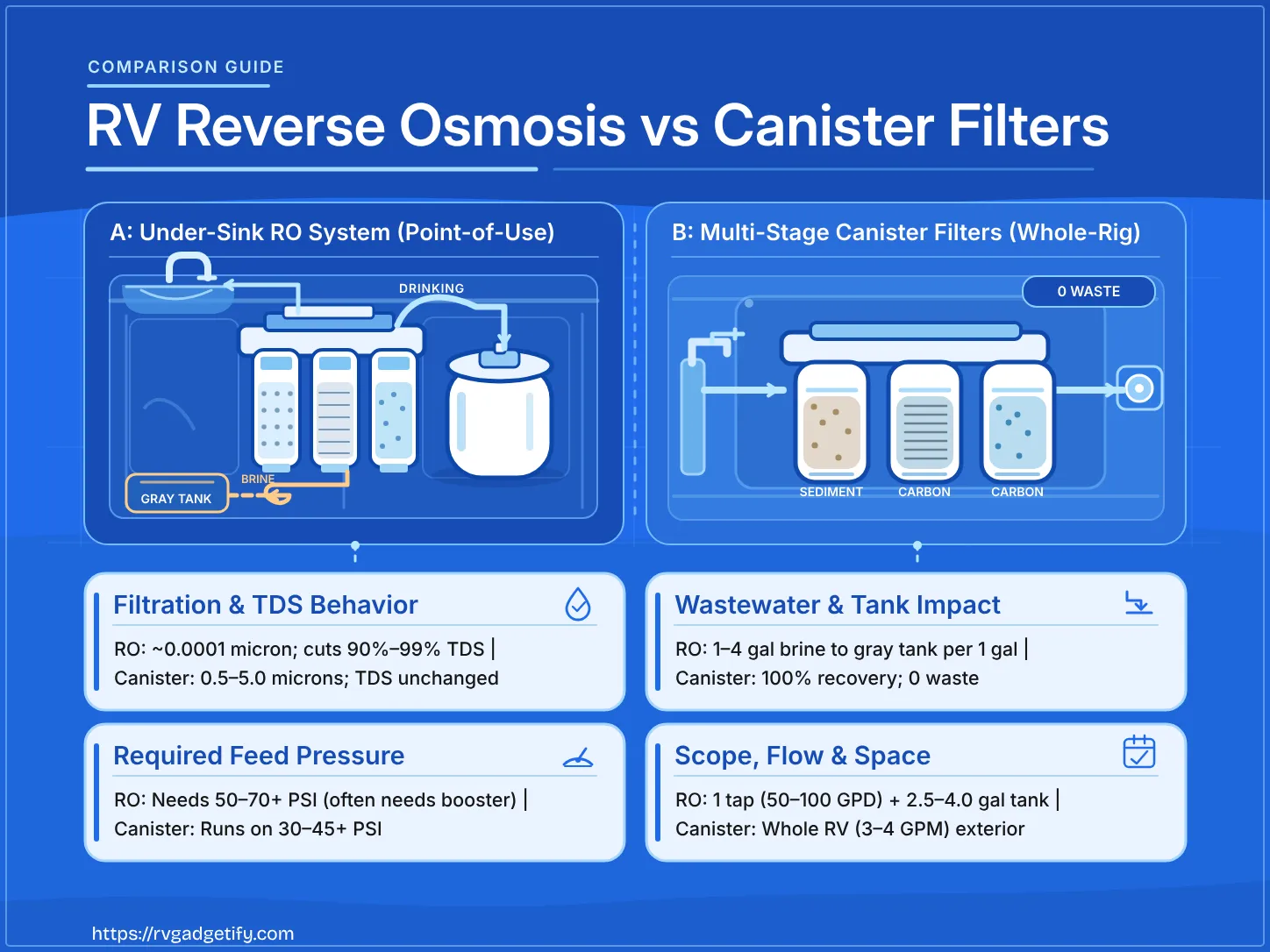
Typical RV reverse osmosis systems push water through a membrane rated around 0.0001 microns under pressure. Under proper operating pressure, the membrane rejects roughly 90% to 99% of total dissolved solids, making RO the practical choice when source water has high mineral content or objectionable dissolved solids.
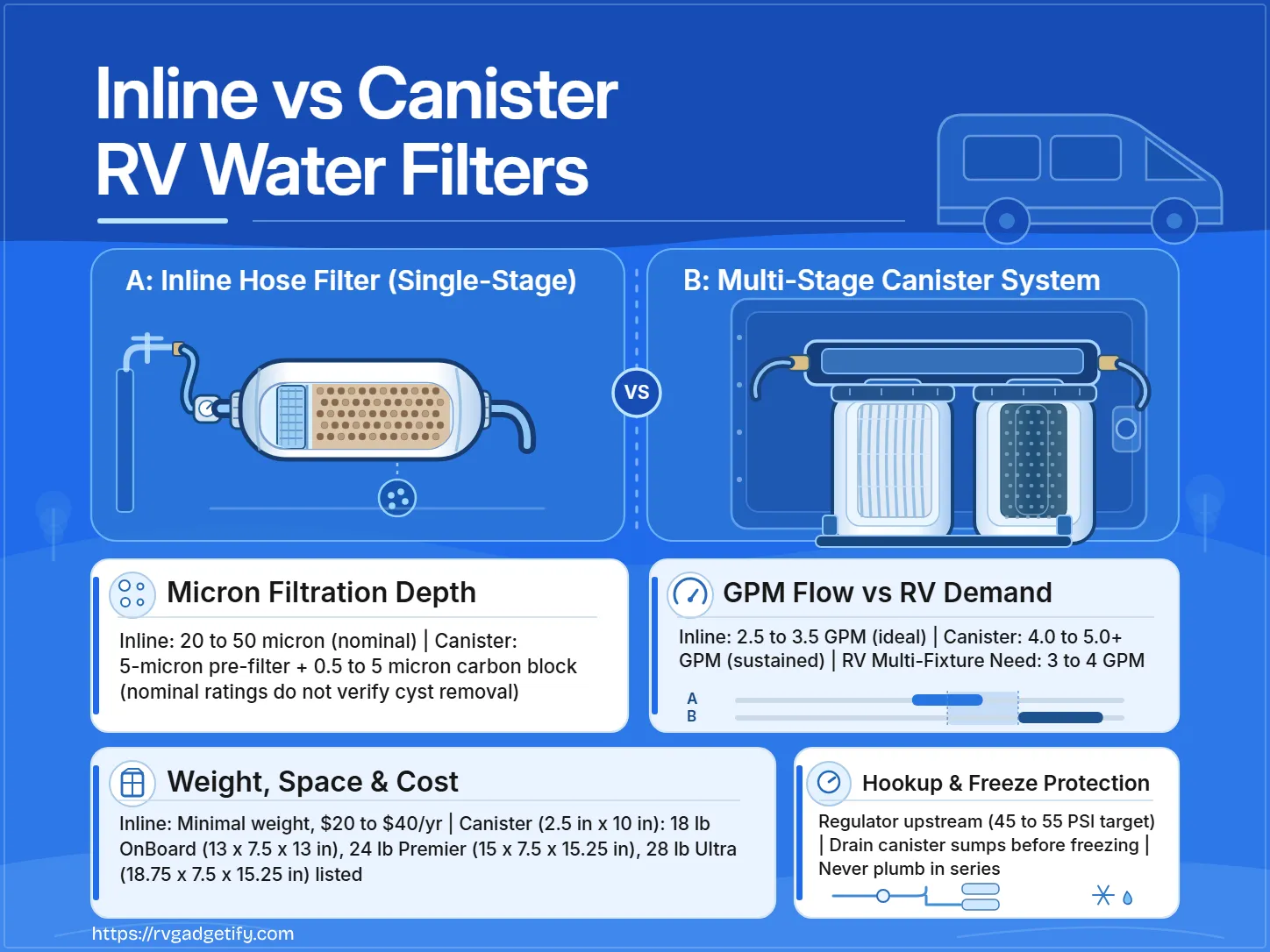
Multi-stage canister systems commonly use sediment and carbon block cartridges rated between 0.5 and 5.0 microns. Mechanical filtration captures rust, sand, and silt, while activated carbon adsorbs chlorine, bad tastes, and odors. Because dissolved mineral ions pass straight through 0.5-to-5.0-micron pores, TDS readings remain unchanged after canister filtration.
How Does Each Filtration System Work in an RV?
How Does an RV Reverse Osmosis System Work?
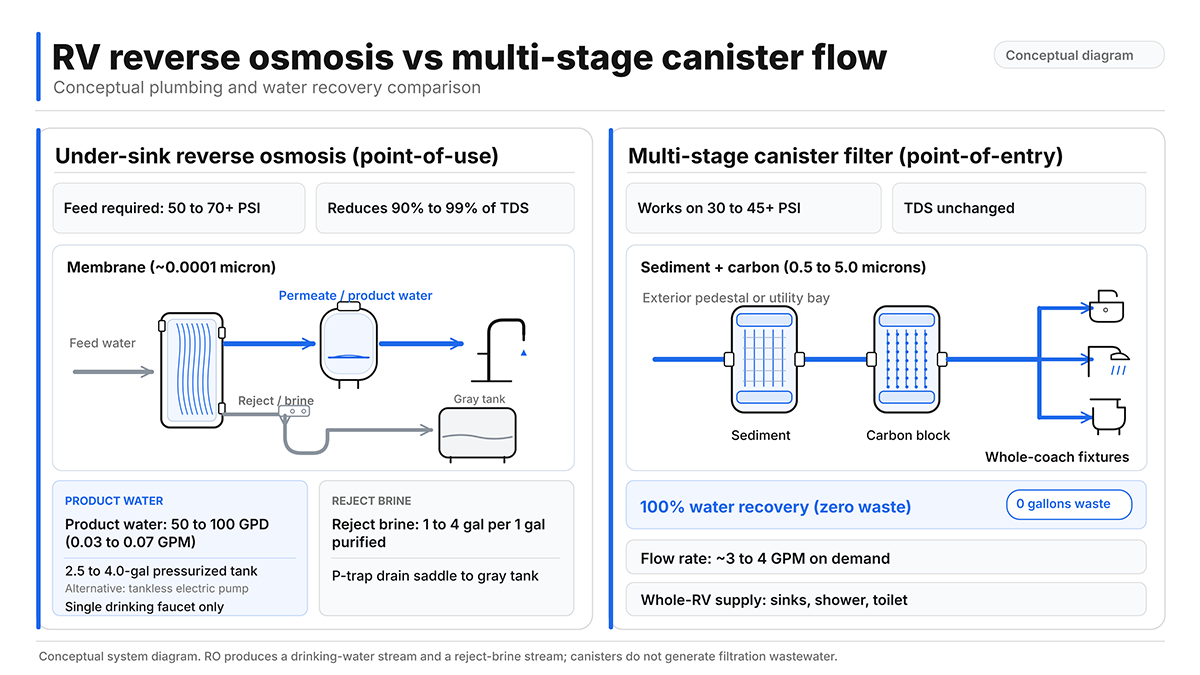
An RV reverse osmosis system separates incoming feed water into two streams: purified product water (permeate) for drinking and reject water (brine) that carries concentrated minerals to the drain. Because forcing water through a 0.0001-micron membrane is slow, most under-sink systems rely on a pressurized storage tank to supply water at a usable faucet flow rate.
Standard tank-based RO membranes are commonly rated for 50 to 100 gallons per day (GPD) under ideal test conditions, which equals a trickle of roughly 0.03 to 0.07 gallons per minute (GPM). A 2.5 to 4.0-gallon pressurized air-bladder tank accumulates that output so the dedicated drinking faucet can dispense water immediately when opened. Tankless RO designs eliminate the bladder tank by using an integrated electric pump, though they require shore or inverter power whenever you dispense water.
A dedicated drinking faucet fed by a bladder tank is one route to that flow, while dedicated RV drinking water filtration straight off the spigot is the other, compared in our guide to the 10 best RV water filters.
Because of slow production and continuous brine discharge, under-sink RO is strictly a point-of-use system for drinking and cooking water. It should never be plumbed to supply whole-rig fixtures such as showers or toilets.
How Do Multi-Stage Canister Filters Work?
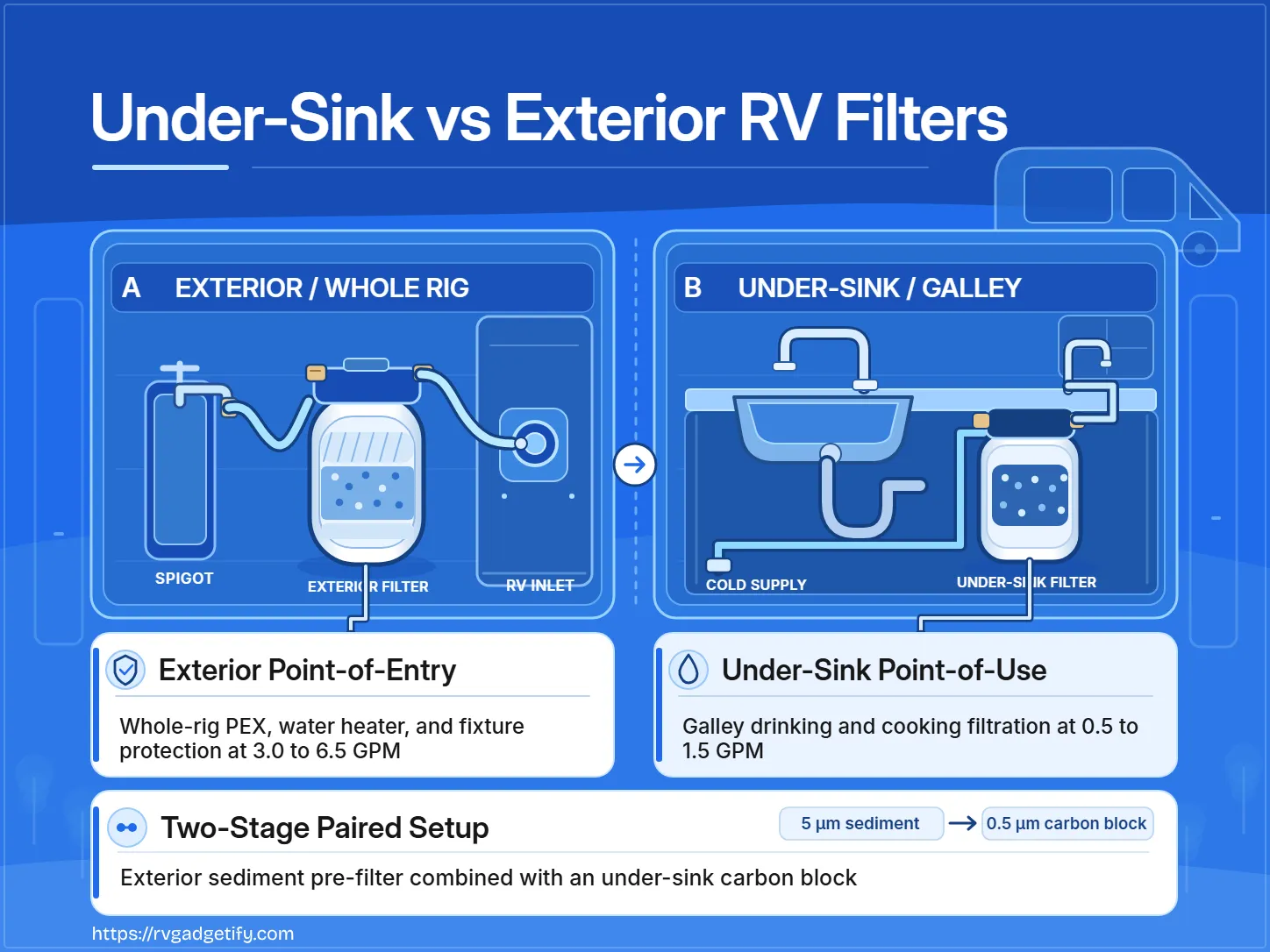
Multi-stage canister systems filter all incoming water in series before it reaches the RV’s fixtures. A typical two- or three-stage setup pairs a sediment pre-filter with one or more carbon block cartridges so that particulates do not clog the carbon pores prematurely.
Unlike membrane separation, canister filtration is a flow-through process with 100% water recovery and zero continuous reject stream. Every gallon of water that enters the housing passes through to the RV plumbing, aside from the small volume held inside the sumps during cartridge swaps.
Whole-rig canister assemblies typically sit outside near the campground water pedestal or mount inside the RV’s utility bay. This point-of-entry placement protects the coach’s plumbing, water heater, and faucet aerators while preserving under-sink cabinet space inside the galley.
How Do RV Reverse Osmosis and Canister Filters Compare?
The table below compares typical under-sink tank-based RV reverse osmosis setups against exterior or utility-bay multi-stage canister systems across nine core operating attributes.
| Attribute | RV Reverse Osmosis System (Typical Under-Sink Setup) | Multi-Stage Canister System (Whole-Rig Setup) |
|---|---|---|
| Filtration mechanism | Semi-permeable membrane (typically ~0.0001 micron) with pre/post filters | Mechanical sediment and carbon block media (commonly 0.5 to 5.0 microns) |
| TDS and mineral behavior | Reduces roughly 90% to 99% of TDS under proper feed pressure | Leaves dissolved minerals and TDS unchanged |
| Filtration wastewater | Generates 1 to 4 gallons of brine waste per gallon of purified water (1:1 to 1:4 ratio) | 100% water recovery; zero filtration wastewater |
| Application scope | Point-of-use (single dedicated drinking-water faucet) | Point-of-entry (whole-RV supply for sinks, shower, and toilet) |
| Flow and production rate | 50 to 100 GPD (0.03 to 0.07 GPM) membrane output, buffered by a storage tank | Roughly 3 to 4 GPM on-demand flow across coach fixtures |
| Required feed pressure | Typically 50 to 70+ PSI for efficient membrane recovery | Operates on standard RV pump or regulated city pressure (30 to 45+ PSI) |
| Storage and mounting footprint | Under-sink filter assembly plus a 2.5 to 4.0-gallon pressurized tank (unless tankless) | Exterior pedestal stand or utility bay; uses zero interior galley cabinet space |
| Plumbing modifications | Requires a dedicated drinking faucet and a P-trap drain saddle for brine | Connects inline via standard garden-hose or utility-bay fittings |
| Remineralization | Optional post-filter cartridge to restore trace minerals and taste | Not needed because natural minerals remain in the water |
In practice, the comparison comes down to water recovery versus demineralization. Canister systems treat high-volume water for the whole coach without wasting a drop, while RO sacrifices water volume, cabinet space, and plumbing simplicity to remove dissolved solids at a single tap.
How Much Wastewater Does RV Reverse Osmosis Produce?
Typical RV reverse osmosis systems produce 1 to 4 gallons of brine wastewater for every 1 gallon of purified drinking water (a 1:1 to 1:4 product-to-waste ratio). Multi-stage canister systems generate zero filtration wastewater because all incoming water passes directly through the filter media to the faucets.
In an under-sink RV installation, the RO drain saddle routes reject brine directly into the sink P-trap and down into the gray water holding tank. When dry camping or boondocking off the fresh-water tank, that math compounds quickly: producing 1 gallon of drinking water draws 2 to 5 gallons out of your fresh tank and transfers 1 to 4 gallons straight into your gray tank.
RVGadgetify / Dry-Camping Water Systems
RV Reverse Osmosis Dry-Camping Tank Impact Calculator
Estimate how much fresh water an under-sink reverse osmosis system consumes and how much reject brine goes to the gray tank when you do not have a sewer hookup.
RO holding tank impact
Total purified drinking water produced
Total fresh tank water drawn by RO
Purified water plus reject brine; all originates from the fresh tank.
Total reject brine sent to gray tank
Wastewater routed through the under-sink RO drain saddle into the sink P-trap.
Tank capacity used by RO alone
Fresh-water capacity used
Gray-tank space used
No tank capacities were supplied. The water-use totals are calculated, but the tool cannot determine whether either holding tank has sufficient space.
Because gray tank capacity is usually the limiting factor when boondocking, standard under-sink RO is poorly suited to off-grid trips unless you specifically plan around the water loss. Full-hookup campsites with an open sewer connection eliminate the gray-tank penalty, making long-term park stays the most practical setting for an RV RO system.
What Water Pressure Does Each System Need?
Reverse osmosis membranes generally require 50 to 70+ PSI of feed pressure to push water through the membrane efficiently, whereas multi-stage canister systems operate on standard RV plumbing pressure without a booster pump.
Most 12V RV demand water pumps cycle between roughly 30 and 45 PSI, and many common inline RV brass pressure regulators cap incoming campground water at 40 to 45 PSI. Running a standard RO unit at 30 to 45 PSI starves the membrane of driving pressure, which slows water production, lowers TDS rejection, and increases the ratio of brine wasted per gallon of drinking water.
To run RO reliably in an RV, you often need an auxiliary 12V or 120V electric booster pump to raise inlet pressure to 70 PSI or higher, or an adjustable shore-water regulator set to match both the RO unit’s needs and the RV plumbing’s safe working limit. Even with a booster pump, cold feed water or high incoming TDS can keep wastewater ratios elevated.
Multi-stage canister systems do not require a booster pump. They operate passively on normal 12V pump or regulated city-water pressure, though chaining multiple fine carbon blocks (such as 0.5-micron cartridges) will create a modest pressure drop at the faucets as the filters load with sediment.
How Much Space and Plumbing Does Each System Require?
Tank-based RV reverse osmosis systems require significant under-sink cabinet space and permanent plumbing connections, while exterior multi-stage canisters connect inline outside the living area.
Installing a standard tank-based RO system under the galley sink involves mounting the multi-stage membrane manifold, fitting a 2.5 to 4.0-gallon pressurized bladder tank, drilling or using an accessory hole for a dedicated drinking-water faucet, and clamping a drain saddle onto the sink P-trap for brine discharge. In smaller RVs with compact galley cabinets or drawers beneath the sink, the bladder tank alone can take up most of the usable storage volume.
Whole-rig canister systems mount inside an exterior utility bay or stand outside near the campground water spigot using flexible RV water hoses. While you still need basement or wet-bay room to stow the canisters on travel days, exterior setups require zero interior cabinet space and no modifications to your sink drain or countertop.
How Does TDS Removal Differ From Water Softening?
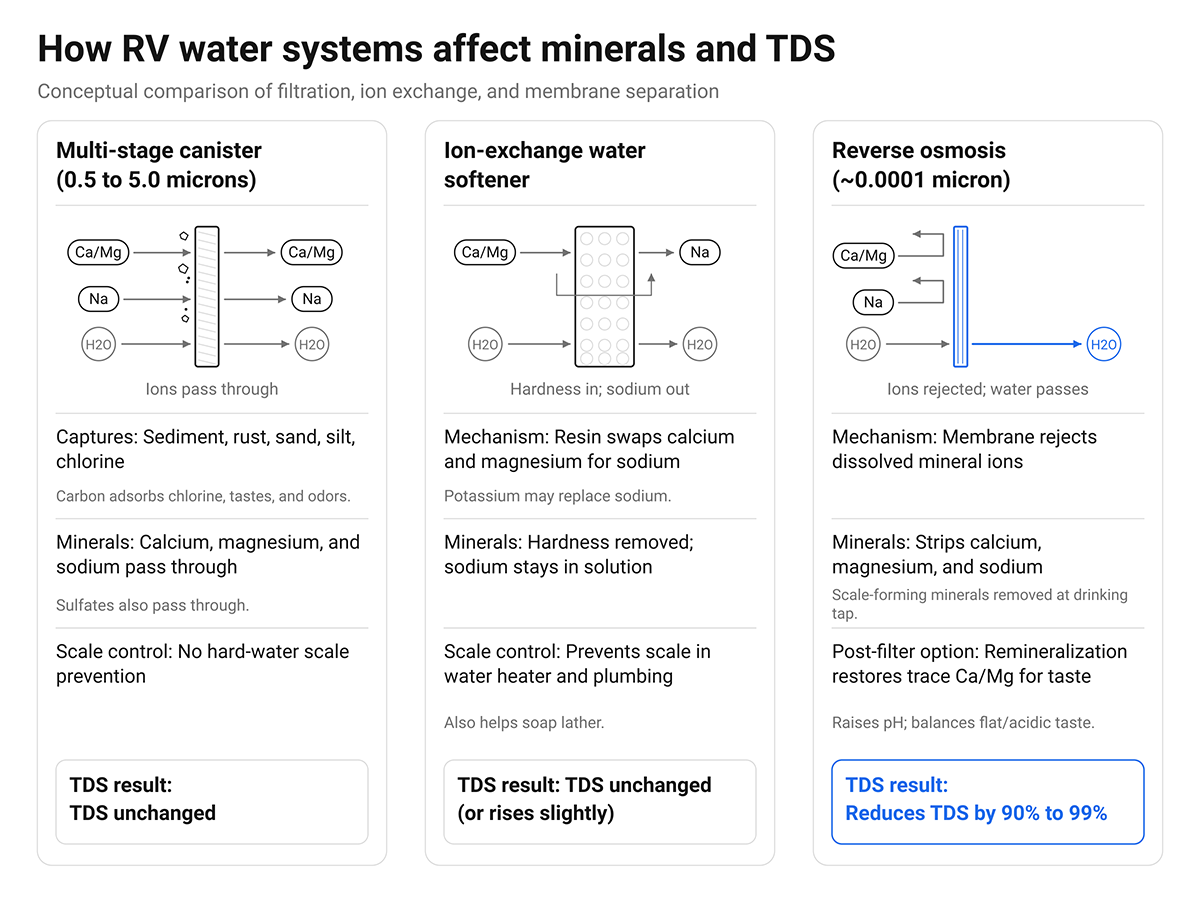
Reverse osmosis lowers total dissolved solids by physically rejecting mineral ions across a membrane, whereas canister filters leave dissolved minerals untouched and ion-exchange water softeners merely swap one mineral ion for another.
Because standard sediment and carbon canisters do not remove calcium, magnesium, sodium, or sulfates, they will not prevent hard-water scale or reduce a high TDS meter reading. Portable RV water softener models address scale by using ion-exchange resin to replace calcium and magnesium ions with sodium (or potassium) ions. That ion swap eliminates water hardness so soap lathers better and scale does not build up in the water heater, but total dissolved solids remain essentially the same (or rise slightly) because sodium replaces the hardness minerals in solution.
Reverse osmosis strips both hardness minerals and sodium, reducing overall TDS by 90% to 99%. Because demineralized RO water lacks mineral buffering, it can taste flat or slightly acidic. Adding an inline post-remineralization cartridge after the RO membrane adds back trace calcium and magnesium to raise pH and restore a clean mineral taste.
Which Filtration Option Fits Your RV Scenario?
Use the table below to match your primary camping style and rig constraints to the appropriate filtration setup.
| RV Scenario | Recommended Setup | Why It Fits |
|---|---|---|
| Full-hookup sites with an open sewer drain | Point-of-use RO (often paired with exterior canisters) | Open gray-water drainage makes the 1:1 to 1:4 brine waste stream manageable |
| Dry camping and boondocking | Multi-stage canister system | 100% water recovery preserves limited fresh-water supply and gray-tank capacity |
| Standard 30 to 45 PSI RV water pressure (no booster) | Multi-stage canister system | Operates passively without the 50 to 70+ PSI feed pressure required by RO membranes |
| Tight galley under-sink cabinet space | Exterior or utility-bay canister system | Avoids storing a 2.5 to 4.0-gallon bladder tank and manifold under the kitchen sink |
| High dissolved minerals or brackish source water | Point-of-use RO | Membrane filtration removes 90% to 99% of dissolved solids that carbon canisters cannot stop |
| Flat or acidic taste from RO water | RO with post-remineralization cartridge | Reintroduces trace calcium and magnesium after the membrane to balance taste |
For most RVers who split time between hookups and dry camping, a whole-rig canister system is the foundational first purchase because it works everywhere without wasting water or power.
Can You Use Canister Filters and Reverse Osmosis Together?
Yes. Combining an exterior multi-stage canister system with an under-sink RO unit creates an effective division of labor when you camp at full-hookup sites with poor water quality.
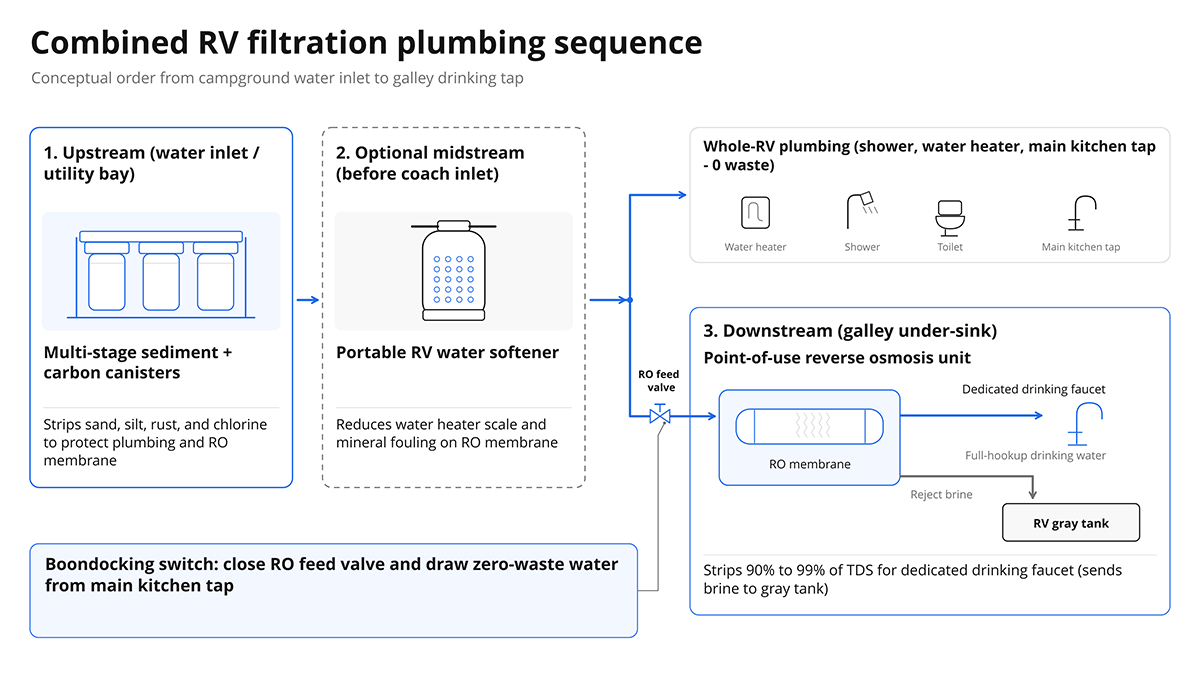
In a combined setup, plumbing sequence matters:
- Upstream (Water Inlet / Utility Bay): Install the multi-stage sediment and carbon block canisters first so all water entering the RV is stripped of sand, silt, rust, and chlorine.
- Optional Midstream (Water Inlet): If you use a portable RV water softener, place it after the sediment/carbon pre-filter and before the coach inlet so softened water reduces scale in the water heater and reduces mineral fouling on the downstream RO membrane.
- Downstream (Galley Under-Sink): The point-of-use RO unit draws pre-filtered water to strip remaining dissolved solids for the dedicated drinking faucet.
Running exterior sediment and carbon canisters upstream protects the entire RV plumbing system and extends the life of your interior RO pre-filters and membrane, since free chlorine and heavy silt degrade RO membranes prematurely. If you transition from a full-hookup site to boondocking, you can simply stop using the RO faucet (or shut its feed valve) and draw zero-waste drinking water from the main kitchen tap supplied by your multi-stage canisters.
What Freeze, Power, and Pump Limits Apply?
Before installing an RV reverse osmosis system or upgrading its components, account for three operational constraints that affect seasonal storage, off-grid power, and wastewater efficiency:
- Winterization and freeze damage: RO membranes and pressurized air-bladder tanks trap water in tight internal passages that are difficult to drain completely in place. If left in sub-freezing temperatures, expanding ice ruptures internal membrane layers, cracks filter housings, and damages tank bladders. Always remove and store the RO membrane per the manufacturer’s instructions and fully depressurize and drain all tanks and canister sumps before winter storage.
- Off-grid electrical draw (Tankless and Booster-Equipped RO): While passive canister systems and unboosted tank-based RO units require no extra electricity beyond the RV water pump, tankless RO systems typically draw 60 to 80 watts while dispensing, and standalone 12V or 120V RO booster pumps add electrical load during tank refill. If you camp off-grid on batteries and an inverter, check the exact wattage and amp-hour draw in the model manual before buying.
- Permeate pump upgrades: On tank-based RO systems, rising backpressure inside the bladder tank slows membrane production and increases brine waste as the tank fills. A non-electric permeate pump uses the energy of the outgoing brine stream to push product water into the tank against backpressure, which can improve product-to-waste ratios toward 1:1. Verify that your specific RO manifold supports permeate pump plumbing before assuming you can retrofit one.
What Should You Check Before Choosing a System?
Run through these four checks on your RV before buying filtration hardware:
- Measure your operating water pressure: Use a gauge at an interior faucet or exterior inlet to check whether your 12V pump and shore-water regulator deliver the 50 to 70+ PSI required for unassisted RO, or only 30 to 45 PSI.
- Audit your camping mix and gray-tank margin: If you frequently dry camp without a sewer hookup, prioritize a zero-waste multi-stage canister setup so brine discharge does not fill your gray tank prematurely.
- Measure under-sink cabinet clearance: If you want tank-based RO, verify that your galley cabinet has physical room for both the filter manifold and a 2.5 to 4.0-gallon bladder tank alongside access to the sink P-trap.
- Confirm winterization access: Make sure any under-sink RO manifold or utility-bay canister housing is mounted where you can easily reach shutoff valves, drain plugs, and membrane housings before freezing weather arrives.
Frequently Asked Questions
Does a canister filter remove TDS?
No. Sediment and carbon block canister filters trap particulates and adsorb chemicals like chlorine, tastes, and odors, but dissolved mineral ions pass right through 0.5-to-5.0-micron pores. Your water’s TDS reading will remain essentially unchanged after passing through a standard canister system.
Can an RV reverse osmosis system supply the whole coach?
Not with standard consumer RV setups. Typical under-sink RV RO units produce only 50 to 100 gallons per day (0.03 to 0.07 GPM) and waste 1 to 4 gallons of brine per gallon produced, making them point-of-use drinking-water systems rather than whole-coach supplies for showers and toilets.
Do RV RO systems need a booster pump?
Often, yes. Because typical 12V RV water pumps and preset inline pressure regulators operate around 30 to 45 PSI, they fall below the 50 to 70+ PSI range that most RO membranes need for efficient production and lower brine waste.
Is RV reverse osmosis a good fit for dry camping?
Generally no. Because an RO system sends 1 to 4 gallons of brine into the gray tank for every 1 gallon of purified water produced, it rapidly depletes your fresh-water supply and fills your gray holding tank when camping without a sewer hookup.
Does an RV reverse osmosis system require a storage tank?
Traditional tank-based RO systems require a 2.5 to 4.0-gallon pressurized bladder tank to store slow membrane output so water flows immediately at the tap. Tankless RO systems eliminate the separate bladder tank by using a built-in electric booster pump, but they require 60 to 80 watts of electrical power whenever you dispense water.
Why does RO water sometimes taste flat?
Reverse osmosis removes 90% to 99% of dissolved minerals, including the calcium and magnesium that give water a familiar body and neutral pH. Installing an inline post-remineralization cartridge after the membrane reintroduces trace calcium and magnesium to balance the taste.
Is a portable RV water softener the same as reverse osmosis?
No. An ion-exchange water softener swaps hardness minerals (calcium and magnesium) for sodium ions to prevent scale buildup without lowering overall TDS. Reverse osmosis removes virtually all dissolved mineral ions – including sodium – to lower total dissolved solids.
What happens if an RV reverse osmosis system freezes?
Water trapped inside the RO membrane sheets, filter housings, and pressurized bladder tank expands when frozen, rupturing membrane layers, cracking housings, and ruining tank seals. The system must be completely drained and winterized according to the manufacturer’s manual before exposure to sub-freezing temperatures.
Sources:
- Use of Lead Free Pipes, Fittings, Fixtures, Solder, and Flux for Drinking Water – U.S. Environmental Protection Agency, Safe Drinking Water Act Lead-Free Rule and 0.25% weighted average lead statutory requirement.
- How to Identify Lead Free Certified Drinking Water Products – U.S. Environmental Protection Agency Office of Ground Water and Drinking Water, PDF guidance on third-party certification marks, NSF/ANSI 372 testing, and plumbing product labeling.
- ASSE International Plumbing Product Standards – ASSE International, performance requirements and test methods for backflow prevention and water filtration system assemblies.
- Home Water Systems: Backflow Prevention Devices – Colorado State University Extension, technical guidance on cross-connection control, plumbing backflow protection, and filtration system integrity.