
Choose the On The Go Double Standard (rated at 16,000 grains) if your RV storage bay can accommodate a 9.5-inch diameter tank and your typical campgrounds have hard water that would quickly exhaust a smaller unit. Choose the On The Go Standard (rated at 8,000 grains) if compartment width is tight, lifting a lighter tank is a priority, or your water sources are only moderately hard.
This comparison evaluates both documented On The Go portable water softener variants against the wider category of best portable RV water softeners using the manufacturer’s official product specifications and support instructions. All capacity, dimension, weight, and flow figures below are manufacturer-attributed specifications rather than independent test measurements.
Quick Summary
- Models Covered: On The Go Standard (
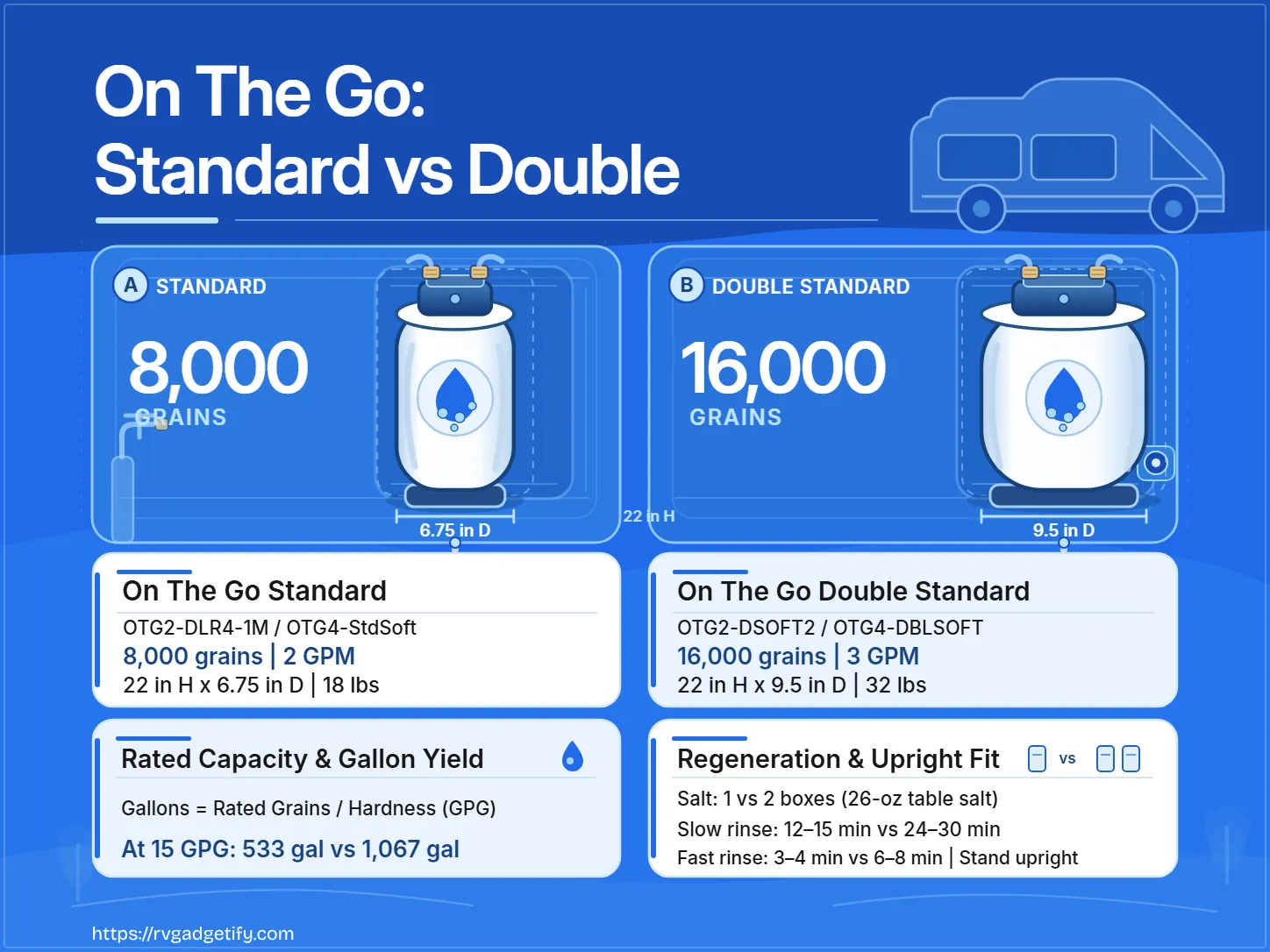
OTG2-DLR4-1M/OTG4-StdSoft) and On The Go Double Standard (OTG2-DSOFT2/OTG4-DBLSOFT).- Rated Capacity: 8,000 grains for the Standard; 16,000 grains for the Double Standard.
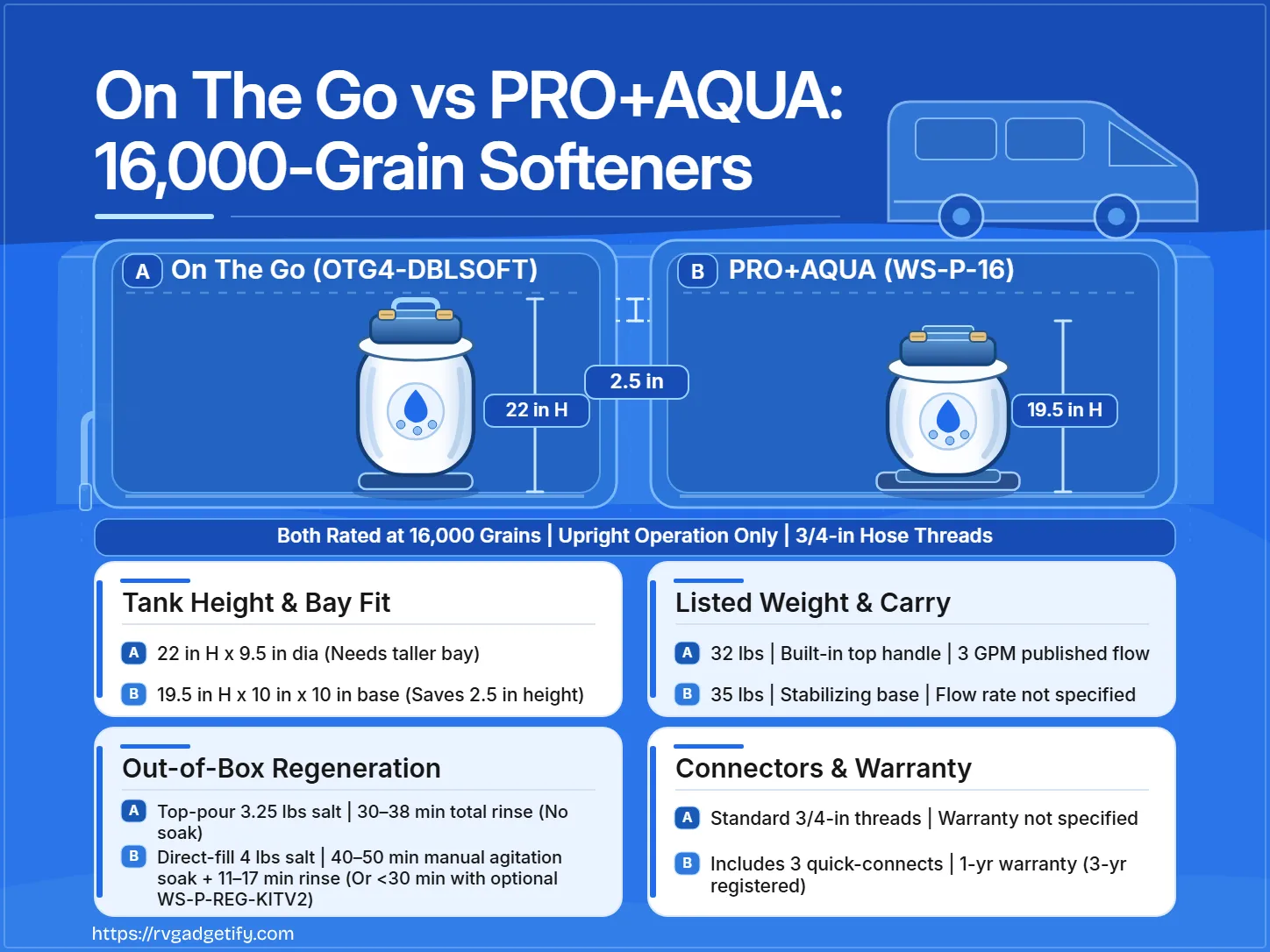
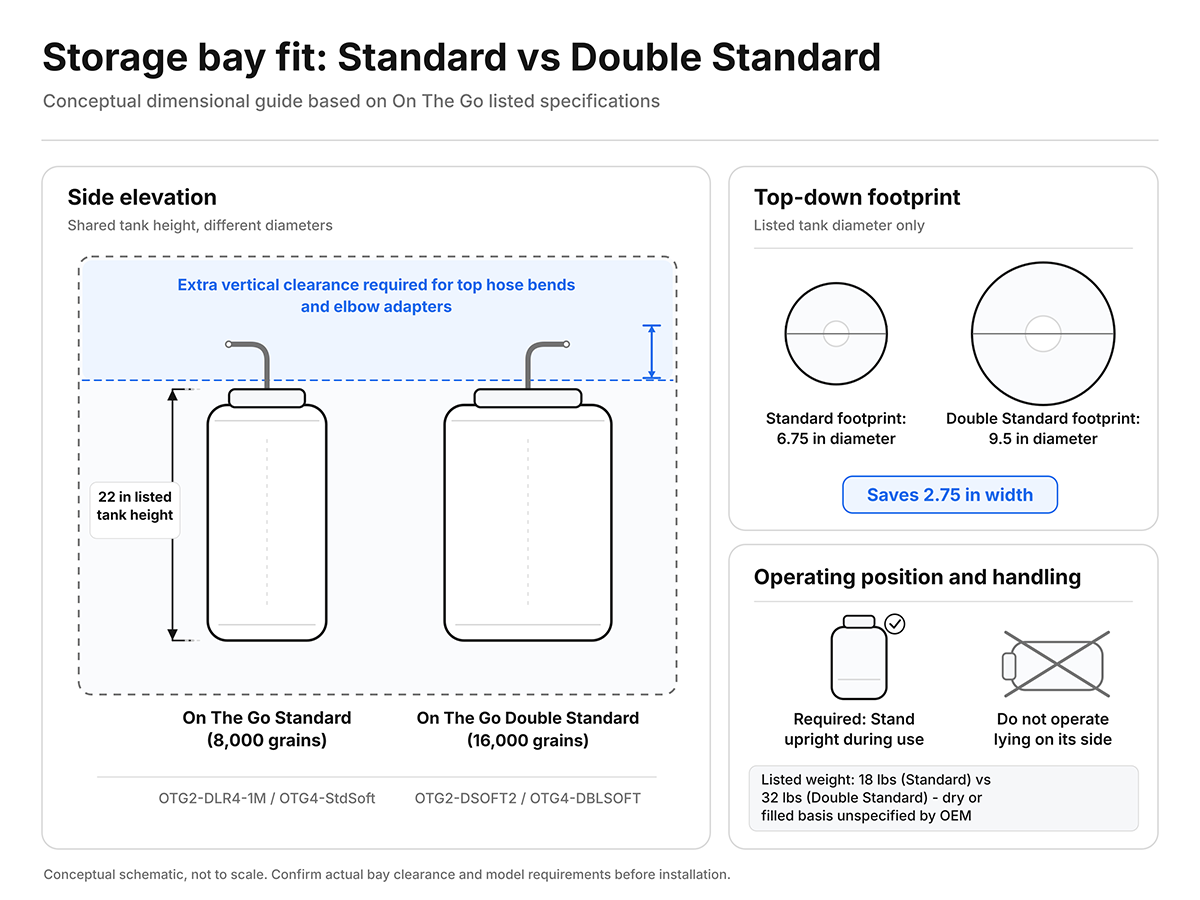
- Listed Dimensions: Both stand 22 inches tall. The Standard has a 6.75-inch diameter; the Double Standard has a 9.5-inch diameter.
- Listed Weight: 18 pounds for the Standard and 32 pounds for the Double Standard (the manufacturer does not specify whether these weights are dry, filled, or shipping weights).
- Listed Flow Rate: 2 GPM for the Standard; 3 GPM for the Double Standard.
- Regeneration Salt: One 26-ounce box of plain table salt (iodized or non-iodized) for the Standard; two 26-ounce boxes for the Double Standard.
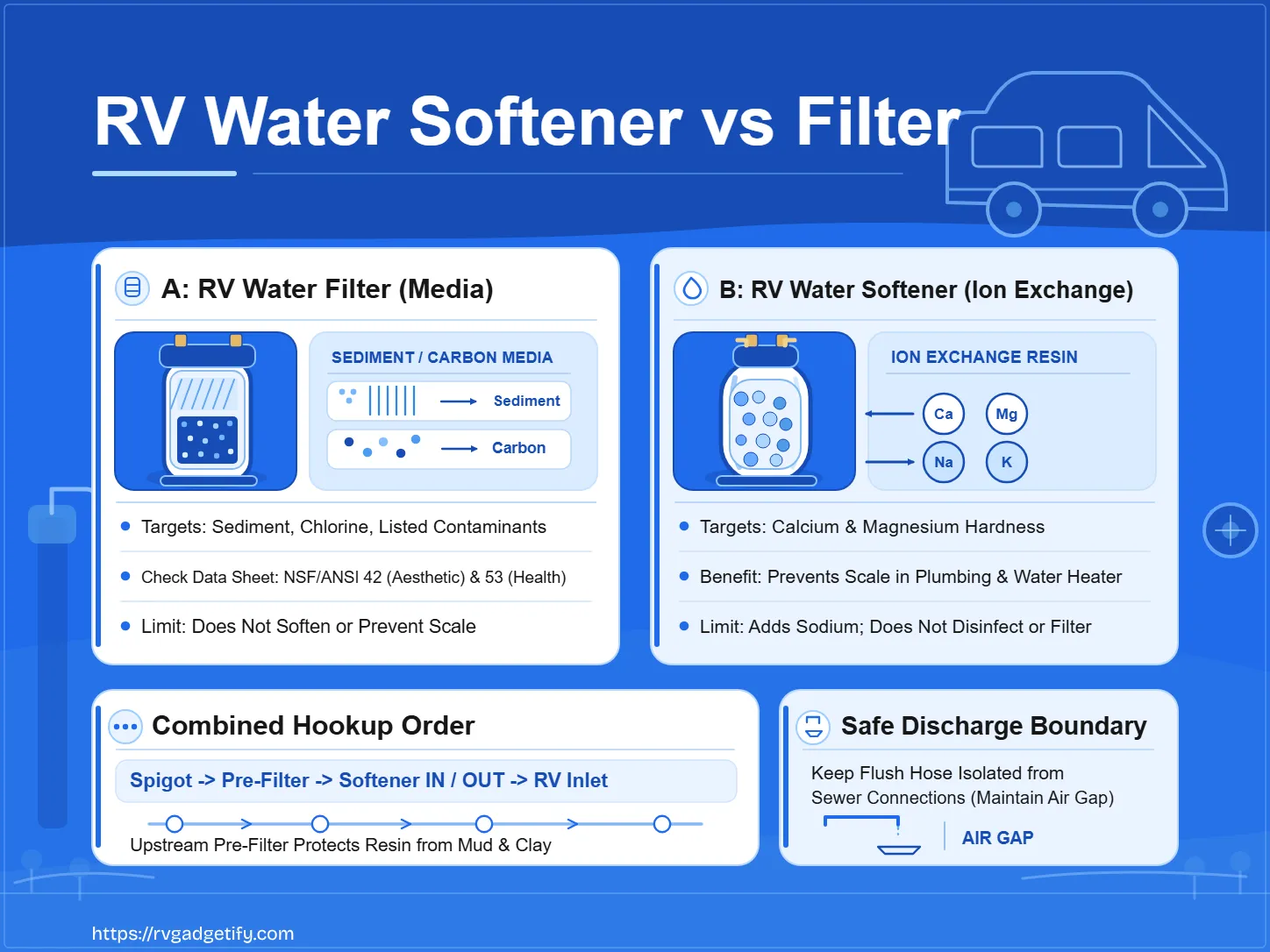
- Power & Orientation: Neither unit requires electricity. Both must stand upright during operation.
Standard vs Double Standard: Which Model Fits Your Rig?
Because both tanks share a 22-inch listed height, your decision comes down to four practical constraints, evaluated in detail in our guide on what size RV water softener you need: storage bay width, lifting weight, water hardness, and regeneration time.


| Buyer Constraint | Better Fit | Practical Consequence |
|---|---|---|
| Narrow utility bay or basement pass-through | On The Go Standard | The 6.75-inch diameter saves 2.75 inches of width compared to the Double Standard. |
| Minimizing lifting and handling weight | On The Go Standard | Listed at 18 lbs versus 32 lbs for the larger tank (weight basis unspecified by OEM). |
| Camping in high-hardness regions (15+ GPG) or longer stays | On The Go Double Standard | 16,000 rated grains yield twice the softened water volume before requiring a salt recharge. |
| Faster regeneration turnaround | On The Go Standard | Uses half the table salt (one 26-oz box) and requires half the rinse time during regeneration. |
Exact Model Identifiers and Specifications
On The Go product pages display two different identifier labels for each softener: an item label in the page heading and a part-number label in the specifications tab. They refer to the same respective units, not separate sub-models. Verify the variant name and rated grain capacity on the retail listing before ordering.
| Specification | On The Go Standard | On The Go Double Standard |
|---|---|---|
| Product-page item label | OTG2-DLR4-1M | OTG2-DSOFT2 |
| Specifications part-number label | OTG4-StdSoft | OTG4-DBLSOFT |
| Rated grain capacity | 8,000 grains | 16,000 grains |
| Listed dimensions | 22 in H x 6.75 in D | 22 in H x 9.5 in D |
| Listed weight | 18 lbs (basis unspecified) | 32 lbs (basis unspecified) |
| Listed flow rate | 2 GPM | 3 GPM |
| Hose connection | Standard hose connection | Standard hose connection |
| Electricity required | None | None |
Practical Consequences of These Specs
- Flow rate: On The Go lists 2 GPM for the Standard and 3 GPM for the Double Standard as unit specifications. Actual flow at your RV fixtures will still depend on campground water pressure, pressure regulators, and inline filters.
- Connections: Both units use a standard hose connection between the park faucet and the RV inlet. Because the manufacturer does not list specific thread clearances or brass/plastic fitting tolerances on the spec sheet, confirm physical clearance for hoses, quick-connects, and 90-degree elbows against your actual water bay before permanent placement.
- First-time readiness: On The Go states that a new unit is ready for service out of the box and does not require salt or regeneration before its first use. Follow our step-by-step guide on how to setup an RV water softener for the exact hookup order and first-flush sequence.
How Grain Capacity Affects Soft-Water Gallon Yield
On The Go calculates approximate soft-water yield by dividing the tank’s rated grain capacity by the campground water’s hardness in grains per gallon (GPG):
Harder water depletes the resin bed faster. Neither model guarantees a fixed number of days between regenerations because actual calendar time depends on both local water hardness and your daily water consumption.
| Source Water Hardness | On The Go Standard (8,000 Grains) | On The Go Double Standard (16,000 Grains) | Source Basis |
|---|---|---|---|
| 5 GPG | 1,600 gallons | 3,200 gallons | OEM estimated capacity table |
| 10 GPG | 800 gallons | 1,600 gallons | Calculated from OEM equation |
| 15 GPG | 533 gallons | 1,067 gallons | Calculated from OEM equation |
| 20 GPG | 400 gallons | 800 gallons | Calculated from OEM equation |
| 25 GPG | 320 gallons | 640 gallons | OEM estimated capacity table |
Test the water at your campground or check local municipal water reports to find the actual GPG rather than relying on regional averages.
RVGadgetify / Water Systems
On The Go RV Water Softener Gallon Yield & Regeneration Interval Calculator
Compare the Standard and Double Standard using your campground’s water hardness. Add daily RV water use to estimate the days between salt regenerations.
Estimated gallons and regeneration requirements
On The Go Standard (8,000 Grains)
OTG2-DLR4-1M / OTG4-StdSoft
Approximate soft-water yield
gallons per charge
Regeneration requirements per charge
- Regeneration salt required
- One 26-oz box of plain table salt (iodized or non-iodized)
- Stage 1: Very-slow rinse (pencil-sized stream)
- 12 to 15 minutes
- Stage 2: Full-stream rinse
- 3 to 4 minutes
- Physical fit
- 22 in H x 6.75 in D | 18 lbs listed (upright operation required)
- Listed flow rate
- 2 GPM
On The Go Double Standard (16,000 Grains)
OTG2-DSOFT2 / OTG4-DBLSOFT
Approximate soft-water yield
gallons per charge
Regeneration requirements per charge
- Regeneration salt required
- Two 26-oz boxes of plain table salt (iodized or non-iodized)
- Stage 1: Very-slow rinse (pencil-sized stream)
- 24 to 30 minutes
- Stage 2: Full-stream rinse
- 6 to 8 minutes
- Physical fit
- 22 in H x 9.5 in D | 32 lbs listed (upright operation required)
- Listed flow rate
- 3 GPM
Storage Bay Clearance, Weight, and Operating Position
Before buying either model, check three physical constraints against your RV:
- Vertical clearance beyond 22 inches: Both tanks list a 22-inch height, which does not account for top-mounted hose bends or elbow fittings. Measure your bay height with extra headroom so attached supply hoses do not kink.
- Footprint width: The Standard requires at least a 6.75-inch diameter footprint, while the Double Standard requires 9.5 inches.
- Weight and upright operation: On The Go lists 18 pounds for the Standard and 32 pounds for the Double Standard without defining whether those figures represent dry shipping weight, wetted resin weight, or water-filled operating weight. If you store the unit in an exterior compartment or lift it in and out of a truck bed before every hookup, plan for the possibility that a wet or filled tank may exceed the listed figure. In addition, On The Go’s hookup instructions require the softener to stand upright during use, so do not plan to operate either unit lying on its side inside a low compartment.
Regeneration Requirements: Salt and Rinse Times
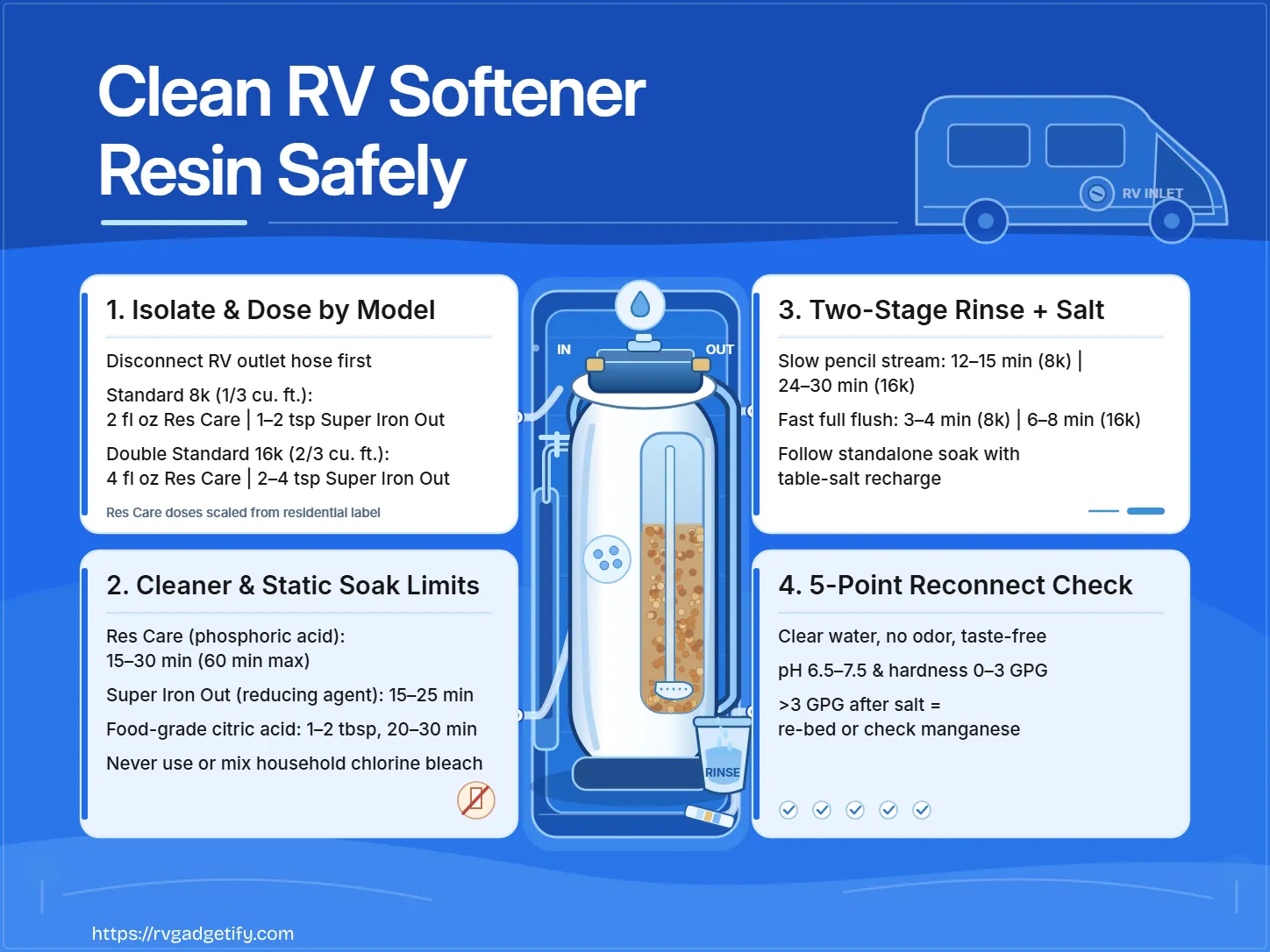
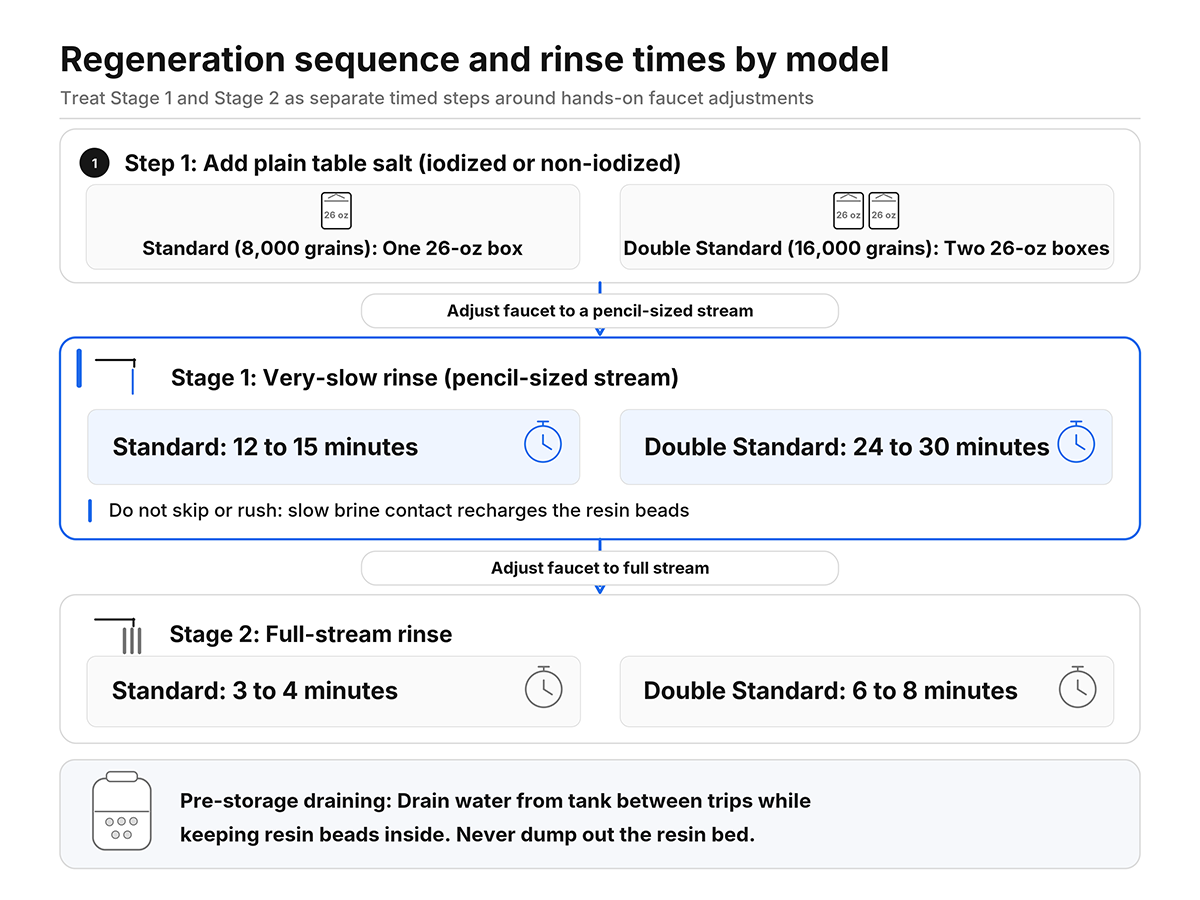
When the resin bed is exhausted, follow our detailed walkthrough on how to regenerate a portable RV water softener using standard kitchen table salt (either iodized or non-iodized) and a two-stage water rinse. Because the Double Standard holds twice the resin capacity, it requires twice the salt and twice the rinse duration of the Standard.
| Regeneration Step | On The Go Standard | On The Go Double Standard |
|---|---|---|
| Documented salt amount | One 26-oz box of table salt | Two 26-oz boxes of table salt |
| Stage 1: Very-slow rinse (pencil-sized stream) | 12 to 15 minutes | 24 to 30 minutes |
| Stage 2: Full-stream rinse | 3 to 4 minutes | 6 to 8 minutes |
Keep these operational rules in mind when planning maintenance:
- Do not skip or rush the slow rinse: The 12-to-15-minute (Standard) or 24-to-30-minute (Double Standard) very-slow, pencil-sized stream is required for the brine solution to recharge the resin beads properly.
- Treat stage times separately: The manufacturer lists the slow rinse and the full-stream rinse as distinct steps in the regeneration sequence rather than a single combined timer figure, since hands-on steps (such as adding salt, removing caps, or adjusting faucet flow) occur around them.
- Pre-storage draining: Before storing the unit between trips, On The Go’s instructions direct owners to drain water from the tank while keeping the resin beads inside. Never dump out the resin bed when draining the tank.
Scope Limits: What This Review Does Not Cover
To keep your buying decision grounded in verified facts, note what the manufacturer’s public documentation does not establish:
- Independent hardness-reduction testing: All capacity and flow figures are manufacturer-stated ratings, not third-party lab or field test results.
- Defined weight condition: The manufacturer does not state whether the 18-pound and 32-pound figures reflect dry, wetted, or fully flooded tanks.
- Installed height with hoses: The 22-inch height applies to the unit as listed; total installed height depends on your specific hoses and elbow adapters.
Frequently Asked Questions
Does a new On The Go water softener need salt before first use?
No. On The Go states that a new unit arrives ready to use and does not require salt or regeneration before its first hookup. Follow the manufacturer’s first-time hookup guide for the initial connection and flushing steps.
Can I use iodized table salt to regenerate these softeners?
Yes. On The Go’s regeneration instructions specify either iodized or non-iodized plain table salt: one full 26-ounce box for the Standard and two full 26-ounce boxes for the Double Standard.
Can I lay the On The Go softener on its side while hooked up?
No. On The Go’s hookup instructions specify that the unit must stand upright during use.
How do I know how many days a regeneration charge will last?
You cannot predict a fixed number of days from the tank rating alone. Divide the rated grain capacity (8,000 or 16,000 grains) by the campground’s water hardness in GPG to estimate total soft-water gallons, then divide that gallon total by your household’s daily RV water use.