
Specialized chemical resin-bed cleaners strip iron, manganese, silt, and mineral coatings that ordinary salt regeneration leaves behind. Isolating the tank from your RV, matching the cleaner and dose to your softener size, controlling the soak window, running a two-stage rinse, and following up with a full salt recharge give a fouled portable softener the best chance of recovering exchange capacity without damaging the media.
Standard sodium chloride brine swaps sodium ions for calcium and magnesium hardness, but it cannot dissolve oxidized rust crusts on resin beads. For On The Go Standard 8k and Double Standard 16k portable softeners, you can remove surface fouling safely with liquid phosphoric acid cleaner (such as NSF/ANSI/CAN Standard 60 certified Pro Products Res Care), sodium hydrosulfite powder (Super Iron Out), or food-grade citric acid before reconnecting the unit once the effluent runs clear, odorless, pH-neutral, and softening below 3 GPG.
Key Takeaways
- Confirm your exact softener model first: Doses and rinse times for the On The Go Standard 8k (approximately 1/3 cu. ft. of resin) and Double Standard 16k (approximately 2/3 cu. ft.) are not interchangeable.
- Disconnect the RV outlet hose before dosing: Never allow acidic cleaners, reducing agents, or dislodged iron sludge to enter RV PEX lines, fixtures, or the water heater tank.
- Match the cleaner to the mineral buildup: Use liquid phosphoric acid for general iron, silt, and scale; sodium hydrosulfite powder for heavy reddish-brown iron fouling; and citric acid for light surface film.
- Respect the 60-minute acid limit: Soak Res Care for 15 to 30 minutes and never exceed 60 minutes, as prolonged concentrated acid exposure can embrittle internal plastic distributor screens.
- Never use or mix household chlorine bleach: Bleach permanently breaks cation resin crosslinks and releases hazardous chlorine or chloramine gas if combined with acidic cleaners.
Which RV Softener Models Use These Doses and Rinse Times?
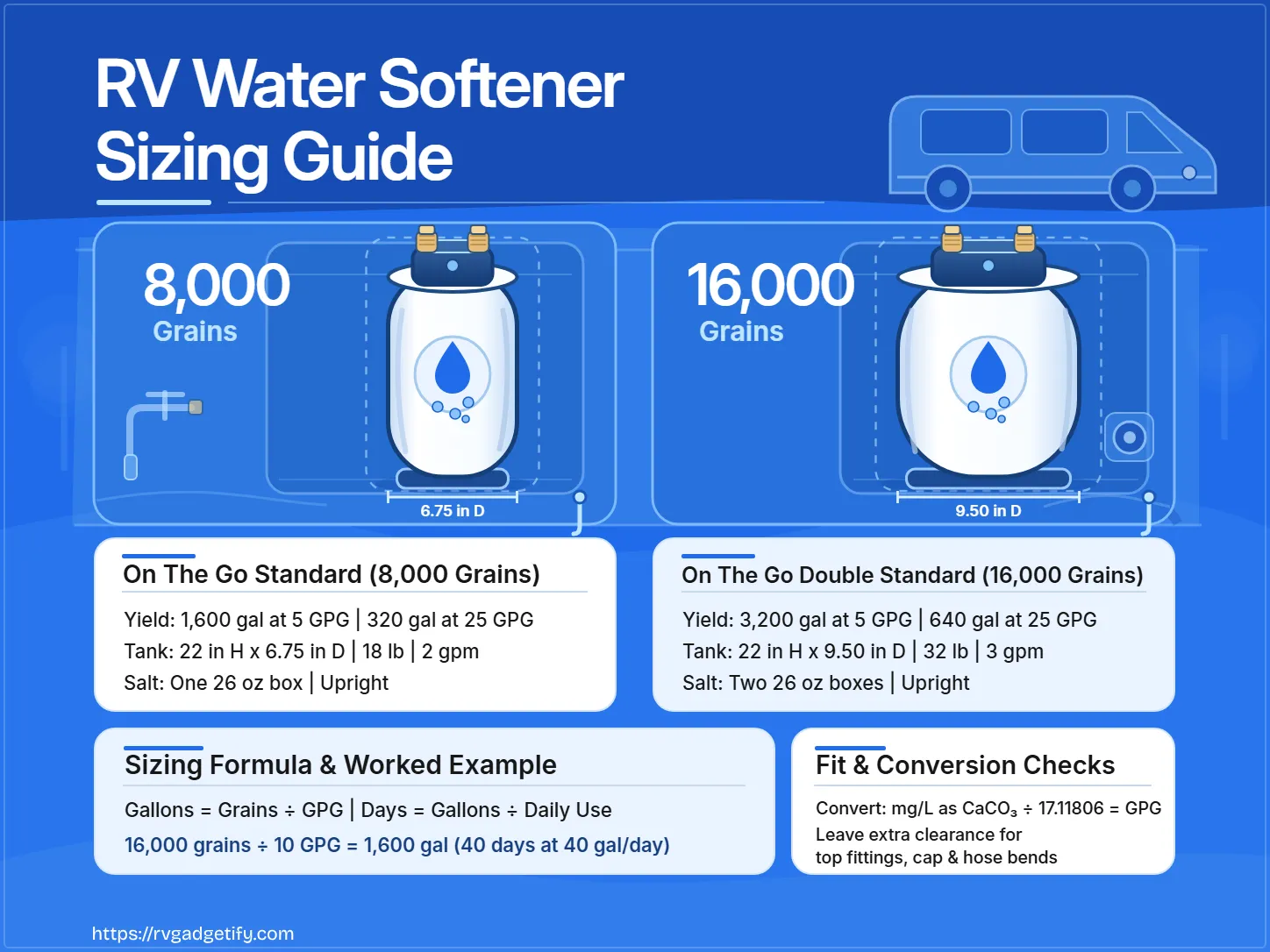
The doses and rinse durations in this guide apply specifically to the On The Go Standard 8k and Double Standard 16k portable RV water softeners. Because the Double Standard 16k holds roughly twice the resin volume of the Standard 8k, both chemical quantities and rinse durations scale with bed volume.
| Softener model | Approximate resin capacity | Liquid Res Care dose (adapted) | Super Iron Out dose (OEM) | Slow displacement rinse (pencil stream) | Fast potable flush (full stream) |
|---|---|---|---|---|---|
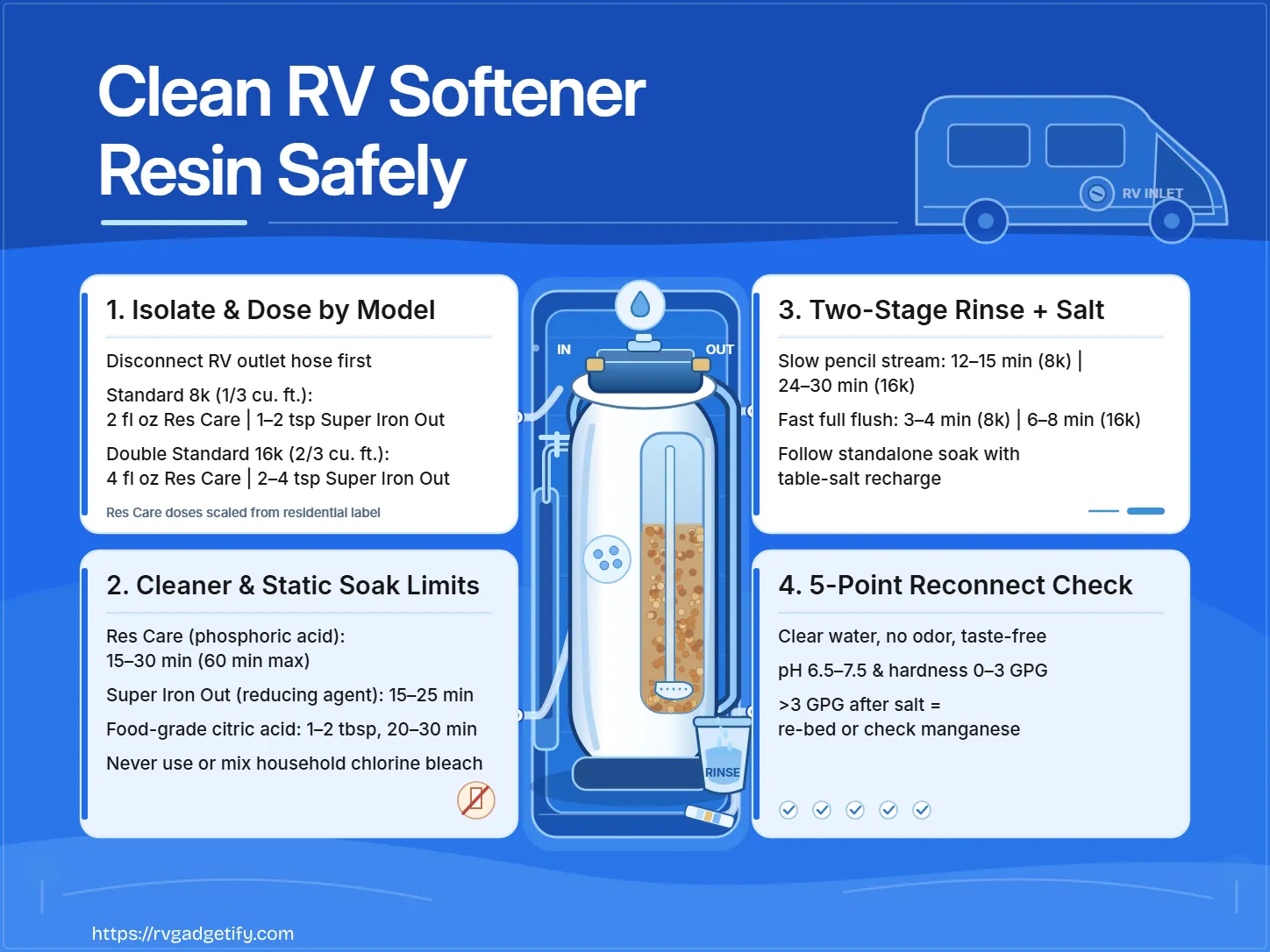
| On The Go Standard 8k | 1/3 cu. ft. | 2 fl oz | 1 to 2 teaspoons | 12 to 15 minutes | 3 to 4 minutes |
| On The Go Double Standard 16k | 2/3 cu. ft. | 4 fl oz | 2 to 4 teaspoons | 24 to 30 minutes | 6 to 8 minutes |
Check your tank label or manual before measuring any cleaner. While On The Go’s regeneration instructions explicitly specify the 1 to 2 teaspoon (Standard 8k) and 2 to 4 teaspoon (Double Standard 16k) Super Iron Out doses alongside those exact slow and fast rinse windows, the liquid Res Care doses above are scaled for portable 1/3 cu. ft. and 2/3 cu. ft. beds from Pro Products’ residential label (4 fl oz per cubic foot of fouled resin). Do not apply these quantities blindly to other softener brands or sealed inline cartridges.
Which Cleaners Are Safe for RV Softener Resin?
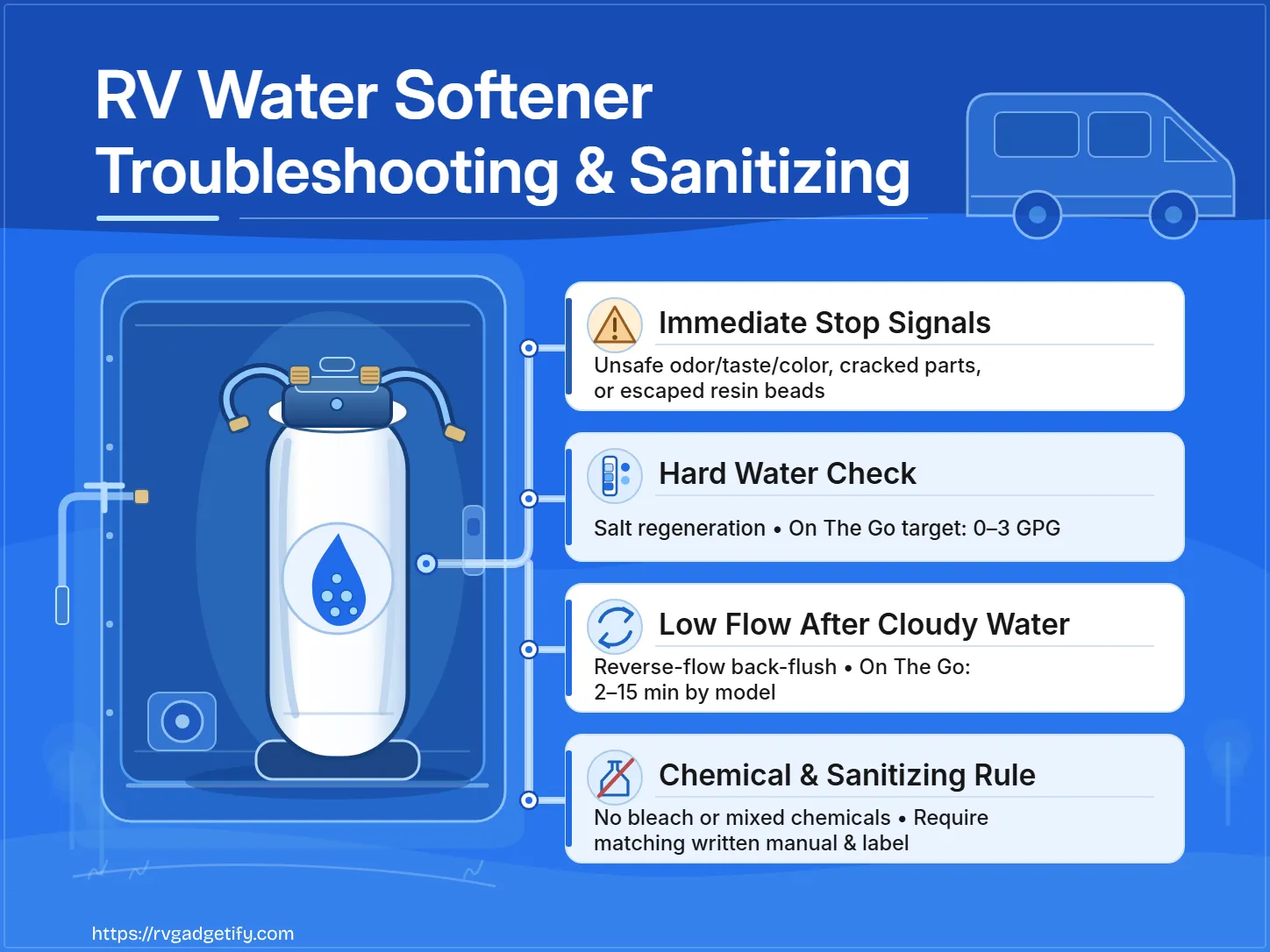
Three chemical cleaners can safely strip mineral fouling from cation exchange resin when used within their soak limits: liquid phosphoric acid, sodium hydrosulfite powder, and food-grade citric acid. Routine table-salt brine handles normal hardness ions only, while household chlorine bleach destroys cation resin and must never enter the tank.
| Cleaner | Active chemical | Target fouling | Standard 8k dose | Double Standard 16k dose | Static soak window | Critical safety boundary |
|---|---|---|---|---|---|---|
| Pro Products Res Care | Phosphoric acid formulation | Light-to-moderate iron, manganese, silt, and mineral scale | 2 fl oz | 4 fl oz | 15 to 30 minutes | Never exceed 60 minutes; never mix with bleach |
| Super Iron Out (powder) | Sodium hydrosulfite reducing agent | Heavy clear-water ferrous iron and stubborn reddish-brown rust | 1 to 2 teaspoons | 2 to 4 teaspoons | 15 to 25 minutes | Pre-dissolve in 1 cup warm water; avoid inhaling powder dust |
| Food-grade citric acid | Citric acid powder | Light surface iron film, calcium carbonate scale, and stale odors | 1 to 2 tablespoons | 1 to 2 tablespoons | 20 to 30 minutes | Pre-dissolve in 1 cup warm water; flush until pH is 6.5 to 7.5 |
| Routine table-salt recharge | Sodium chloride | Normal calcium and magnesium hardness ions | Model-specific salt recharge | Model-specific salt recharge | Continuous slow trickle rinse | Salt brine alone cannot dissolve oxidized iron crusts |
Each cleaner works through a different chemical mechanism and carries strict handling rules:
- Phosphoric acid (Pro Products Res Care): Certified to NSF/ANSI/CAN Standard 60 for drinking water treatment additives, this liquid acid dissolves light-to-moderate iron, manganese, silt, and scale coatings that block exchange sites.
- Sodium hydrosulfite (Super Iron Out powder): Acts as a chemical reducing agent that converts insoluble oxidized ferric iron deposits back into soluble ferrous ions so they can be rinsed out of the bed. On The Go’s manual also allows adding the model-specific teaspoon dose directly with table salt during regeneration under severe hardness or iron conditions.
- Never use chlorine bleach: Sodium hypochlorite attacks the divinylbenzene (DVB) crosslinks that give cation resin beads their rigid structure, causing beads to swell, turn mushy, and permanently lose softening capacity.
- Never combine bleach with resin cleaners: Mixing chlorine bleach with phosphoric acid, citric acid, or sodium hydrosulfite generates toxic chlorine or sulfur-oxide gases. Keep sanitizers completely separate from resin-cleaning chemicals.
Step-by-Step: How to Isolate, Soak, and Flush the Resin Bed
Follow these steps in order outside your RV so cleaning chemicals and loosened mineral sludge discharge safely before you reconnect to your fresh-water inlet.
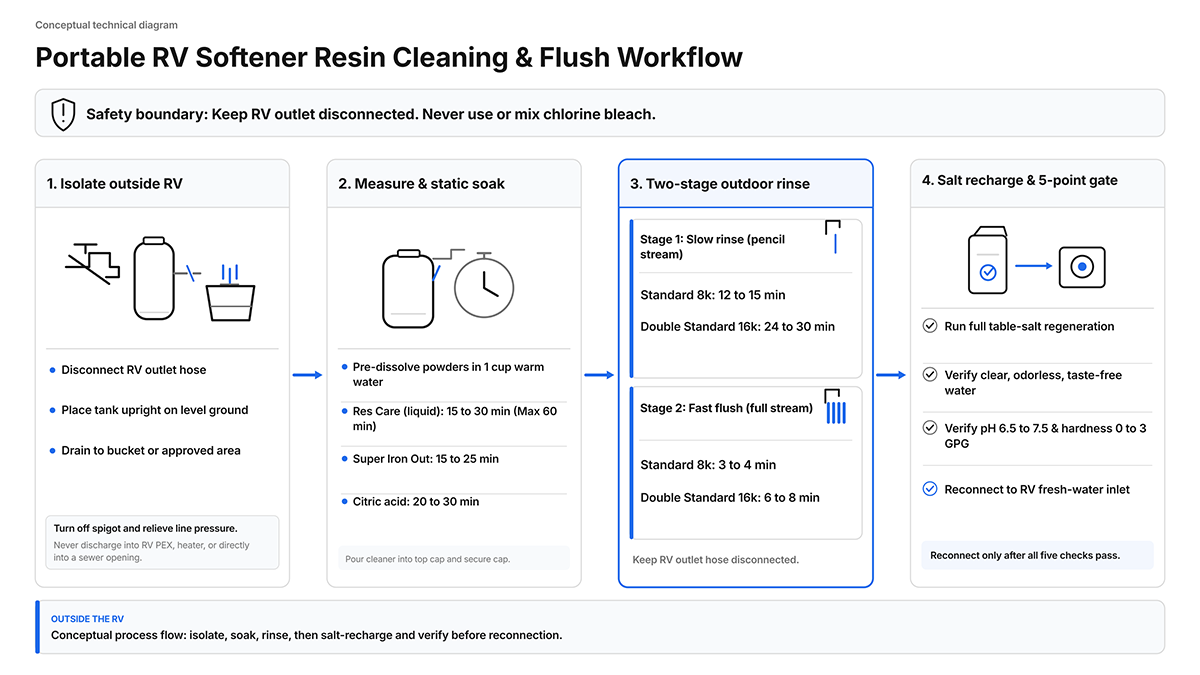
Step 1: Isolate the Softener From Your RV Plumbing
- Turn off the campground water spigot and open a downstream fixture or hose valve to relieve line pressure.
- Disconnect the outlet hose from the softener so no water can flow into your RV fresh-water inlet, PEX plumbing, water heater, or faucets.
- Place the softener upright on level ground near an approved drainage area or collection bucket. Do not insert the softener discharge hose directly into a campground sewer opening; check campground or local rules for gray/rinse water disposal first.
Step 2: Measure, Add, and Soak the Cleaner
- Remove the softener top cap (after draining enough standing headspace water for the cleaner, if needed).
- Measure the exact dose for your model and fouling type from the table above. If using powdered Super Iron Out or food-grade citric acid, dissolve the powder completely in 1 cup of warm water before pouring it into the tank.
- Pour the cleaner into the top of the softener and thread the top cap back on securely.
- Let the unit sit for the cleaner’s static soak period:
- Pro Products Res Care: 15 to 30 minutes (hard maximum of 60 minutes to prevent acid damage to internal plastic distributor screens).
- Super Iron Out: 15 to 25 minutes (or proceed directly to the slow displacement rinse if applying alongside table salt per On The Go’s regeneration method).
- Food-grade citric acid: 20 to 30 minutes.
Step 3: Run the Two-Stage Displacement and Potable Rinse
- Keep the outlet hose disconnected and confirm the top cap is tight.
- Stage 1 (Slow displacement rinse): Open the water spigot slightly so the outlet stream barely clears the side of the tank (roughly the width of a pencil). Maintaining this slow flow gives the water enough contact time to push dissolved iron and cleaner evenly through the bed:
- Standard 8k: 12 to 15 minutes.
- Double Standard 16k: 24 to 30 minutes.
- Stage 2 (Fast potable flush): After the slow rinse finishes, open the water supply to a full stream and flush outside the RV:
- Standard 8k: 3 to 4 minutes.
- Double Standard 16k: 6 to 8 minutes.
- Follow-up salt regeneration: If you performed a standalone chemical soak without salt, run a full model-specific table-salt regeneration (slow pencil-stream rinse followed by the fast full-stream flush) so the stripped resin beads are recharged with sodium ions. Continue the final fast flush until no chemical or salty taste remains.
How Do You Verify the Water Before Reconnecting to the RV?
Do not reconnect the outlet hose to your RV until the discharge water passes all five physical and chemical checks below.
| Reconnection check | Pass condition | Required action if check fails |
|---|---|---|
| Visual clarity | Effluent runs completely clear with no orange, brown, or black tint | Continue fast-flushing outside the RV |
| Odor | No sour, sulfur, or chemical smell remains | Continue fast-flushing outside the RV |
| pH level | pH test strip reads neutral (6.5 to 7.5), especially after citric or phosphoric acid | Continue fast-flushing outside the RV |
| Taste | Water is completely free of chemical or salty taste | Continue fast-flushing outside the RV |
| Output hardness | Hardness test strip at the softener outlet reads 0 to 3 GPG after salt regeneration | See persistent-hardness troubleshooting below |
Remember that clear, clean-tasting water confirms chemical rinse completion, not microbiological potability. Acid and reducing resin cleaners strip mineral deposits rather than disinfecting plumbing, so biological sanitization requires a separate procedure.
What If Output Water Stays Hard After Cleaning and Regeneration?
If output water at the softener outlet still tests above 3 GPG immediately after both a chemical cleaning and a verified salt regeneration, the resin bed has lost its exchange capacity and needs replacement (follow our step-by-step guide on re-bedding the tank with fresh cation resin when media is permanently exhausted). Chemical cleaners remove surface mineral crusts, but they cannot rebuild polymer crosslinks once free chlorine or age has structurally degraded the beads.
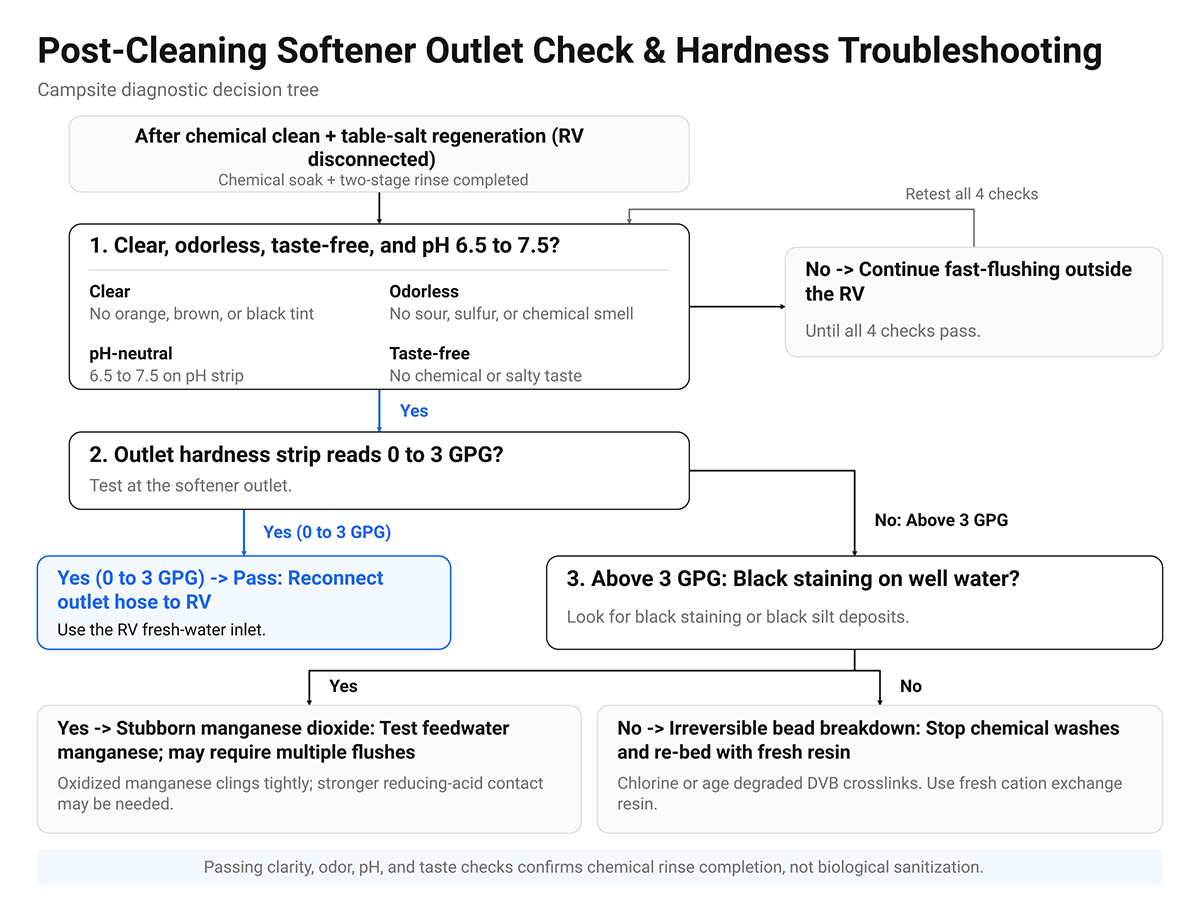
Before condemning the resin on well water with black staining, check for heavy manganese fouling:
- Irreversible bead breakdown (>3 GPG after cleaning and salt recharge): Stop repeating acid or reducing washes and re-bed the tank with fresh cation exchange resin.
- Stubborn manganese dioxide (black silt fouling): Oxidized manganese dioxide clings tightly to resin and may require stronger reducing-acid contact or multiple flushes to clear. Test feedwater manganese levels rather than assuming a single standard wash will strip heavy black deposits.
How Often Should You Clean an RV Softener Resin Bed?
When camping regularly on iron-bearing well water, clean the resin bed every 3 to 6 months and follow each cleaning with a full salt regeneration. If you camp primarily on municipal water with low iron, only use a chemical resin cleaner when orange staining, metallic taste, or premature hardness breakthrough points to mineral fouling.
Between periodic chemical cleanings, maintain the bed by recharging the resin beads with table salt whenever hardness strips show output rising above 3 GPG. Salt recharges the sodium sites for everyday calcium and magnesium removal, while periodic chemical cleaning keeps iron and silt from sealing off the beads.
Actionable Next Step
Check your softener label to confirm whether you have the Standard 8k or Double Standard 16k model, disconnect the outlet hose from your RV, and choose the cleaner that matches your water’s fouling type. Complete the timed soak, slow pencil-stream rinse, fast flush, follow-up salt recharge, and 5-point water check before reconnecting the unit to your rig.
Frequently Asked Questions
Why can’t ordinary table salt clean iron off softener resin?
Sodium chloride brine exchanges sodium ions for calcium and magnesium hardness ions, but once clear-water ferrous iron oxidizes into insoluble ferric rust on the bead surface, salt water cannot dissolve the crust. Removing oxidized iron requires an acidic cleaner (phosphoric or citric acid) or a chemical reducing agent (sodium hydrosulfite).
Why must household bleach never be used or mixed with resin cleaners?
Chlorine bleach is a strong oxidizer that severs the divinylbenzene crosslinks inside cation resin beads, turning them soft and permanently destroying their softening capacity. In addition, mixing bleach with phosphoric acid, citric acid, or sodium hydrosulfite creates dangerous chlorine or sulfur-oxide fumes.
Does clean-tasting outlet water prove the softener is sanitized?
No. Passing the clarity, odor, pH, and taste checks only confirms that the chemical resin cleaner and regeneration salt have been flushed from the tank. Mineral-stripping cleaners do not disinfect water or sanitize biological contamination.
Where should chemical rinse water be discharged at a campsite?
Direct all slow-rinse and fast-flush water into a bucket or an approved outdoor drainage area according to campground and local regulations. Never flush chemical cleaners through your RV plumbing, and never insert the softener’s potable discharge hose directly into a sewer connection.