
Inline RV water filters are compact, single-canister attachments that thread between a campground water spigot and your RV fresh-water drinking hose. Choosing the right model comes down to matching the internal filtration media, micron rating, and published flow rate to your typical campground water quality and trip length.
For standard municipal RV-park hookups, the Camco TastePURE RV/Marine Inline Water Filter (40043) remains a practical seasonal baseline with a 20-micron sediment disc, granular activated carbon (GAC), and KDF-55 media. Campers dealing with fine silt can step up to the 1-micron solid carbon block in the CLEAR2O CRV2006 (rated at 3.5 GPM at 50 PSI), while full-time RVers and snowbirds seeking higher gallon capacity can look to the Hydro Life Camco HL-200 (52141), which pairs KDF-55 with catalytic carbon for up to 8,000 gallons.
Key Takeaways
- Match media to the water source: Standard 20-micron GAC and KDF-55 canisters handle municipal chlorine taste, odor, and coarse pipe scale, whereas 1-micron and 5-micron solid carbon blocks capture finer suspended silt.
- Distinguish pore size from certified cyst removal: A 1-micron solid carbon block (such as the CLEAR2O CRV2006) traps much finer particulates than a 20-micron GAC filter, but verified biological cyst reduction on untreated water requires independent certification such as NSF/ANSI Standard 53.
- Check published flow conditions: Only four models in this lineup publish specific GPM flow figures: CLEAR2O CRV2006 (3.5 GPM at 50 PSI), SpiroPure SP-RV100 (2.5 to 3.5 GPM at 45 to 55 PSI), Waterdrop (3.0 GPM), and AQUACREST (2.5 to 3.0 GPM).
- Protect the housing at the spigot: Always install a water pressure regulator upstream of an inline filter and use a flexible spring hose protector to prevent mechanical strain on the plastic fittings.
- Follow seasonal replacement limits: Most disposable inline canisters are rated for 3 months or one camping season (roughly 1,000 to 2,000 gallons where stated), while the heavy-duty Hydro Life HL-200 is rated for up to 8,000 gallons.
Quick Picks for Inline RV Water Filters
- Best overall budget: Camco TastePURE RV/Marine Inline Water Filter (40043) for weekend campers seeking simple 20-micron GAC and KDF-55 municipal-water filtration.
- Best 1-micron carbon block: CLEAR2O CRV2006 RV and Marine Inline Water Filter for campers who want 1-micron solid-block filtration and a published 3.5 GPM flow rate at 50 PSI.
- Best 5-micron carbon block for silty water: CLEAR2O CRV1005 RV and Marine Inline Water Filter for campers who want solid-block filtration with higher dirt-holding tolerance than a 1-micron core.
- Best certified multi-stage value: Waterdrop RV Inline Water Filter with Hose Protector for campers seeking NSF/ANSI 42 and 372 certification paired with GAC, KDF-55, and fluoride-targeting media.
- Best for long seasonal capacity: Hydro Life Camco HL-200 External Filter Kit (52141) for snowbirds and full-time RVers who want catalytic carbon and an up-to-8,000-gallon capacity rating.
- Best multi-pack with dual hose protectors: Hourleey RV Inline Water Filter with Flexible Hose Protector for campers who want a two-filter seasonal kit with two included spring protectors.
- Best multi-pack with brass fittings: Kohree RV Marine Inline Water Filter with Hose Protector for travel trailers and fifth wheels that prioritize brass garden-hose couplings in a two-pack format.
- Best certified coconut-shell carbon option: AQUACREST RV Inline Water Filter with Hose Protector for campers who want NSF/ANSI 42 and 372 certification with coconut-shell GAC and a 2.5 to 3.0 GPM rating.
- Best pressure-specified multi-stage GAC option: SpiroPure SP-RV100 Multi-Stage Inline RV Water Filter for RVers who want dual sediment screens with a published 2.5 to 3.5 GPM rating at 45 to 55 PSI.
- Best lightweight weekend pick: EcoBlueLife RV Water Filter with KDF and Activated Carbon for camper vans, pop-up campers, and weekend RVers who want an 11-inch canister weighing under 1 pound dry.
Comparison at a Glance
Inline RV water filters differ primarily in internal media structure (loose granular beds versus extruded solid carbon blocks), rated service life, published flow specifications, and fitting hardware.
Whichever of the two you buy, connecting inline filters in the proper campsite sequence keeps the housing downstream of a regulator, and our walkthrough on how to install an RV water filter system lists that order.
| Model | Filtration Media | Rated Service Life or Capacity | Published Flow Rate | Best Fit |
|---|---|---|---|---|
| 1. Camco TastePURE 40043 | 20-micron sediment disc, GAC, KDF-55 | 1 camping season or 3 months (~1,000 to 2,000 gal) | Not published by manufacturer | Budget municipal-water camping |
| 2. CLEAR2O CRV2006 | 1-micron solid carbon block | 3 to 6 months | 3.5 GPM at 50 PSI | Fine silt and 1-micron solid-block filtration |
| 3. CLEAR2O CRV1005 | 5-micron solid carbon block | 3 to 6 months | Not published by manufacturer | Moderate silt with solid-block filtration |
| 4. Waterdrop Inline Filter | NSF 42/372 certified GAC, KDF-55, fluoride-reduction media | 3 months (~2,000 gal) | 3.0 GPM | Certified multi-stage municipal filtration |
| 5. Hydro Life Camco HL-200 (52141) | KDF-55 and catalytic carbon | Up to 8,000 gal | Not published by manufacturer | Extended seasonal and full-time hookups |
| 6. Hourleey Inline Filter (2-Pack) | Multi-stage sediment screen, KDF-55, GAC | 3 months per filter (2-pack) | Not published by manufacturer | Full-season backup with 2 hose protectors |
| 7. Kohree Inline Filter (2-Pack) | 20-micron sediment pre-filter, GAC, KDF-55 | 3 months per filter (2-pack) | Not published by manufacturer | Municipal hookups with brass GHT fittings |
| 8. AQUACREST Inline Filter | NSF 42/372 certified coconut-shell GAC, KDF-55 | 3 months per filter | 2.5 to 3.0 GPM | Certified coconut-shell carbon filtration |
| 9. SpiroPure SP-RV100 | Dual sediment screens, KDF-55, GAC | 3 months | 2.5 to 3.5 GPM at 45 to 55 PSI | Pressure-specified multi-stage GAC filtration |
| 10. EcoBlueLife Inline Filter | KDF redox alloy, granular activated carbon | 3 months or 1 camping season | Not published by manufacturer | Compact, sub-1-lb weekend storage |
1. Camco TastePURE RV/Marine Inline Water Filter (40043)
The Camco TastePURE 40043 is the standard budget baseline for casual municipal-water camping, combining an internal 20-micron sediment disc with granular activated carbon (GAC) and KDF-55 media. It threads onto standard 3/4-inch campsite spigots to catch coarse sand and rust flakes while reducing chlorine taste and odor over a three-month or single-season service window (approximately 1,000 to 2,000 gallons). Because its 20-micron nominal rating targets coarse debris rather than fine silt, it fits weekend and seasonal campers using treated city hookups rather than silty well supplies.

Why buy it
- Combines a 20-micron sediment disc, GAC, and KDF-55 media to reduce coarse sediment and chlorine taste while inhibiting bacterial growth inside the wet canister
- Includes a flexible steel spring hose protector to reduce kinking and thread strain at the spigot
- BPA-free sealed plastic housing rated for approximately one camping season or 3 months of typical municipal use
Trade-offs
- 20-micron pore size does not trap fine silt or biological cysts
- Manufacturer does not publish a specific GPM flow rating or third-party NSF certification for this model
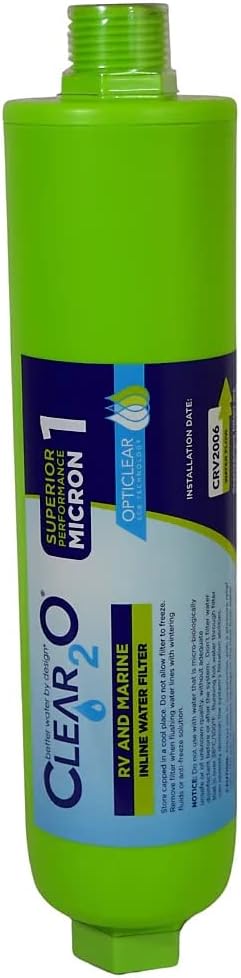
2. CLEAR2O CRV2006 RV and Marine Inline Water Filter
The CLEAR2O CRV2006 steps away from loose granular carbon beds by using a 1-micron solid carbon block rated to deliver 3.5 GPM at 50 PSI line pressure. Because water is forced through the uniform pores of an extruded carbon block rather than channeling around loose granules, it captures fine silt and particulates down to 1 micron that pass straight through standard 20-micron inline filters. It is the best fit for campers who want the finest micron rating in this inline lineup without dropping below the 3.0 to 3.5 GPM flow range needed for RV showers, though heavier mud or unscreened well grit can blind a 1-micron core faster than a 5-micron or 20-micron unit.
Why buy it
- 1-micron solid carbon block provides the finest physical filtration rating among the 10 models compared
- Published flow specification of 3.5 GPM at 50 PSI supports standard single-fixture and shower demand when clean
- Includes a flexible hose protector and carries a 3- to 6-month service interval depending on source water sediment
Trade-offs
- 1-micron carbon block clogs faster than 5-micron or 20-micron filters when exposed to heavy raw sediment
- While 1-micron pores physically target cyst-sized particulates, no independent NSF/ANSI Standard 53 certification is cited in the product documentation
3. CLEAR2O CRV1005 RV and Marine Inline Water Filter
The CLEAR2O CRV1005 uses a full-length 5-micron solid carbon block inside an impact-resistant green housing to balance fine sediment reduction against dirt-holding longevity. Stepping from 1 micron up to 5 microns gives the carbon block more tolerance for moderate campground silt before surface pores blind, while still capturing four-times-smaller particles than a standard 20-micron GAC canister. Choose the CRV1005 when your campgrounds have enough suspended silt to clog a 1-micron filter prematurely, and skip it if you specifically need 1-micron filtration or a published GPM flow specification.

Why buy it
- Full-length 5-micron solid carbon block captures finer silt than 20-micron GAC filters while resisting premature clogging better than a 1-micron block
- Solid-block media structure prevents the water channeling common in loose granular carbon canisters
- Impact-resistant housing rated for a 3- to 6-month service life
Trade-offs
- 5-micron pore size is too large to block protozoan cysts
- Manufacturer does not publish a specific GPM flow rate or gallon capacity rating for this model
4. Waterdrop RV Inline Water Filter with Hose Protector
The Waterdrop RV Inline Water Filter pairs NSF/ANSI 42 and 372 certification with a multi-stage bed of GAC, KDF-55, and fluoride-reduction media rated at 3.0 GPM. Its NSF/ANSI 42 certification verifies aesthetic chlorine taste and odor reduction, while NSF/ANSI 372 confirms lead-free material compliance across a 3-month or roughly 2,000-gallon service window. It fits campers on treated municipal hookups who want third-party material compliance and a stated 3.0 GPM flow rate, though its loose media bed is not built for sub-5-micron silt or cyst filtration.

Why buy it
- Certified to NSF/ANSI Standard 42 (chlorine taste and odor reduction) and NSF/ANSI Standard 372 (lead-free compliance)
- Combines GAC, KDF-55, and manufacturer-stated fluoride-reduction media with a published 3.0 GPM flow rate
- Rated for 3 months or approximately 2,000 gallons and includes a flexible anti-kink hose protector
Trade-offs
- Fluoride and heavy-metal reduction are manufacturer media claims rather than NSF/ANSI Standard 53 certified reductions
- Loose granular media architecture does not provide fine 1- to 5-micron solid-block particulate filtration
5. Hydro Life Camco HL-200 External Filter Kit (52141)
The Hydro Life Camco HL-200 (52141) is built for extended seasonal stays and full-time RVers, combining KDF-55 with catalytic carbon to support a manufacturer rating of up to 8,000 gallons. Unlike standard activated carbon that mainly adsorbs free chlorine, catalytic carbon is formulated to target chloramines (commonly used by municipal water districts) as well as hydrogen sulfide odors. It is the strongest match for stationary seasonal sites or multi-month tours where a 1,000- to 2,000-gallon canister would expire mid-trip, provided you have room for a larger, heavy-duty ribbed canister at the spigot.

Why buy it
- Highest rated capacity in the lineup at up to 8,000 gallons (four times the gallon rating of standard 2,000-gallon seasonal canisters)
- Pairs catalytic carbon with KDF-55 media to target chloramines, free chlorine, heavy metals, and hydrogen sulfide odors
- High-pressure ribbed exterior housing ships with a hose connection kit
Trade-offs
- Manufacturer does not publish a specific GPM flow rate or micron pore rating in the supplied specifications
- Overbuilt for occasional weekend campers who discard their filter after a few short trips
6. Hourleey RV Inline Water Filter with Flexible Hose Protector
The Hourleey RV Inline Water Filter is a two-pack value kit that bundles two GAC and KDF-55 canisters with two flexible hose protectors. Each filter is rated for up to 3 months of service, giving seasonal campers a full six-month supply plus a spare strain-relief spring hose attachment in one box. It fits budget-conscious RVers who camp on municipal hookups and want an immediate mid-season replacement on hand, though shoppers seeking published GPM figures or third-party NSF certifications should look to Waterdrop or AQUACREST instead.

Why buy it
- Includes two inline filters and two flexible hose protectors for two full 3-month service intervals
- Multi-stage internal sediment screen, KDF-55, and GAC media reduce coarse sediment and municipal chlorine taste
- Constructed from BPA-free, food-grade plastic
Trade-offs
- Manufacturer does not publish a specific micron rating, gallon limit, or GPM flow rate
- Does not carry third-party NSF/ANSI certification
7. Kohree RV Marine Inline Water Filter with Hose Protector
The Kohree RV Marine Inline Water Filter packages two 20-micron GAC and KDF-55 canisters equipped with brass 3/4-inch garden hose thread (GHT) couplings. Brass threads resist cross-threading and cracking better than molded plastic nipples when connected repeatedly at different RV-resort spigots. With a 3-month service life per cartridge, this two-pack suits fifth-wheel and travel-trailer owners who move frequently between municipal campgrounds and want metal thread durability, though its 20-micron pre-filter is not intended for fine well silt.

Why buy it
- Durable brass GHT couplings reduce the risk of stripped or cracked plastic threads during frequent hookups
- Two-pack format provides two 3-month filters with a 20-micron sediment pre-filter, GAC, and KDF-55 media
- Targets rust flakes, coarse pipe scale, and chlorine taste and odor on municipal hookups
Trade-offs
- 20-micron pre-filter leaves fine silt and biological cysts unaddressed
- Manufacturer does not publish a specific GPM flow rate or gallon capacity figure
8. AQUACREST RV Inline Water Filter with Hose Protector
The AQUACREST RV Inline Water Filter combines NSF/ANSI 42 and 372 certification with coconut-shell granular activated carbon and KDF-55 media, rated for 2.5 to 3.0 GPM over a 3-month service life. Coconut-shell GAC offers a high density of micropores suited for adsorbing volatile organic compounds and chlorine taste in municipal drinking and cooking water. It is a solid fit for campers who want certified coconut-shell carbon media with a published flow range, though RVs that require more than 3.0 GPM for simultaneous shower and sink use may notice the upper flow ceiling.

Why buy it
- Certified under NSF/ANSI Standard 42 for chlorine taste/odor reduction and NSF/ANSI Standard 372 for lead-free materials
- Uses coconut-shell GAC and KDF-55 media with a published 2.5 to 3.0 GPM flow range
- Food-grade plastic housing includes a flexible hose protector for a 3-month replacement cycle
Trade-offs
- Published 2.5 to 3.0 GPM flow range sits slightly below the 3.5 GPM rating of the CLEAR2O CRV2006 and SpiroPure SP-RV100
- Manufacturer does not publish a specific micron rating or total gallon capacity
9. SpiroPure SP-RV100 Multi-Stage Inline RV Water Filter
The SpiroPure SP-RV100 pairs dual internal sediment mesh barriers with KDF-55 and GAC media, and is one of only two models in this guide to publish a pressure-specific flow rating: 2.5 to 3.5 GPM at 45 to 55 PSI. Because 45 to 55 PSI matches the standard output of an RV water pressure regulator, buyers get a realistic picture of how the filter will perform on regulated campground hookups. It fits RVers who want a 3-month GAC/KDF-55 filter with brass coupling hardware and transparent flow specifications under normal regulated pressure.

Why buy it
- Explicitly rated to deliver 2.5 to 3.5 GPM at standard regulated RV water pressures of 45 to 55 PSI
- Dual sediment mesh screens work with KDF-55 and GAC to trap suspended debris and reduce chlorine odor
- Includes a flexible brass coupling and a 3-month service interval
Trade-offs
- Mesh sediment screens and loose GAC do not match the 1- to 5-micron physical filtration of a solid carbon block
- Manufacturer does not publish a specific micron pore size or total gallon capacity
10. EcoBlueLife RV Water Filter with KDF and Activated Carbon
Measuring approximately 11 inches long and weighing under 1 pound dry, the EcoBlueLife RV Water Filter is a lightweight, compact option for weekend trips in camper vans, teardrops, and pop-up campers. Inside its BPA-free housing, KDF redox alloy and granular activated carbon work to reduce municipal chlorine taste, odor, and coarse pipe grit over a 3-month or single-season service window. Choose it when small storage footprint and low dry weight are priorities, and skip it if you need published GPM specifications or fine solid-block sediment capture.

Why buy it
- Compact 11-inch body weighs under 1 pound dry, making it easy to stow in small camper-van or pop-up utility totes
- Combines KDF redox alloy and granular activated carbon in a food-grade, BPA-free shell with a hose protector
- Rated for 3 months or one camping season of weekend municipal-water use
Trade-offs
- Manufacturer does not publish a specific micron rating, GPM flow rate, or gallon capacity
- Granular carbon bed is built for treated municipal water rather than high-silt or untreated well sources
How to Choose an Inline RV Water Filter
Selecting the right inline RV water filter requires checking four practical variables before you hook up at the campground: internal media architecture, published flow performance, service capacity, and connection hardware.
1. Filtration Media: GAC and KDF-55 vs. Solid Carbon Block vs. Catalytic Carbon
An inline filter’s internal media dictates what it can trap and how water moves through the cylinder:
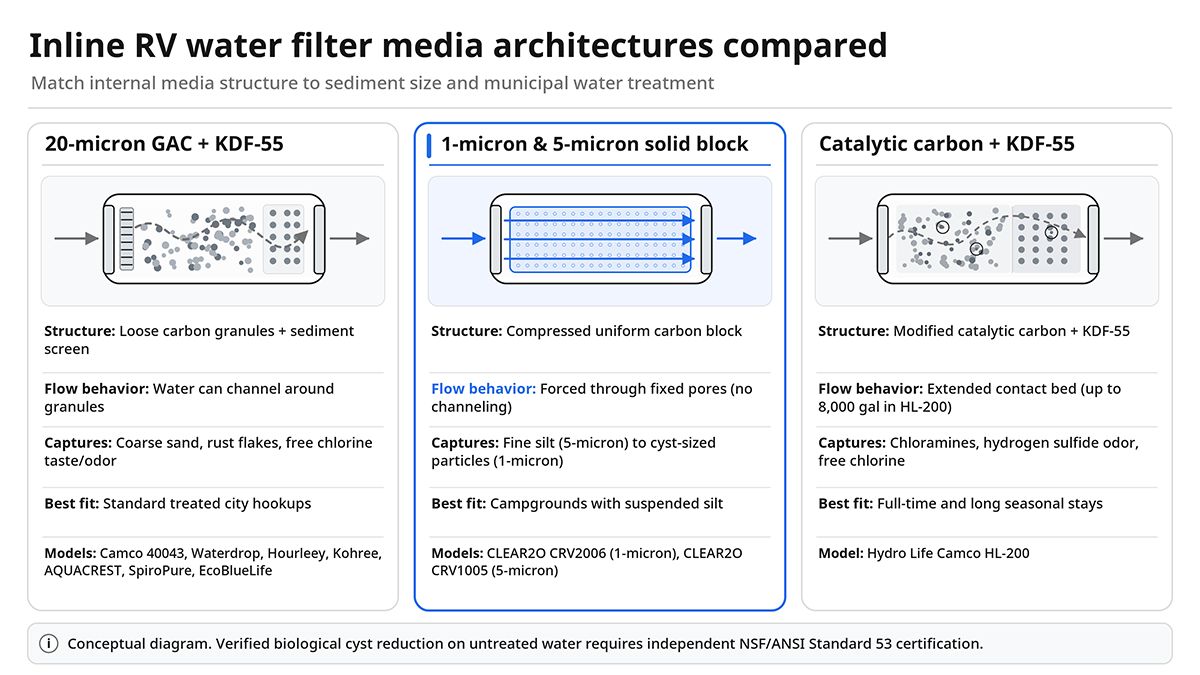
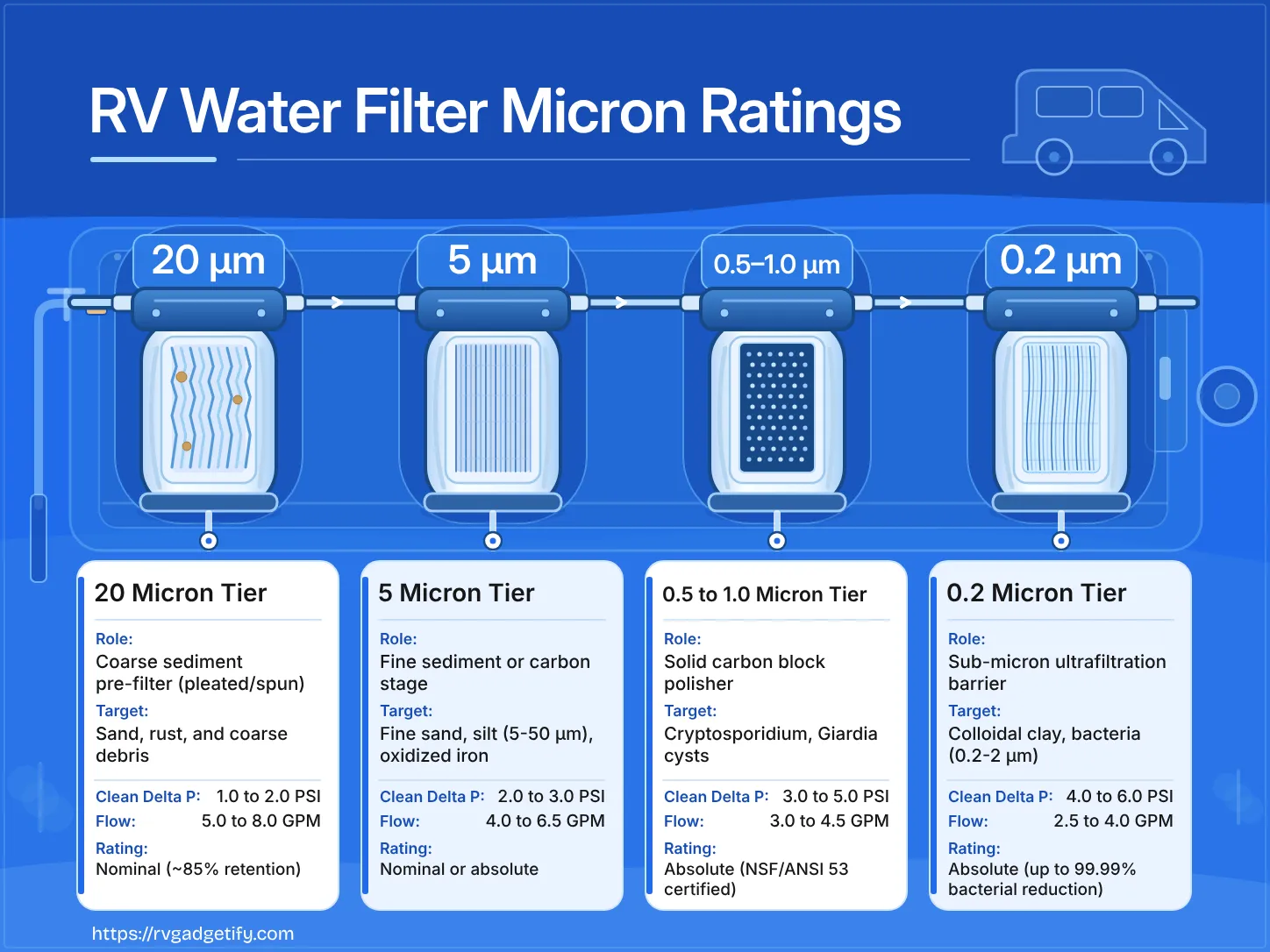
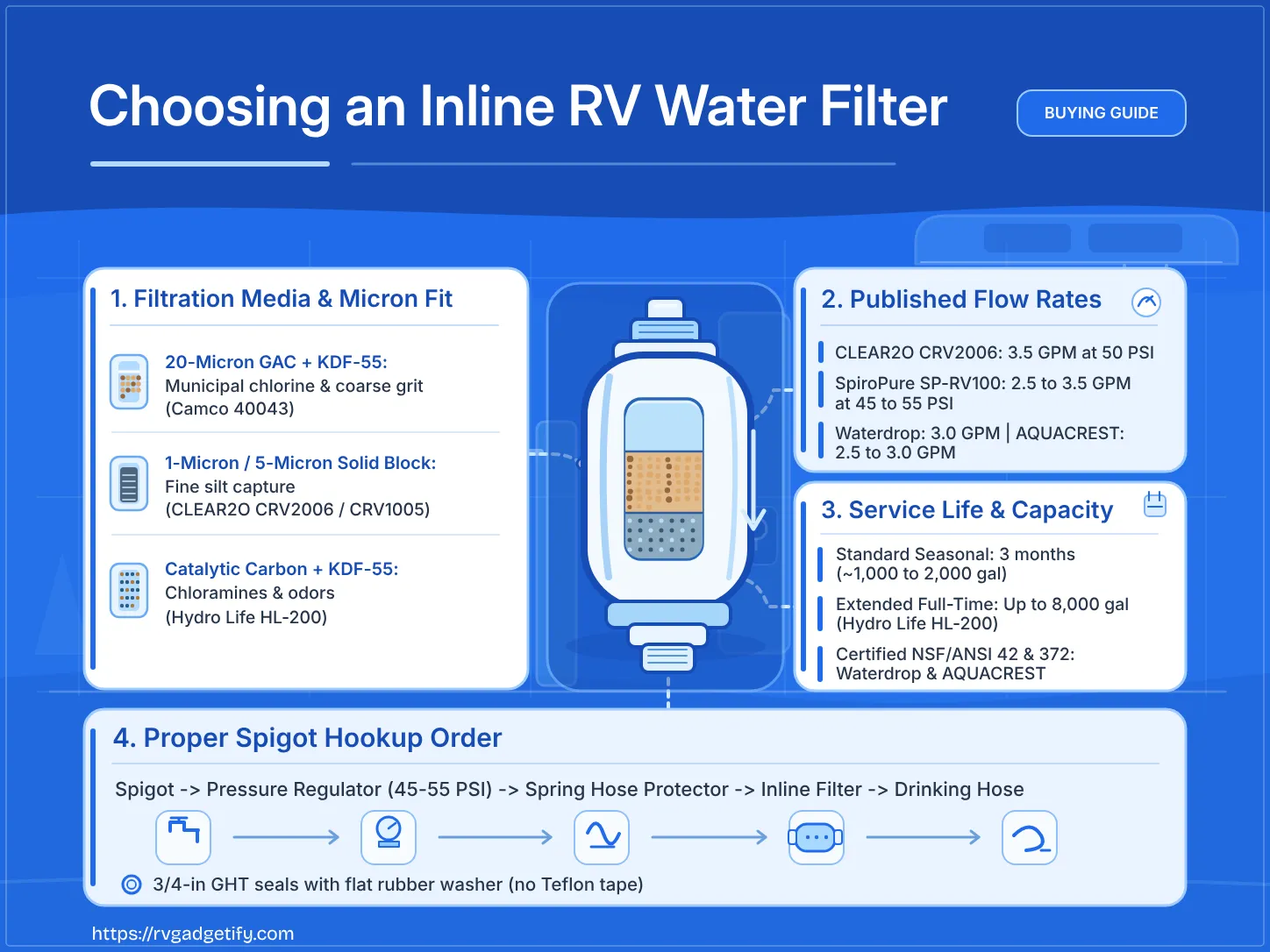
- 20-micron sediment + GAC + KDF-55 (Camco 40043, Waterdrop, Hourleey, Kohree, AQUACREST, SpiroPure, EcoBlueLife): These canisters use a coarse sediment pad or screen to stop sand and rust flakes, loose granular activated carbon (GAC) to adsorb chlorine taste and odor, and KDF-55 copper-zinc redox media to target heavy metals and inhibit bacterial growth inside the wet canister during storage. They fit established campgrounds with treated municipal water.
- 1-micron and 5-micron solid carbon blocks (CLEAR2O CRV2006 and CRV1005): Instead of loose granules that water can channel around, solid blocks compress carbon into a uniform matrix with fixed 1-micron or 5-micron pores. Use the 5-micron CRV1005 for moderate silt and higher dirt-holding capacity, or the 1-micron CRV2006 when fine silt and cyst-sized particulates are a concern.
- Catalytic carbon + KDF-55 (Hydro Life Camco HL-200): Catalytic carbon has a modified surface structure that breaks down chloramines (a disinfectant blend of chlorine and ammonia that standard GAC struggles to remove) as well as hydrogen sulfide odors.
2. Published Flow Rates and Shower Pressure
Most RVs need at least 3.0 to 4.0 GPM of water flow to run two fixtures simultaneously without a noticeable drop in shower pressure. Among the 10 filters in this guide, four publish explicit GPM figures:
- CLEAR2O CRV2006: 3.5 GPM at 50 PSI
- SpiroPure SP-RV100: 2.5 to 3.5 GPM at 45 to 55 PSI
- Waterdrop Inline Filter: 3.0 GPM
- AQUACREST Inline Filter: 2.5 to 3.0 GPM
CLEAR2O CRV2006 and SpiroPure SP-RV100 stand out because they specify the exact line-pressure conditions (50 PSI and 45 to 55 PSI) alongside their GPM ratings, matching the typical output of an RV pressure regulator.
3. Rated Service Life, Capacity, and Multi-Pack Value
Standard disposable inline filters (including Camco 40043, Waterdrop, Hourleey, Kohree, AQUACREST, SpiroPure, and EcoBlueLife) specify a replacement interval of roughly 3 months or one camping season, with Camco and Waterdrop estimating capacity at around 1,000 to 2,000 gallons. If you camp full-time or park for an entire winter season, the Hydro Life Camco HL-200 (52141) offers the longest stated capacity at up to 8,000 gallons.
For campers who prefer to carry a spare filter in their wet bay, Hourleey and Kohree both ship as two-packs (providing six months of total coverage at 3 months per filter). Choose Hourleey if you want two flexible hose protectors included in the box, or Kohree if you prefer durable brass 3/4-inch GHT couplings on the filter ends.
4. Evaluation Criteria
To compare these 10 inline filters on a consistent basis, we evaluated each model across six documented attributes from manufacturer specifications and certification records: exact model and part identity, internal filtration media and micron rating, stated gallon capacity or replacement interval, published GPM flow rate and test pressure, third-party certifications (such as NSF/ANSI Standards 42 and 372), and included connection hardware (brass couplings and flexible hose protectors).
How Should You Connect an Inline RV Water Filter?
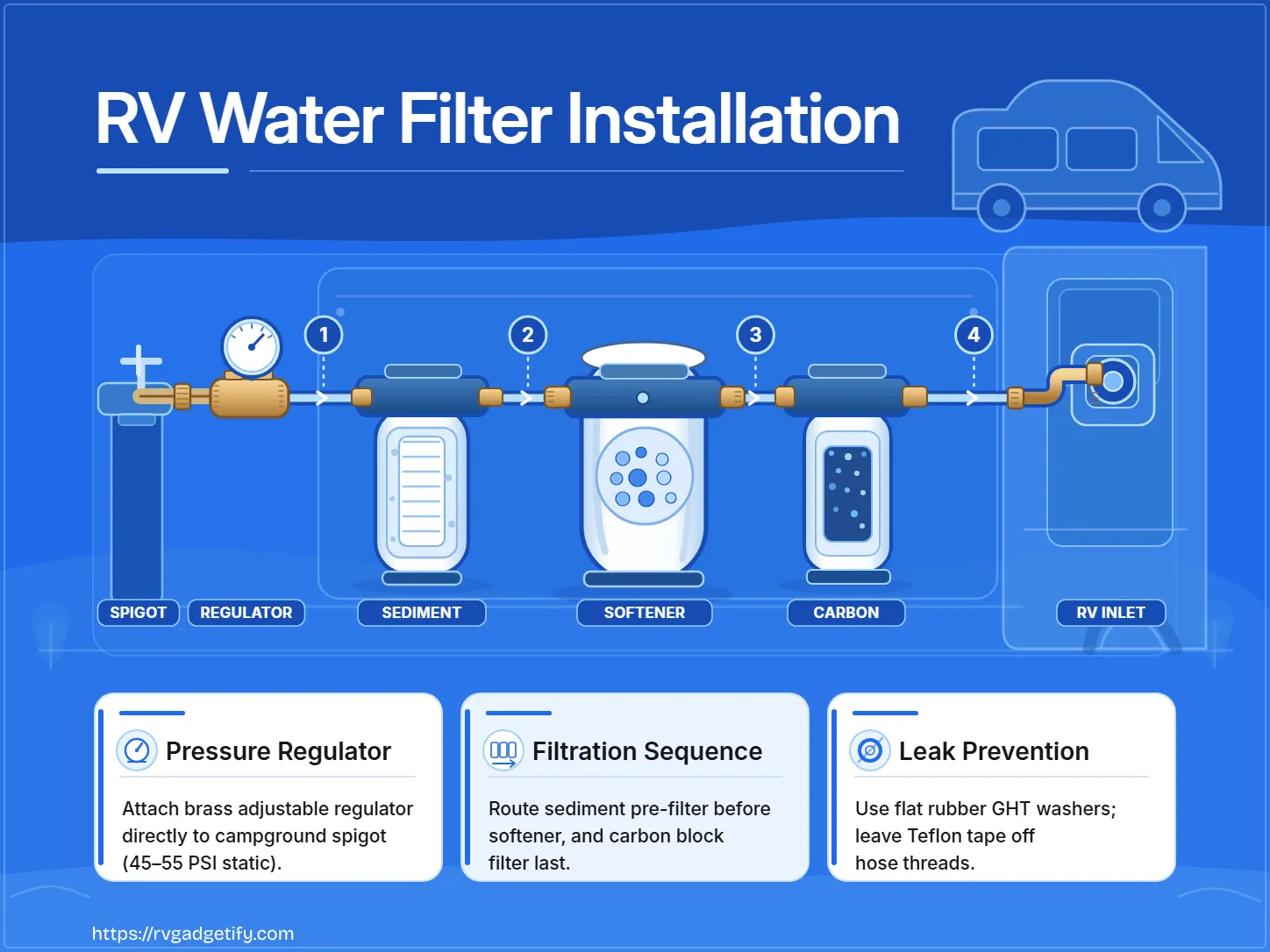
Connect your inline water filter in a strict upstream-to-downstream order: Campground spigot -> Water pressure regulator -> Flexible hose protector -> Inline water filter -> Potable drinking water hose -> RV city water inlet.
This hookup sequence protects both the plastic filter housing and your coach plumbing:
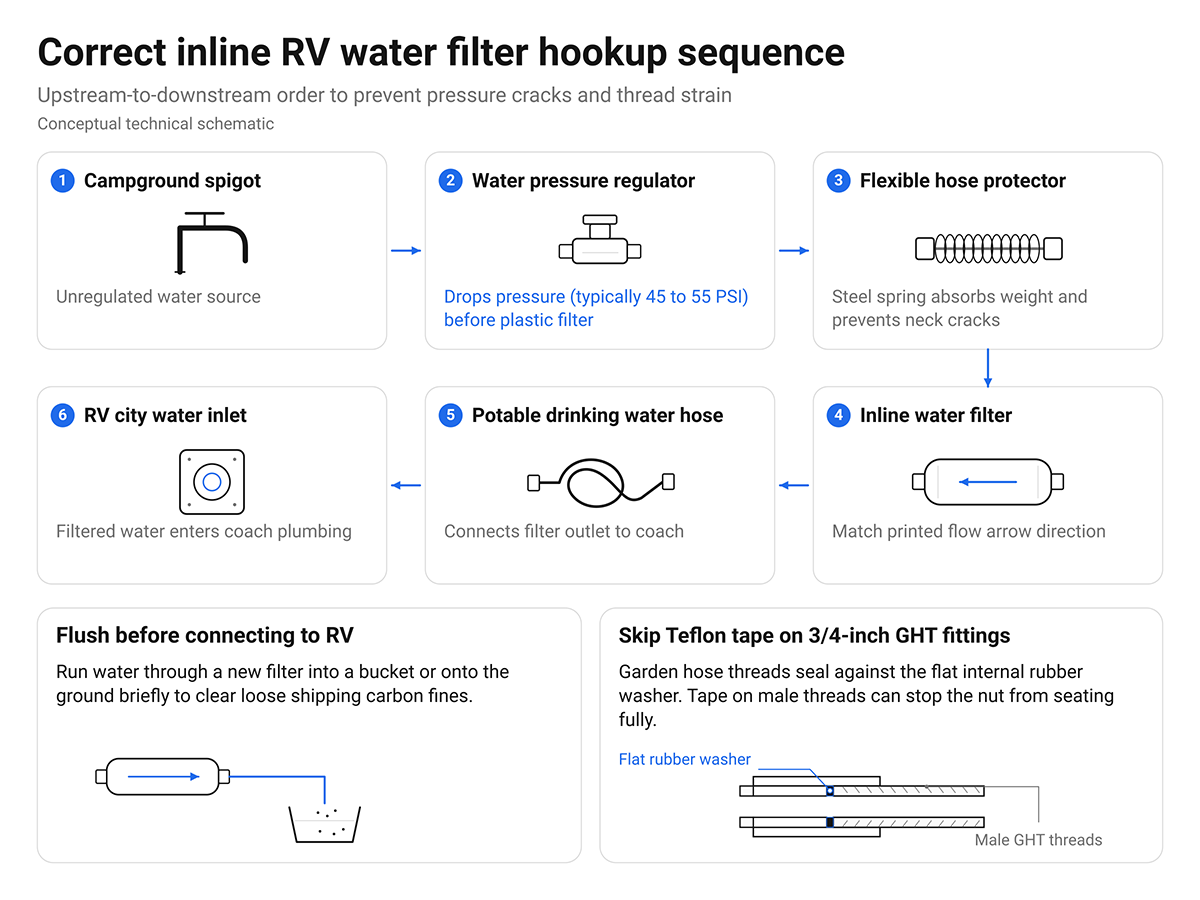
- Attach the water pressure regulator directly to the spigot: Regulating campground pressure (typically to 45 to 55 PSI) before the filter shields the plastic canister from high-pressure municipal surges.
- Thread the flexible steel spring hose protector onto the regulator outlet: Placing the flexible protector between the spigot/regulator assembly and the filter absorbs the hanging weight of the water-filled canister and prevents leverage from cracking the filter neck or stripping spigot threads.
- Connect the inline filter in the direction of the flow arrow, followed by your drinking hose: Flush a new filter into a bucket or onto the ground briefly before connecting to your RV inlet to clear loose carbon fines from shipping.
- Skip Teflon tape on garden hose threads: Standard 3/4-inch garden hose thread (GHT) fittings seal by compressing a flat rubber washer against the mating face, not by wedging tapered pipe threads. Wrapping Teflon tape around male GHT threads can prevent the coupling nut from seating fully against the rubber washer and cause leaks.
When Should You Choose a Multi-Stage Canister System Instead?
Step up from a single inline hose filter to a multi-stage canister system when your camping routine exceeds the physical limits of a single disposable cartridge:
Heavy-duty multi-stage canister systems are what that step up looks like in practice, and our guide to the 10 best multi-stage RV water filter systems compares the dual and triple stands.
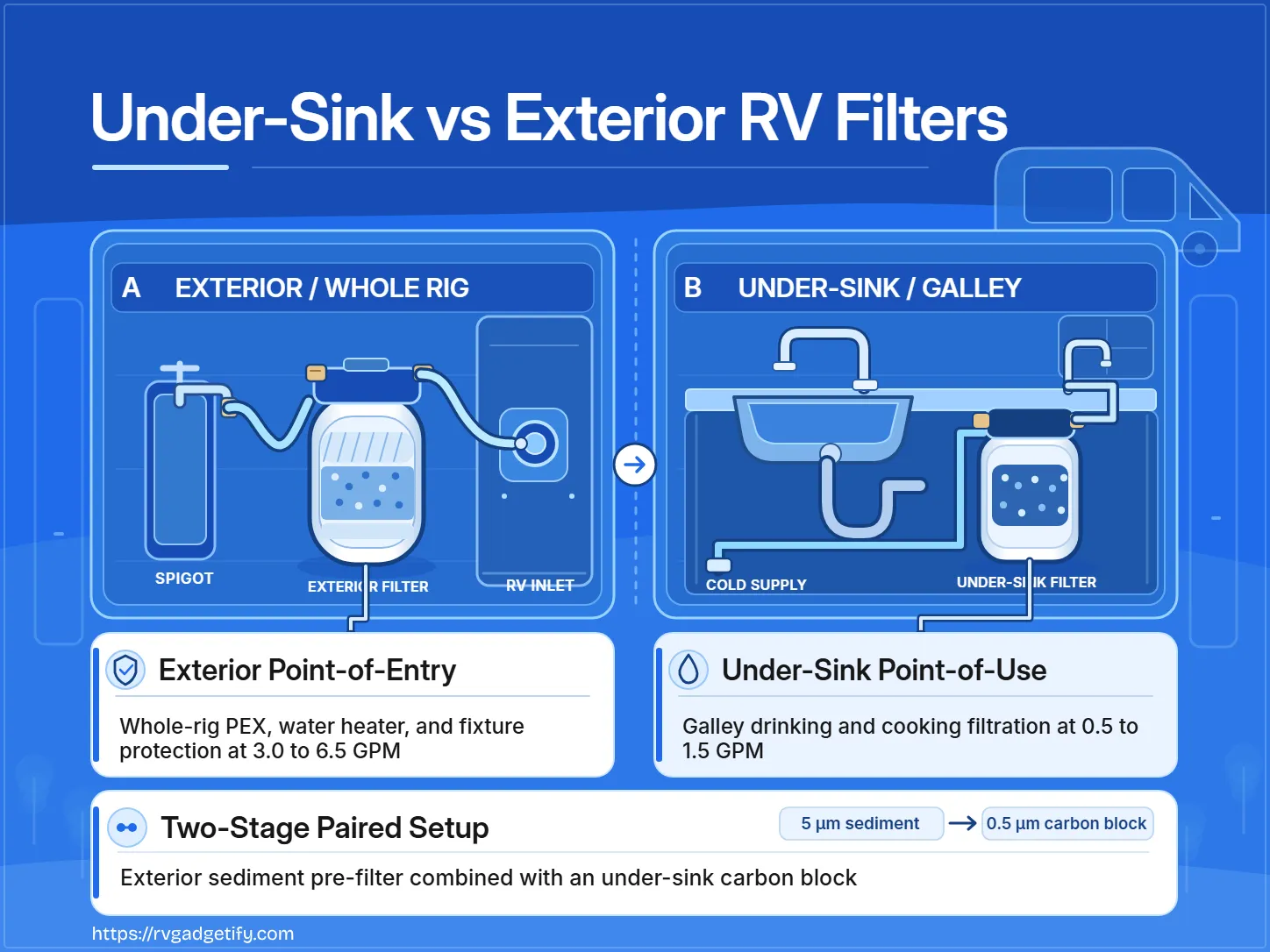
- High-sediment well or surface hookups: In silty campground water, a single inline cylinder has no upstream pre-filter to catch heavy sand and rust before it blinds the main carbon media. Multi-stage canister stands use a dedicated Stage 1 sediment cartridge to protect the finer Stage 2 carbon block.
- High multi-fixture flow demand: While top inline units peak around 3.0 to 3.5 GPM when clean, multi-stage canisters using 2.5 in x 10 in drop-in cartridges sustain 4.0 to 5.0+ GPM across multiple open faucets.
- Verified sub-micron or cyst protection: When camping on untreated water where protozoan cysts (Giardia and Cryptosporidium) are a concern, multi-stage canister housings let you install replaceable 0.5-micron absolute carbon blocks certified under NSF/ANSI Standard 53 behind a protective sediment stage.
Actionable Conclusion
Before ordering an inline filter, identify your primary water source and trip length:
- For weekend and seasonal stays on chlorinated city water: Pick the Camco TastePURE 40043 for a simple single filter, the Waterdrop or AQUACREST for NSF/ANSI 42 and 372 certification, or the Hourleey or Kohree 2-pack for a full-season supply.
- For finer silt control or verified 3.5 GPM flow at 50 PSI: Choose the 1-micron CLEAR2O CRV2006 (or the 5-micron CLEAR2O CRV1005 for moderate silt) or the pressure-specified SpiroPure SP-RV100.
- For multi-month or full-time stays: Select the Hydro Life Camco HL-200 (52141) for catalytic carbon chloramine reduction and an up-to-8,000-gallon rating, and always install your filter downstream of a pressure regulator with a flexible hose protector.
Frequently Asked Questions
What is an inline RV water filter?
An inline RV water filter is a sealed, single-stage cylinder with standard 3/4-inch garden hose threads that connects between a campground water spigot and your RV fresh-water drinking hose.
Do inline RV water filters remove Giardia and Cryptosporidium cysts?
Standard 20-micron inline GAC filters do not trap biological cysts. A 1-micron solid carbon block (such as the CLEAR2O CRV2006) physically filters down to 1 micron to target cyst-sized particles, but verified biological cyst removal on untreated water requires a filter independently tested and certified for cyst reduction (such as under NSF/ANSI Standard 53).
Do inline RV water filters soften hard water?
No. Neither GAC/KDF-55 nor solid carbon block inline filters remove dissolved hardness minerals (calcium and magnesium) or lower total dissolved solids (TDS). Softening requires an ion-exchange RV water softener.
How often should an inline RV water filter be replaced?
Most disposable inline RV water filters should be replaced every 3 months or once per camping season (around 1,000 to 2,000 gallons where specified), or sooner if sediment restricts water flow or chlorine taste returns.
Which inline RV water filter has the highest rated gallon capacity?
The Hydro Life Camco HL-200 External Filter Kit (52141) carries the highest stated capacity in this guide, rated for up to 8,000 gallons.
Do inline RV water filters reduce chlorine taste and odor?
Yes. All 10 models use activated carbon (standard GAC, coconut-shell GAC, catalytic carbon, or solid carbon block) to reduce chlorine taste and odor, with the Waterdrop and AQUACREST models carrying NSF/ANSI Standard 42 certification for aesthetic chlorine reduction.
Which inline RV water filters publish specific GPM flow rates for shower use?
Four models publish GPM specifications: the CLEAR2O CRV2006 (3.5 GPM at 50 PSI), SpiroPure SP-RV100 (2.5 to 3.5 GPM at 45 to 55 PSI), Waterdrop (3.0 GPM), and AQUACREST (2.5 to 3.0 GPM).
Should you use a water pressure regulator with an inline RV water filter?
Yes. Always attach a water pressure regulator at the spigot upstream of the inline filter so high campground water pressure cannot crack the plastic filter housing.
Should Teflon tape be used on inline RV water filter threads?
No. Do not use Teflon tape on 3/4-inch garden hose threads (GHT); the seal is formed by compressing the internal rubber hose washer, and tape on the threads can prevent the coupling from tightening fully against the washer.
Which inline RV water filter is best for a small camper van or pop-up?
The EcoBlueLife RV Water Filter measures approximately 11 inches long and weighs under 1 pound dry, making it a compact choice for rigs with limited storage space.
Sources:
- Use of Lead Free Pipes, Fittings, Fixtures, Solder, and Flux for Drinking Water – U.S. Environmental Protection Agency, Safe Drinking Water Act Lead-Free Rule and 0.25% weighted average lead statutory requirement.
- How to Identify Lead Free Certified Drinking Water Products – U.S. Environmental Protection Agency Office of Ground Water and Drinking Water, PDF guidance on third-party certification marks, NSF/ANSI 372 testing, and plumbing product labeling.
- ASSE International Plumbing Product Standards – ASSE International, performance requirements and test methods for backflow prevention and water filtration system assemblies.
- Home Water Systems: Backflow Prevention Devices – Colorado State University Extension, technical guidance on cross-connection control, plumbing backflow protection, and filtration system integrity.