
Choose standard mesh cation resin for typical municipal campground hookups and water sources with low dissolved iron (below 2 to 3 PPM). It delivers the same hardness-removal capacity per cubic foot as fine mesh resin while maintaining lower pressure drop and fitting standard RV softener distributor baskets. Choose fine mesh cation resin only when you regularly treat well water with moderate to severe dissolved clear-water iron (3 to 10 PPM), your RV water pressure stays at or above 30 PSI, and your softener tank is equipped with a fine-slotted (0.006 to 0.008 inch) distributor basket that prevents smaller beads from washing into your RV plumbing.
Quick Summary
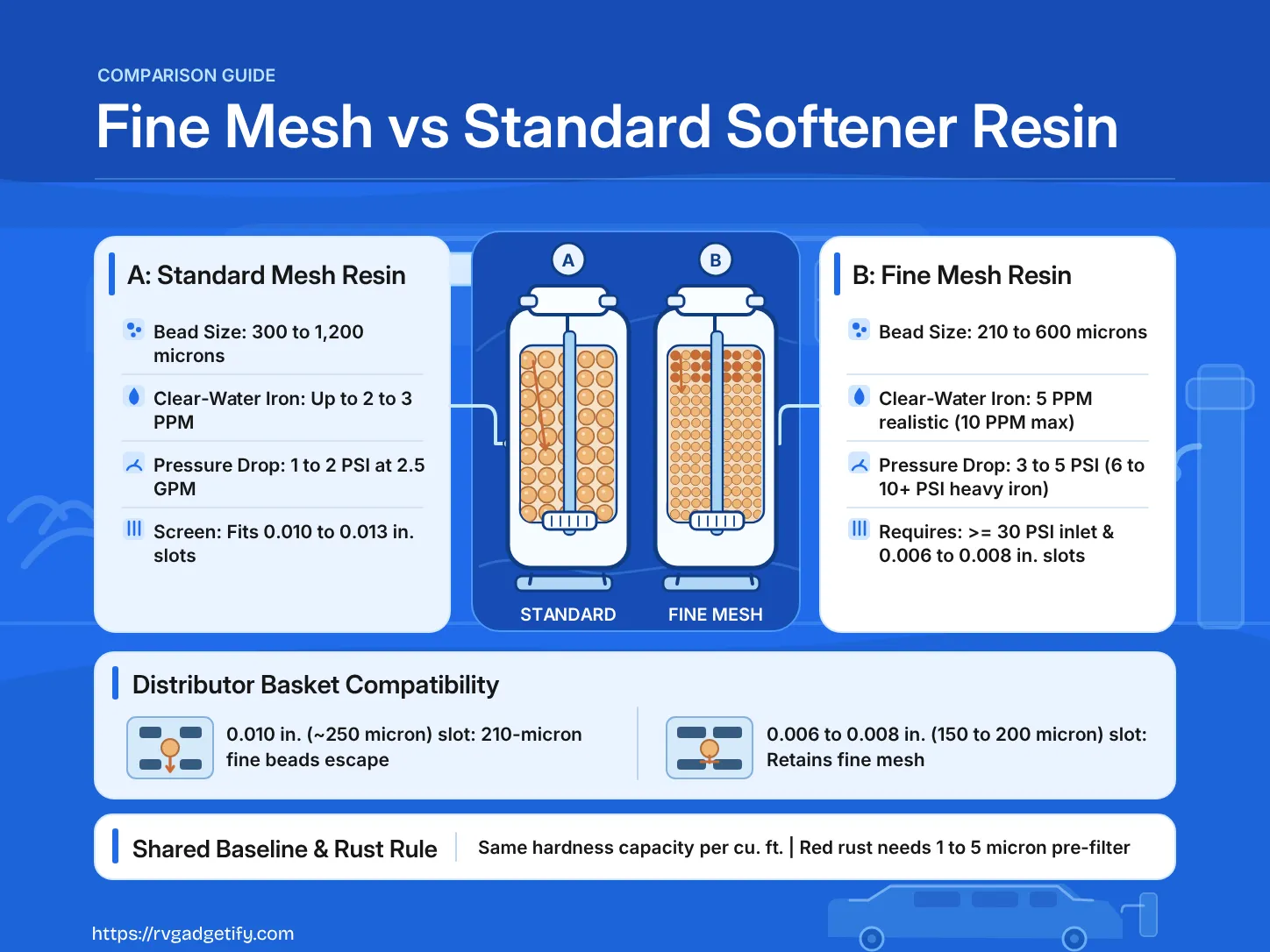
- Bead Size Difference: Standard mesh resin beads measure 300 to 1,200 microns in diameter, while fine mesh beads measure 210 to 600 microns (roughly half the size).
- Identical Hardness Capacity: Both grades share the same volumetric ion-exchange capacity per cubic foot. Fine mesh resin does not soften more gallons of hard water per recharge; its smaller beads simply provide more surface area for faster ion exchange and easier iron stripping during regeneration.
- Clear-Water Iron Limits: Standard resin handles up to 2 to 3 PPM of dissolved ferrous (clear-water) iron. Fine mesh resin is rated up to a 10 PPM ceiling under optimal conditions, with 5 PPM serving as a realistic field expectation.
- Pressure Drop Penalty: Tightly packed fine mesh beads restrict water flow more than standard beads, adding roughly 3 to 5 PSI of pressure loss in moderate iron and 6 to 10+ PSI across compact RV tanks under heavy iron loading. Do not use fine mesh resin if incoming water pressure is below 30 PSI.
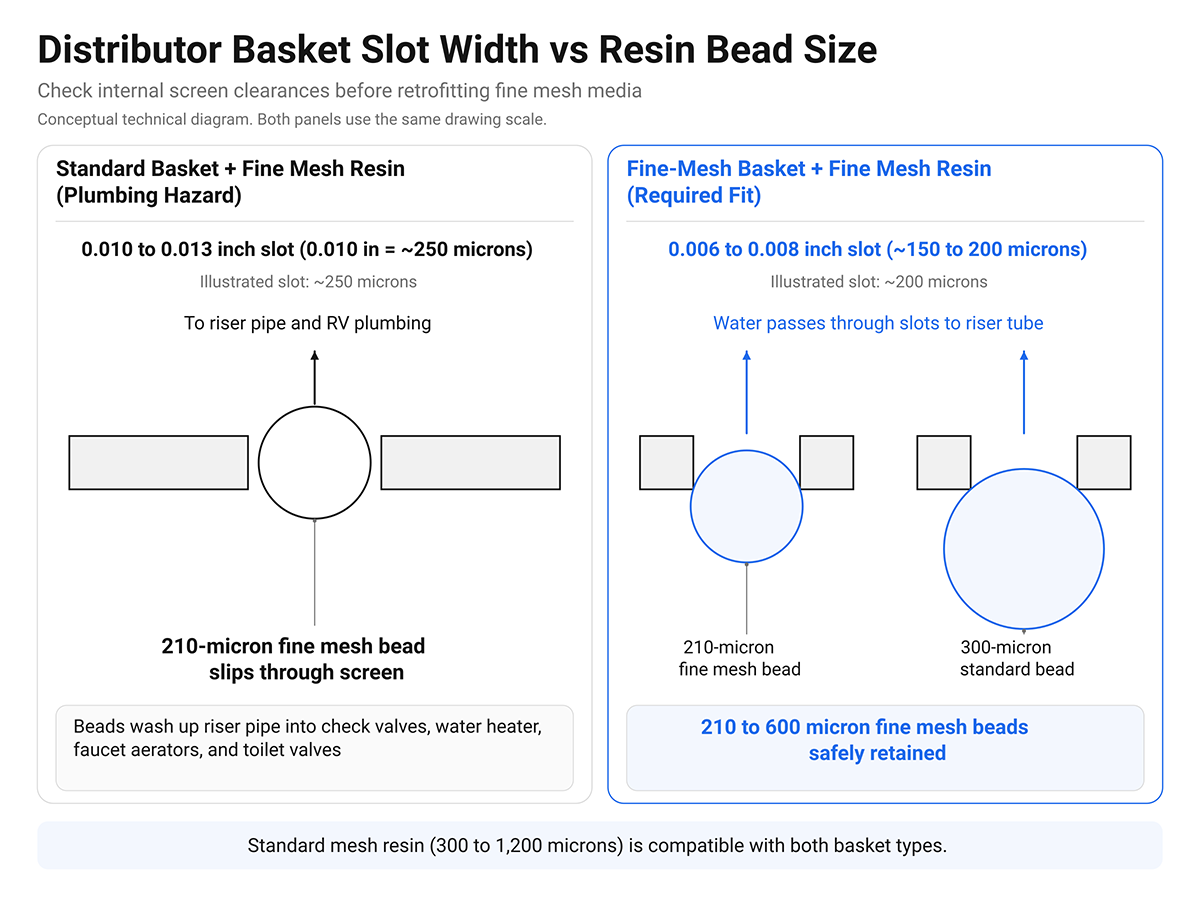
- Distributor Basket Requirement: Fine mesh resin requires a distributor basket with 0.006 to 0.008 inch slots. Pouring fine mesh resin into a tank with a standard 0.010 to 0.013 inch basket allows 210-micron beads to slip through the screen and clog RV fixtures.
- Red-Water Rust Requires Pre-Filtration: Neither resin grade filters out visible red rust flakes, ferric iron precipitate, or silt. Always install a 1 to 5 micron sediment pre-filter upstream when particulate rust is present.
Side-by-Side Comparison: Standard Mesh vs Fine Mesh Resin
Standard and fine mesh resins share the same strong-acid sulfonic exchange chemistry. A cubic foot of fine mesh media holds the same total hardness grain capacity as a cubic foot of standard media. The practical trade-offs come entirely from bead geometry and packing density.
| Attribute | Standard Mesh Cation Resin | Fine Mesh Cation Resin |
|---|---|---|
| Bead diameter range | 300 to 1,200 microns | 210 to 600 microns |
| Volumetric hardness capacity | Standard baseline (equivalent per cubic foot) | Equivalent to standard mesh per cubic foot |
| Ion-exchange kinetics | Standard diffusion rate | Higher surface area per liter; faster surface kinetics |
| Dissolved clear-water (ferrous) iron limit | Up to 2 to 3 PPM (with periodic acid resin cleaner) | Up to 5 PPM realistic; 10 PPM maximum under optimal conditions |
| Estimated pressure drop across RV tank | 1 to 2 PSI at 2.5 GPM on clean municipal water | 3 to 5 PSI in moderate iron; 6 to 10+ PSI under heavy iron loading |
| Minimum recommended RV inlet pressure | Standard RV operating pressure | At least 30 PSI required |
| Required distributor screen slot width | 0.010 to 0.013 inch slots (compatible with fine slots too) | 0.006 to 0.008 inch slots mandatory |
| Insoluble ferric iron / rust flakes | Not compatible (requires 1 to 5 micron pre-filter) | Not compatible (requires 1 to 5 micron pre-filter) |
Why Bead Geometry Matters for Iron
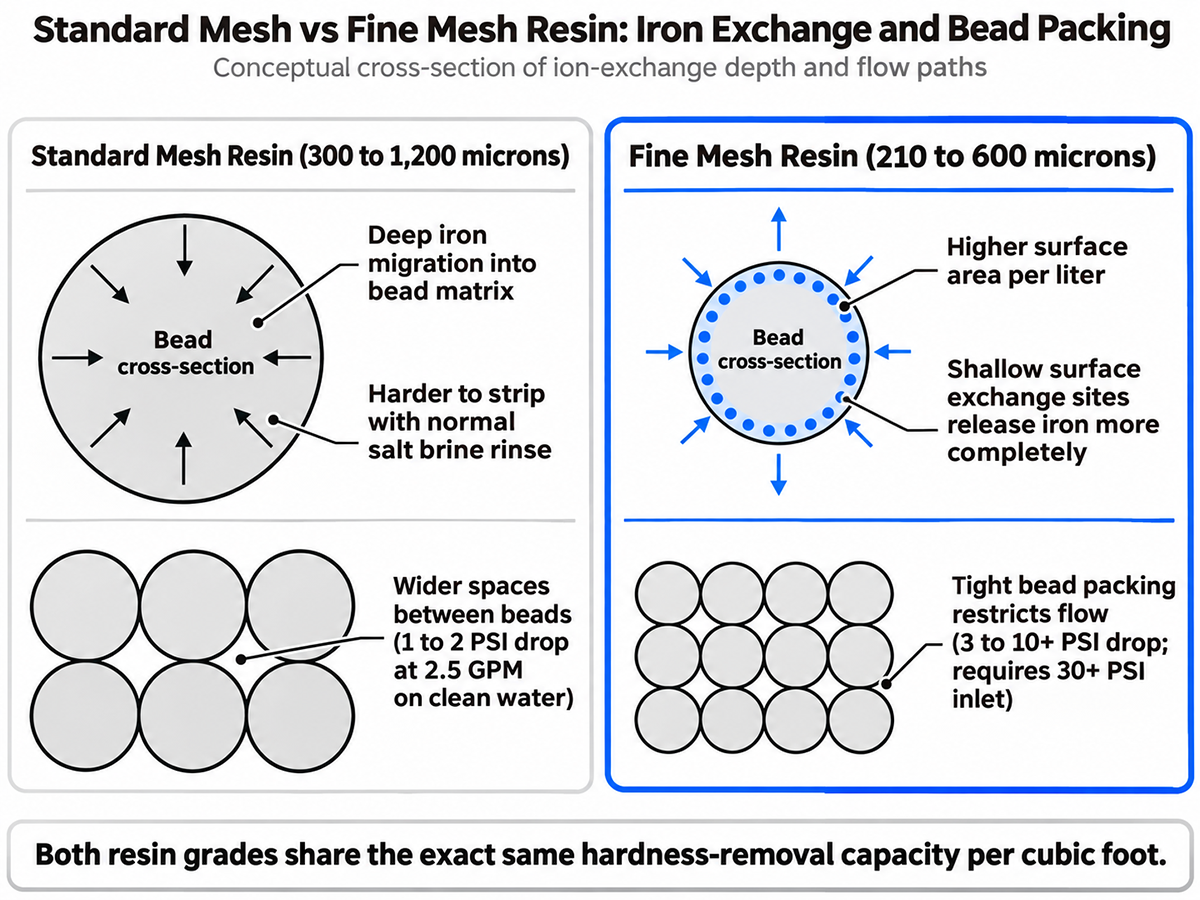
When dissolved ferrous iron exchanges onto a resin bead, it binds tightly to the exchange sites. On larger standard beads (300 to 1,200 microns), iron migrates deeper into the bead matrix and resists letting go during a normal salt brine rinse. Because fine mesh beads (210 to 600 microns) have a higher surface-area-to-volume ratio, the active exchange sites sit closer to the outer surface of each bead. That shallow depth allows fine mesh resin to capture dissolved iron rapidly as water passes through a compact RV tank and release that iron more completely when flushed with salt brine and resin cleaner.
Scenario Decision Matrix: Iron Levels, Flow Impact, and Maintenance
Use your water source’s iron test results and your RV’s water pressure to select the appropriate media and maintenance schedule:
RVGadgetify / Water Systems
RV Water Softener Resin & Iron Compatibility Selector
Match your dissolved iron reading, visible rust conditions, inlet pressure, and distributor basket to a suitable resin path. Fine mesh is never approved by this tool without both the correct basket and at least 30 PSI inlet pressure.
Pre-Filtration Requirement
Standard Mesh Cation Resin
300 to 1,200 micron beads
Fine Mesh Cation Resin
210 to 600 micron beads
Estimated Pressure Drop & Outlet PSI
Regeneration & Resin-Cleaner Schedule
Verify Selector Logic (Built-in Self-Tests)
Test the four article scenarios without changing your entries or results.
| Campground Water Scenario | Standard Resin Fit | Fine Mesh Resin Fit | Expected Flow & Pressure Impact | Required Maintenance Routine |
|---|---|---|---|---|
| Municipal or low-iron campground water (< 0.5 PPM iron) | Recommended | Not recommended (adds unnecessary flow restriction and cost) | 1 to 2 PSI drop at 2.5 GPM with standard resin | Standard table-salt regeneration (typically every 15 to 30 days depending on hardness and usage). |
| Moderate well water (1 to 3 PPM clear-water ferrous iron) | Acceptable (if cleaned monthly) | Effective (requires 0.006 to 0.008 in basket) | Minimal drop with standard resin; 3 to 5 PSI drop with fine mesh | Monthly preventative flush with a reducing resin-bed cleaner (such as citric acid) in addition to salt regeneration. |
| High-iron well water (3 to 10 PPM clear-water ferrous iron) | Not recommended (rapid iron fouling, capacity collapse, and fixture staining) | Recommended (up to 5 PPM realistic / 10 PPM optimal ceiling) | 6 to 10+ PSI loss across compact RV tank as iron loads the fine bed | Bi-weekly salt regenerations plus regular washes with a dedicated iron-reducing resin cleaner. |
| Visible red water, rust flakes, or silt (insoluble ferric iron) | Incompatible alone | Incompatible alone (tight bed traps rust and blinds quickly) | Severe bed plugging and pressure loss if unfiltered | Install a mandatory upstream 1 to 5 micron mechanical sediment pre-filter before the softener. |
Clear-Water (Ferrous) Iron vs Red-Water (Ferric) Rust
Before buying fine mesh resin to solve iron staining, identify which form of iron is in your water supply:
- Ferrous iron (clear-water iron): Found in deep, low-oxygen well water. The water looks completely clear coming out of the faucet, but leaves orange or rust-colored stains on RV sinks and toilets after exposure to air oxidizes the dissolved iron. Because ferrous iron exists as a positively charged dissolved ion, cation resin can capture it through ion exchange.
- Ferric iron (red-water iron) and rust flakes: Water that already looks yellow, orange, or rusty straight from the spigot contains insoluble ferric iron particles. Neither standard nor fine mesh resin is a mechanical particle filter. In fact, because fine mesh beads pack so tightly together, solid rust particles and silt will quickly blind the top of a fine mesh bed, choking off water flow and requiring careful, gentler backwashing. Always place a 1 to 5 micron sediment pre-filter cartridge upstream of the softener to trap ferric iron and silt before water enters the resin tank.
Flow Restriction and the 30 PSI Pressure Floor
The smaller spaces between 210-to-600-micron beads create higher hydraulic resistance than a bed of 300-to-1,200-micron standard beads. On low-iron municipal water where standard resin loses only 1 to 2 PSI at 2.5 GPM, switching to fine mesh sacrifices showerhead pressure and costs more upfront for zero softening benefit.
When treating 3 to 10 PPM iron in a compact portable RV tank, the combination of tight bead packing and accumulated iron can drop outlet pressure by 6 to 10+ PSI. Never install fine mesh resin if your campground or onboard pump system operates below 30 PSI, as the pressure drop across the resin bed can starve downstream RV appliances and fixtures.
Preventing Iron Fouling with Reducing Resin Cleaners
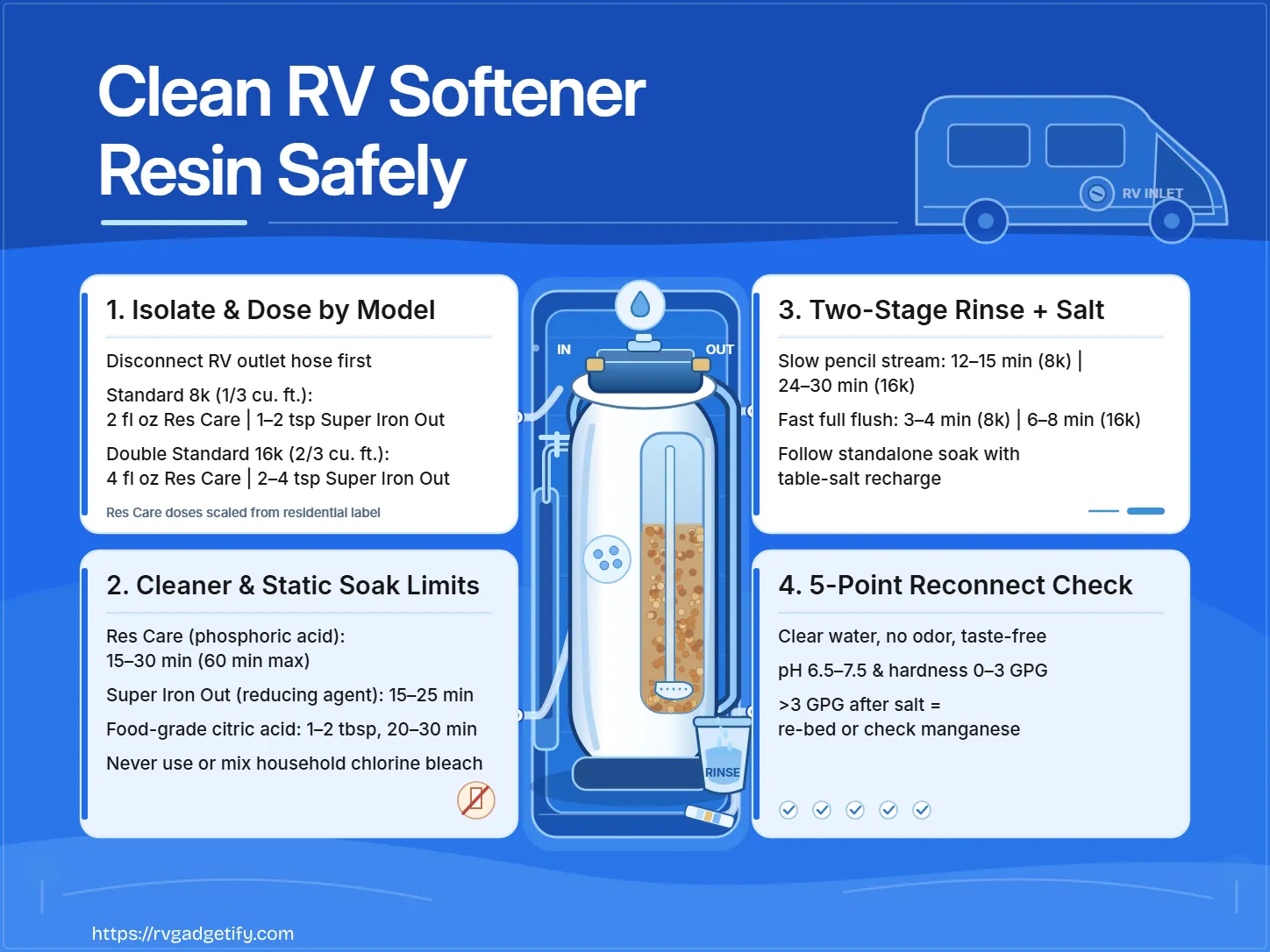
Sodium chloride (table salt) brine alone does not strip 100% of bound iron off cation resin, especially if dissolved iron contacts dissolved oxygen inside the tank and turns into insoluble ferric buildup. Over time, unstripped iron coats the beads, fosters iron bacteria/slime, and blocks calcium and magnesium exchange.
To prevent permanent iron fouling:
- In 1 to 3 PPM clear-water iron, flush either resin grade once a month with a reducing resin-bed cleaner (such as citric acid or a commercial sodium hydrosulfite/bisulfite softener cleaner) that chemically reduces and dissolves iron deposits so they rinse down the drain.
- In 3 to 10 PPM clear-water iron with fine mesh resin, regenerate with salt at least every two weeks and pair those recharges with dedicated iron-reducing cleaner washes.
Hardware Compatibility: Distributor Basket Slot Widths
The most critical mechanical check before buying fine mesh resin is inspecting the slot width on your softener’s internal distributor baskets (the top screen and bottom riser-tube strainer).
| Resin Grade | Standard Basket (0.010 to 0.013 Inch Slots) | Fine-Mesh Basket (0.006 to 0.008 Inch Slots) |
|---|---|---|
| Standard mesh resin (300 to 1,200 microns) | Compatible: 300-micron minimum beads cannot pass through 0.010-inch (~250-micron) slots. | Compatible: Retains all standard beads. |
| Fine mesh resin (210 to 600 microns) | Incompatible (Plumbing Hazard): Smallest 210-micron beads slip through 0.010-inch (~250-micron) slots into RV water lines. | Compatible (Required): 0.006 to 0.008 inch (~150 to 200 micron) slots safely retain 210-micron beads. |
Check Your Softener Screen Before Retrofitting
Most portable RV water softeners ship from the factory with standard mesh resin and a standard 0.010 to 0.013 inch bottom distributor basket. Because 0.010 inch equals roughly 250 microns, pouring 210-micron fine mesh beads into a standard tank without changing the basket allows the smallest beads to wash straight up the central riser pipe and into your RV’s check valves, water heater, faucet aerators, and toilet valves.
Before ordering fine mesh resin to re-bed an existing portable tank:
- Check your softener’s manual or contact the manufacturer to verify the factory distributor screen slot width.
- If the unit has a 0.010 inch screen, confirm whether a compatible 0.006 to 0.008 inch replacement distributor basket and riser assembly is available that matches your tank neck thread and riser pipe diameter. If you cannot verify or upgrade the screen to 0.006 to 0.008 inch slots, stick with standard mesh resin.
Frequently Asked Questions
Does fine mesh resin soften more gallons of hard water than standard resin?
No. A cubic foot of fine mesh resin has the exact same total hardness-exchange capacity as a cubic foot of standard resin. Fine mesh beads are smaller to provide more surface area for capturing and releasing dissolved iron, not to increase soft-water gallon yield between regenerations.
At what iron level should I switch from standard resin to fine mesh resin?
Consider fine mesh resin when dissolved clear-water (ferrous) iron consistently exceeds 2 to 3 PPM, provided your water pressure is at least 30 PSI and your tank has a 0.006 to 0.008 inch distributor basket. Below 2 to 3 PPM (and especially under 0.5 PPM on municipal water), standard mesh resin is the better choice because it restricts water flow far less.
Can fine mesh resin filter out visible red rust flakes?
No. Visible rust flakes and red-water coloring come from insoluble ferric iron particles, which cannot be removed by chemical ion exchange and will clog a tightly packed fine mesh bed. Always install a 1 to 5 micron sediment pre-filter upstream of your softener to trap solid rust and silt.
What happens if I put fine mesh resin into a tank with a standard 0.010-inch distributor screen?
The smallest fine mesh beads (down to 210 microns) will pass right through the 0.010-inch (roughly 250-micron) screen slots under water pressure, sending resin beads directly into your RV plumbing lines and clogging fixtures.
Can regular table salt regeneration keep iron from fouling the resin bed?
Not on its own when iron levels exceed 0.5 to 1 PPM. While salt brine strips some ferrous iron, a portion oxidizes on the beads and requires periodic washing with an acidic or reducing resin cleaner (such as citric acid) to prevent permanent iron fouling and capacity loss.