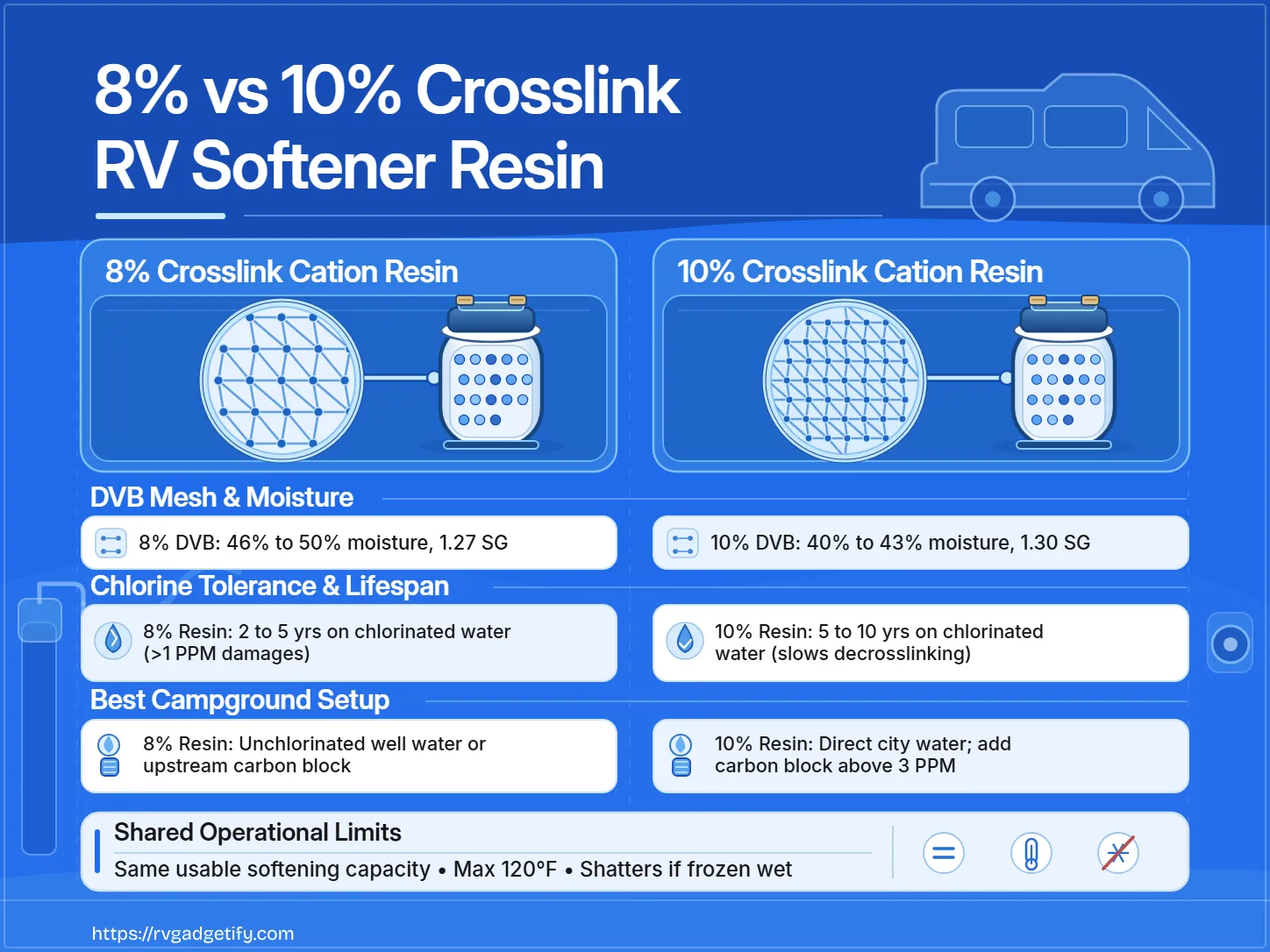

Choose 10% crosslink cation resin if your RV regularly connects to chlorinated campground or municipal water without a dedicated upstream carbon filter. Its denser polymer structure resists chlorine oxidation longer, reducing how often you have to empty and re-bed the tank. Choose 8% crosslink cation resin if you primarily camp on unchlorinated private well water, boondock using non-chlorinated water sources, or run an upstream carbon block pre-filter that strips chlorine before it reaches the softener. Because both grades deliver essentially the same usable softening capacity at standard salt doses, your choice comes down to oxidant durability and upfront media cost rather than soft-water gallon yield.
Quick Summary
- Chemical Difference: 8% resin uses 8% divinylbenzene (DVB) crosslinker by weight (46% to 50% moisture retention), while 10% resin uses 10% DVB (40% to 43% moisture retention) to form a tighter, denser polymer mesh.
- Softening Capacity: Both grades provide essentially equivalent usable ion-exchange capacity at normal regeneration salt doses. Size your RV softener by its total grain rating, not by the resin’s crosslink percentage.
- Chlorine Vulnerability: Free chlorine and other oxidants break DVB crosslinks, causing resin beads to absorb excess water, swell, turn mushy, restrict flow, and eventually fracture.
- Carbon Pre-Filtration: Placing a carbon block filter upstream removes chlorine before water enters the resin bed, allowing lower-cost 8% resin to last significantly longer on city water and protecting 10% resin when chlorine levels exceed 3 PPM (3 mg/L).
- Shared Freeze Limit: Neither resin grade survives freezing when wet. Water-saturated beads in both 8% and 10% resin beds can shatter if exposed to freezing temperatures.
What Crosslink Percentage Means and How 8% vs 10% Resin Compare
Standard RV water softeners use strong-acid cation-exchange resin beads made from polystyrene chains tied together by a crosslinking agent called divinylbenzene (DVB). The crosslink percentage refers to the percentage of DVB by weight used during manufacturing.
Increasing the DVB content from 8% to 10% builds more chemical bridges inside each microscopic bead. That tighter internal mesh leaves less room for water inside the bead (lowering moisture retention from 46%-50% down to 40%-43%), increases bead density, and gives the polymer network extra structural links to withstand chemical attack from oxidants like chlorine.
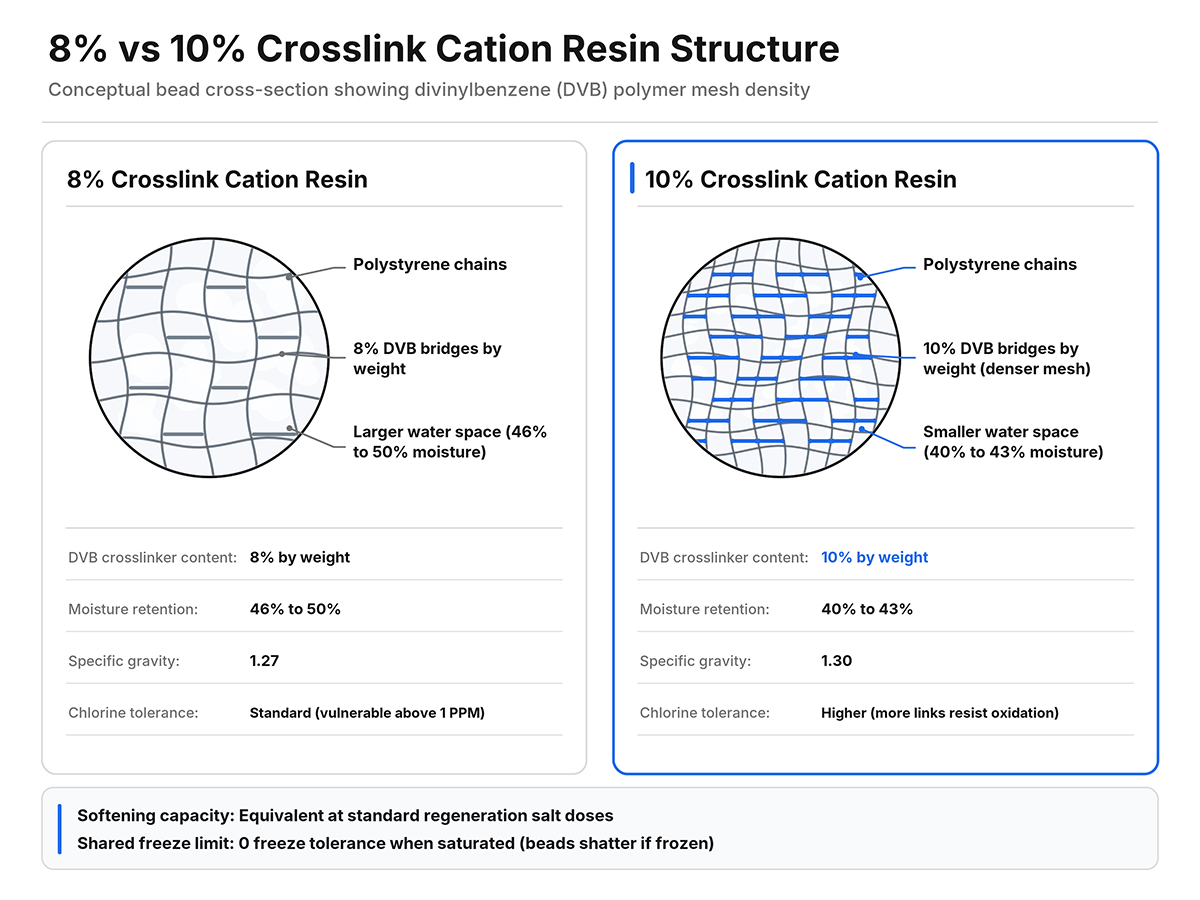
| Attribute | 8% Crosslink Cation Resin | 10% Crosslink Cation Resin |
|---|---|---|
| DVB crosslinker content | 8% by weight | 10% by weight |
| Moisture retention | 46% to 50% | 40% to 43% |
| Specific gravity | 1.27 | 1.30 |
| Usable softening capacity | Equivalent at standard household salt doses | Equivalent at standard household salt doses |
| Chlorine and oxidant resistance | Standard; vulnerable to oxidative breakdown above 1 PPM | Higher; denser polymer mesh slows oxidative decrosslinking |
| Estimated service life (chlorinated water) | Typically estimated at 2 to 5 years (condition-dependent) | Typically estimated at 5 to 10 years (condition-dependent) |
| Estimated service life (unchlorinated water) | Typically estimated at 5 to 10 years (or 6 to 8 years in industry baselines) | Comparable long-term service life when unexposed to oxidants |
| Upfront media cost | Lower purchase price | Higher upfront purchase price |
| Freeze tolerance | None when saturated (beads shatter if frozen) | None when saturated (beads shatter if frozen) |
Note: Physical properties (DVB content, moisture retention, and specific gravity) reflect standard resin specifications, whereas service-life ranges represent published industry estimates that vary with local chlorine levels, water temperature, and usage volume.
How Chlorine and Other Oxidants Degrade Softener Resin
Oxidants in municipal water, including free chlorine, chloramine, ozone, and peroxide, chemically attack and cleave the DVB crosslinks that hold each polystyrene bead rigid.
As oxidant exposure breaks those crosslinks (a process called decrosslinking), the resin bed degrades through a predictable sequence:
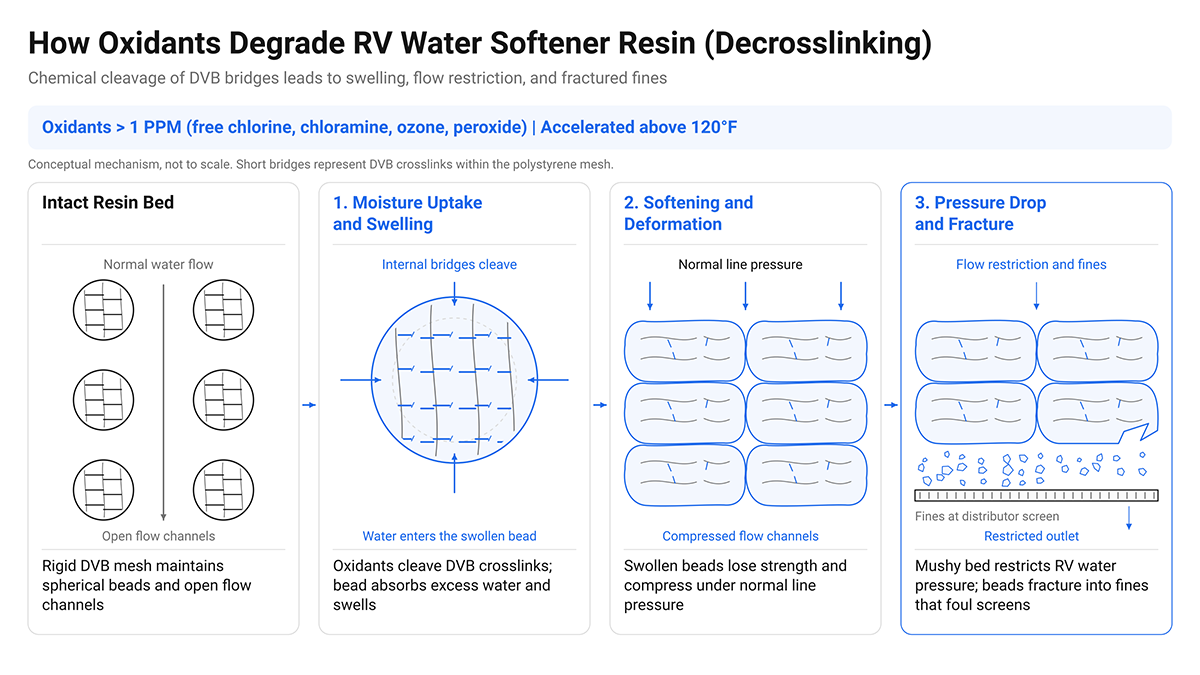
- Moisture uptake and swelling: With fewer internal crosslinks holding the polymer mesh together, the bead absorbs extra water and swells beyond its normal diameter.
- Softening and deformation: Swollen beads lose mechanical strength and compress against one another under normal line water pressure.
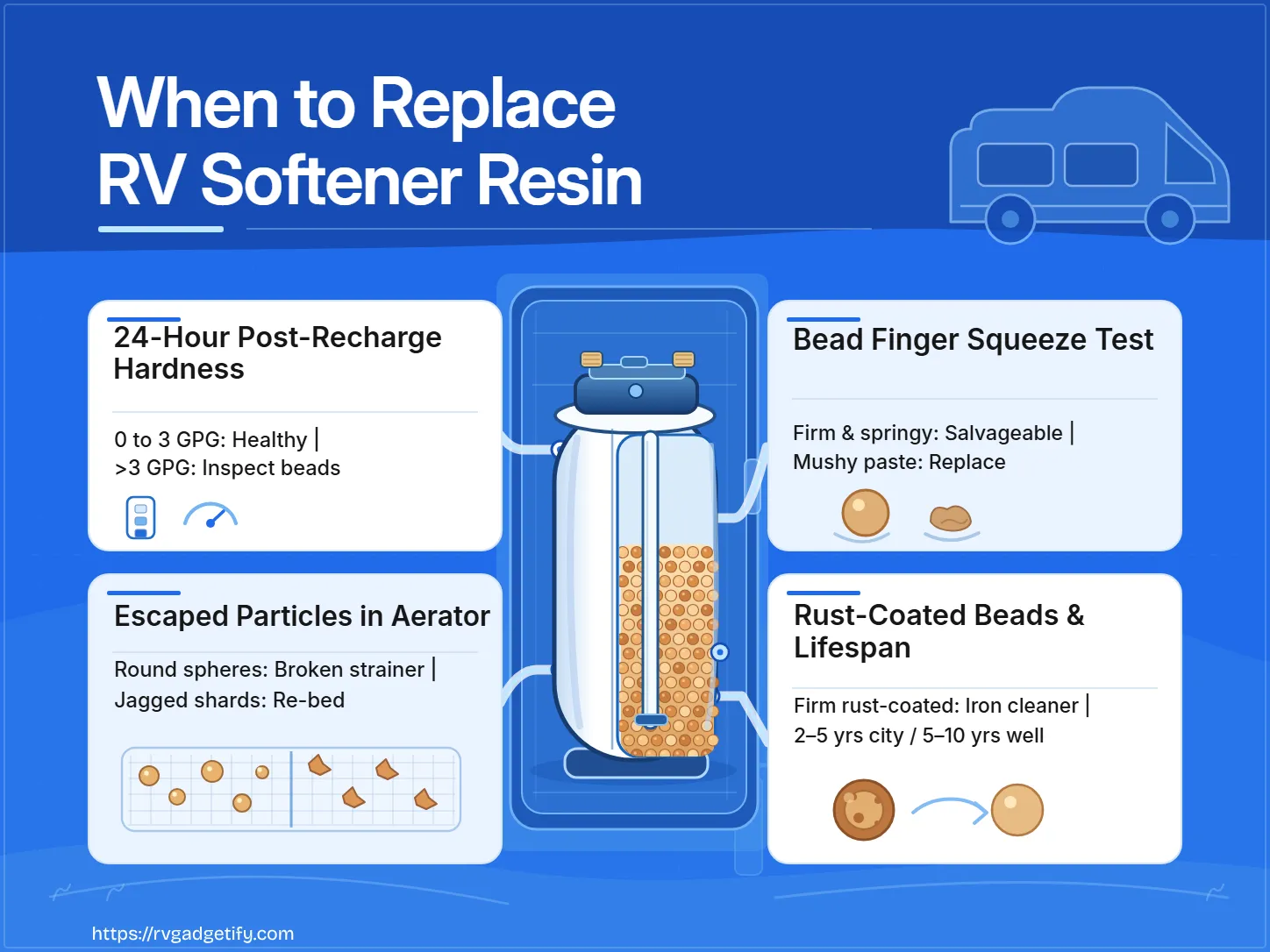
- Pressure drop and bead fracture: Compressed, mushy beads restrict water flow through the tank, causing a noticeable drop in fixture water pressure inside the RV. Eventually, the weakened beads fracture into fine fragments (fines) that can foul distributor screens or wash toward plumbing fixtures.
Published water-treatment guidance identifies oxidant concentrations above 1 part per million (1 PPM) as damaging to standard cation resin over time. According to an industry rule of thumb for 8% resin, every 1 PPM increase in oxidant levels above 1 PPM can cut a baseline 6-to-8-year life expectancy roughly in half. Chloramine degradation kinetics differ slightly from free chlorine, and incoming water temperatures above 120°F also accelerate chemical decrosslinking.
Campground Water Scenarios: Which Resin Grade Should You Buy?
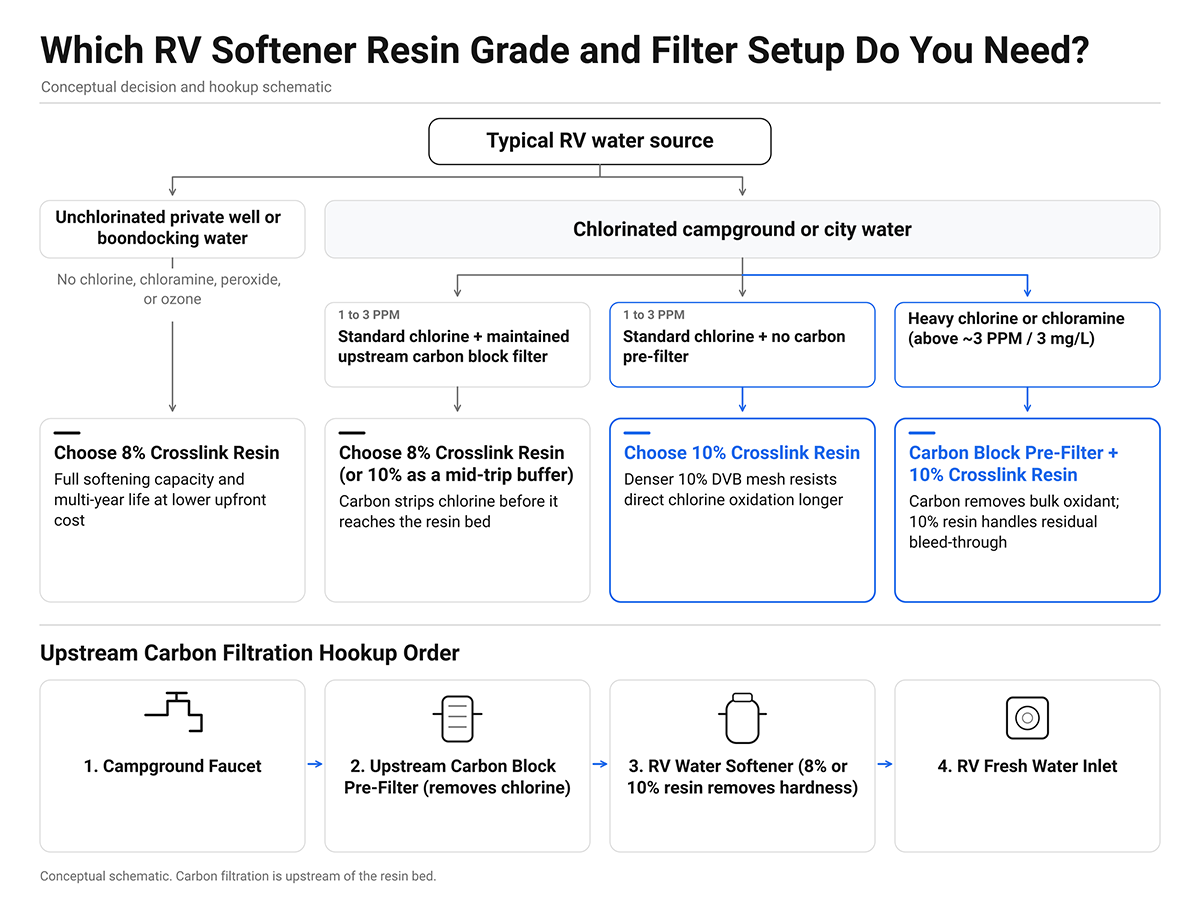
Because 10% crosslink resin costs more upfront without softening more gallons per salt recharge, its financial value comes strictly from avoiding premature resin replacement on chlorinated water. Match your typical camping style and filtration setup to the scenarios below:
| Campground Water Scenario | Recommended Setup | Practical Reasoning |
|---|---|---|
| Frequent chlorinated city or campground hookups without a carbon pre-filter | 10% crosslink resin | Higher DVB density slows chlorine decrosslinking, extending the interval between tank re-bedding projects. |
| Private well water or off-grid boondocking (non-chlorinated sources) | 8% crosslink resin | Without chlorine or chloramine attacking the DVB bonds, 8% resin achieves a long operational lifespan at a lower upfront cost. |
| Chlorinated city water with a maintained upstream carbon block pre-filter | 8% crosslink resin (or 10% for an added margin) | An upstream carbon block filter adsorbs chlorine before water reaches the softener tank, shielding standard 8% resin from oxidative damage. |
| Heavy chlorine or chloramine exposure (above roughly 3 PPM / 3 mg/L) | Upstream carbon block pre-filter + 10% crosslink resin | Above ~3 mg/L of chlorine, resin crosslinking alone cannot prevent long-term oxidation. Use carbon filtration to strip the bulk oxidant and 10% resin to handle any residual bleed-through. |
How Carbon Filtration Changes the Equation
An upstream carbon block pre-filter and 10% crosslink resin work as complementary defenses rather than mutually exclusive choices:
- Carbon filtration removes the oxidant upstream: By placing a chlorine-rated carbon block filter between the campground faucet and the water softener inlet, you reduce free chlorine before it ever touches the resin bed. If you replace that carbon cartridge on schedule, standard 8% resin can deliver years of reliable service on municipal hookups.
- 10% resin provides a chemical buffer: If you prefer not to carry an extra pre-filter canister, or if your carbon cartridge becomes exhausted mid-trip, 10% resin tolerates direct chlorine contact longer before swelling and losing pressure.
Shared Operational Limits: Capacity, Backwash, and Freezing
Before ordering replacement media, keep three operational constraints in mind that apply across both grades:
- Do not change your tank size or salt dose based on crosslink percentage: At standard regeneration salt doses, 8% and 10% resin provide essentially identical usable softening capacity. Buying 10% resin will not turn an 8,000-grain portable tank into a 10,000-grain tank, nor will it extend the gallons between salt regenerations.
- Account for higher bead density during backwash or flushing: Because 10% resin has a higher specific gravity (
1.30versus1.27for 8% resin), its heavier beads require a slightly higher backwash flow rate to lift and expand the bed by the same percentage when flushing out trapped sediment or resin fines. - Protect both resin grades from freezing and high heat: Crosslink percentage does not protect against freeze damage. Water trapped inside saturated resin beads expands when frozen, shattering both 8% and 10% beads alike. Always follow your softener manufacturer’s draining and winterization procedures before freezing weather hits, and never feed water hotter than 120°F through the tank.
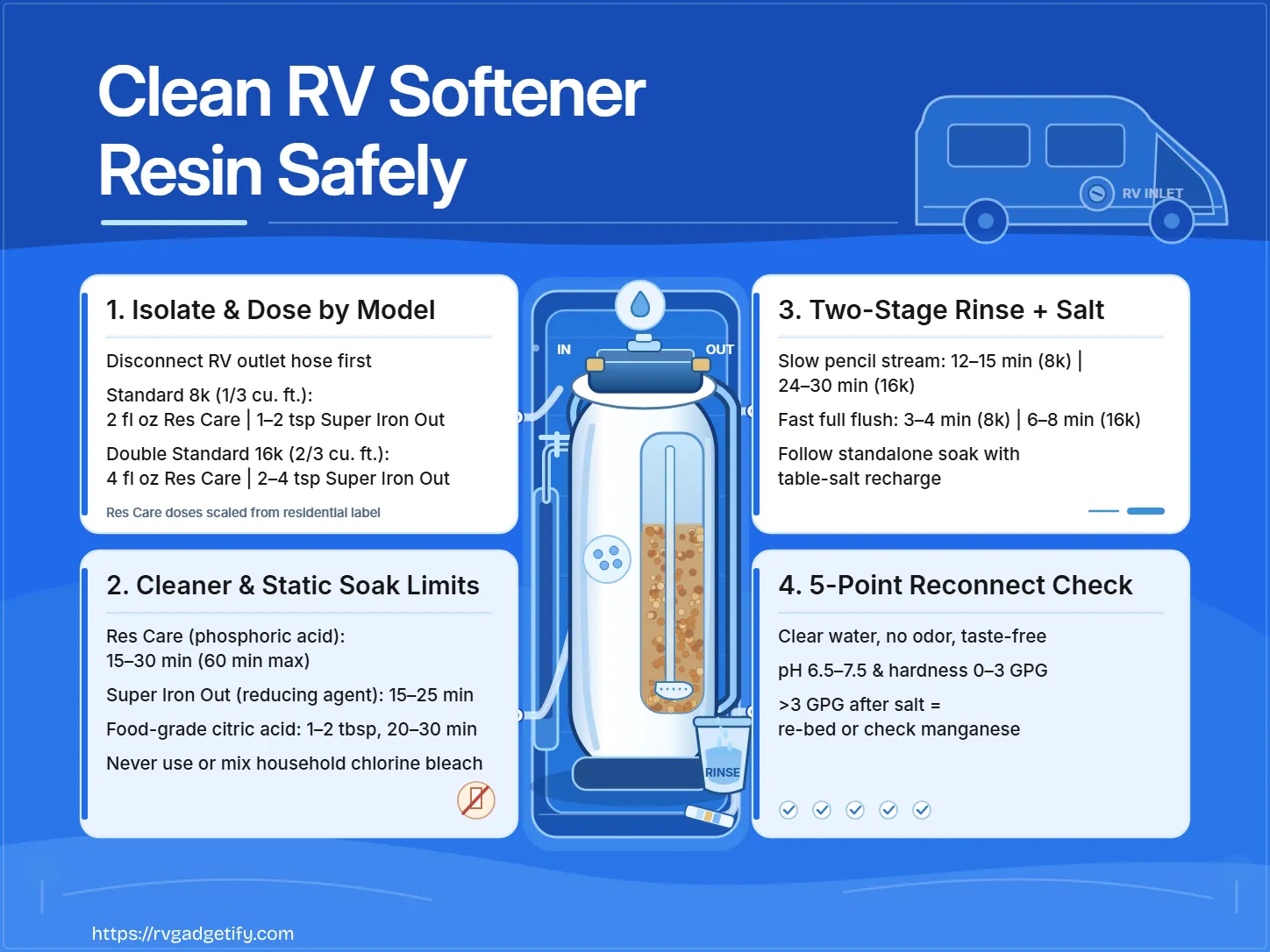
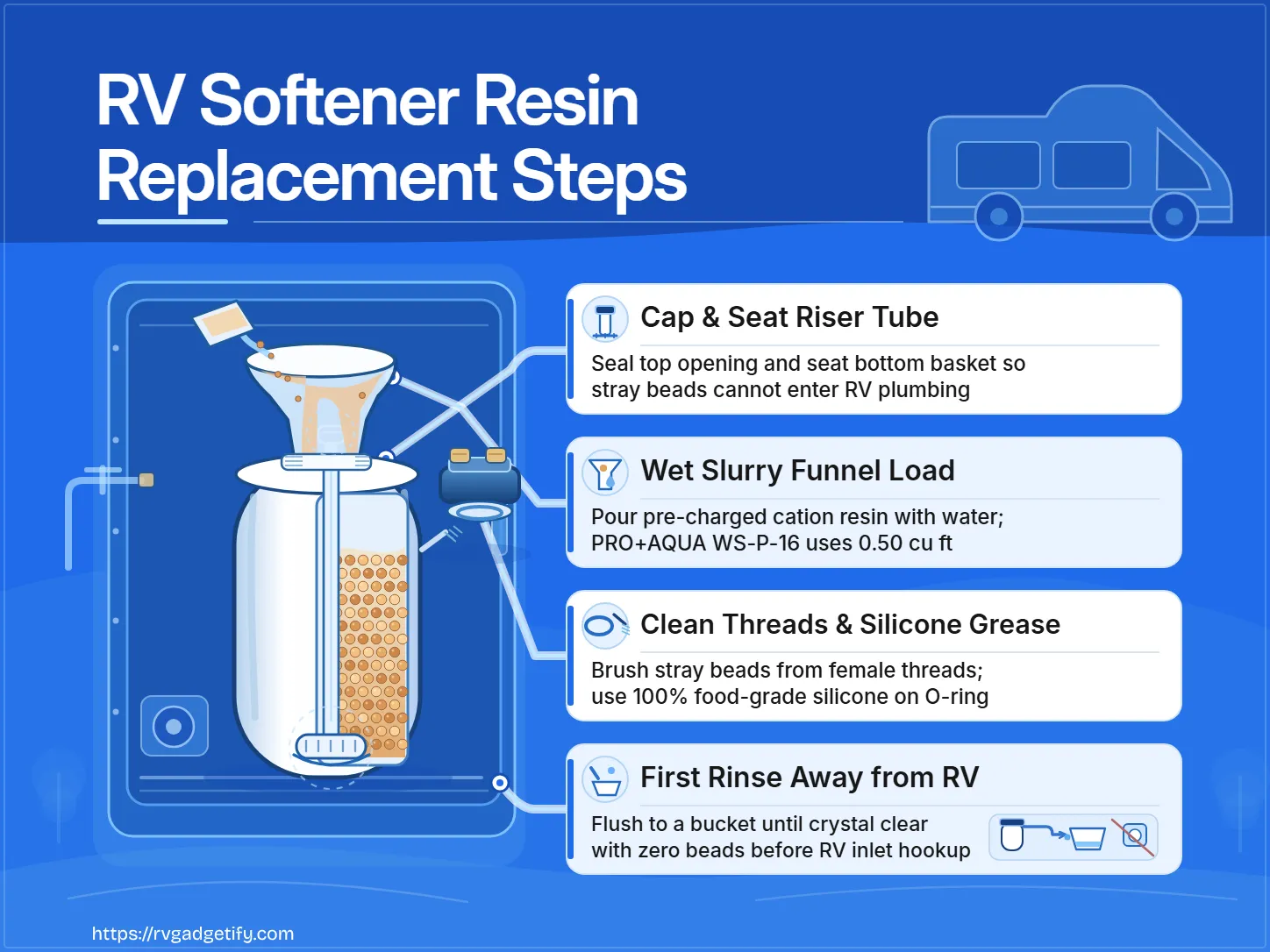
Once you select the right grade for your water source and verify the exact cubic-foot volume required by your softener’s manual, you can proceed with draining the old bed, capping the central distributor riser tube, and funneling in the fresh cation media.
Frequently Asked Questions
Does 10% crosslink resin soften more gallons of water per charge than 8% resin?
No. At typical regeneration salt doses, usable softening capacity is essentially equivalent between 8% and 10% cation resin. Upgrading to 10% resin extends how many years the beads survive chlorine exposure, not how many gallons you get between salt recharges.
Is 10% crosslink resin completely immune to chlorine damage?
No. While 10% resin resists oxidative breakdown much longer than 8% resin, continuous exposure to high oxidant levels (especially above 3 PPM / 3 mg/L) will eventually decrosslink and degrade any polystyrene cation resin. In high-chlorine areas, pair the softener with an upstream carbon block pre-filter.
Do I need 10% resin if I only use private well water?
Usually not. If your well water contains no free chlorine, chloramine, peroxide, or ozone, standard 8% crosslink resin delivers the same softening performance and a multi-year lifespan at a lower purchase price.
Does 10% crosslink resin survive freezing temperatures better than 8% resin?
No. Water-saturated resin beads in both 8% and 10% beds will fracture and shatter if allowed to freeze. Both grades require the exact same cold-weather draining and storage precautions.