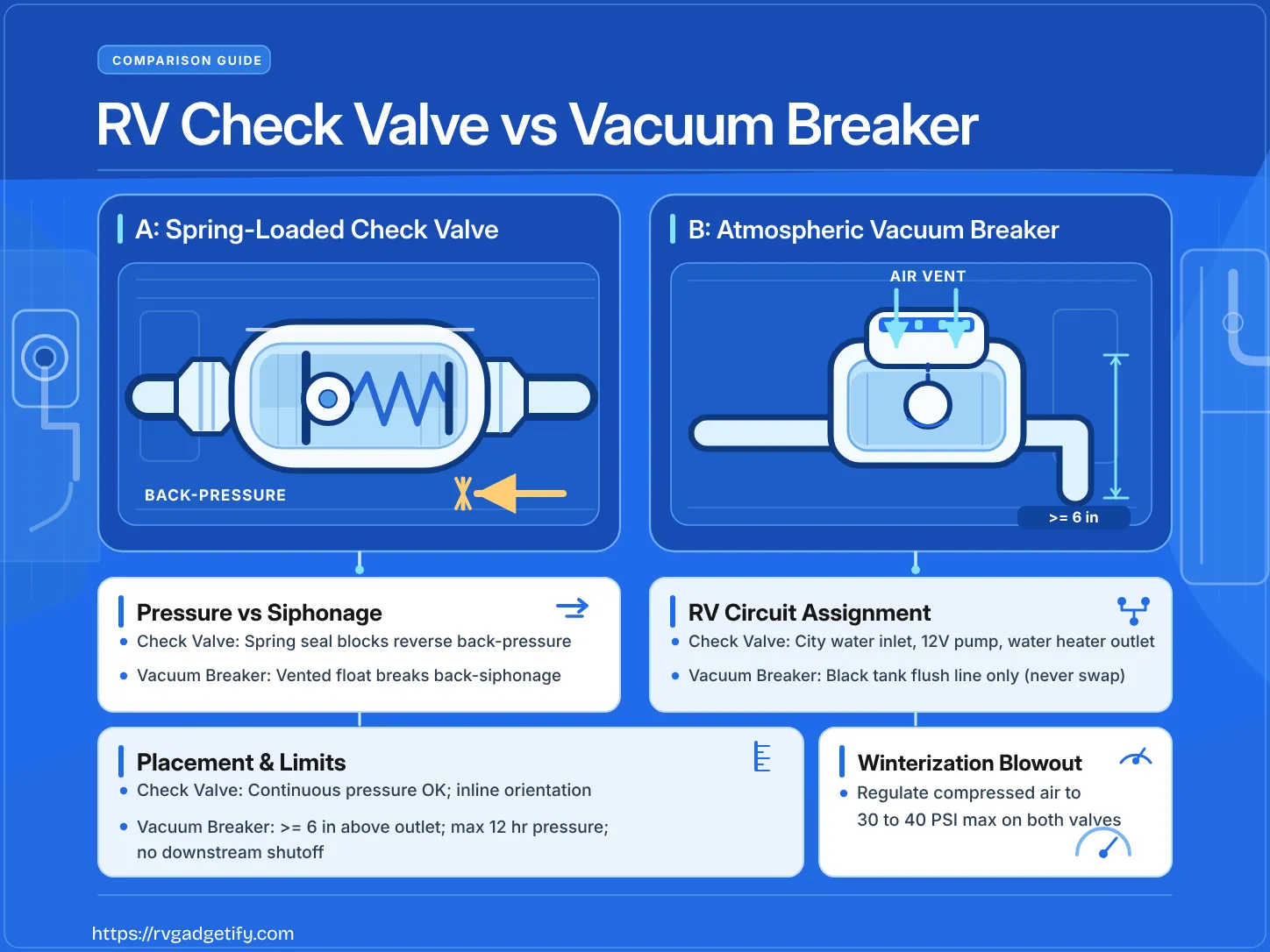

Spring-loaded check valves protect continuously pressurized RV water lines against back-pressure, while atmospheric vacuum breakers protect non-continuous lines against back-siphonage. The two devices are not interchangeable: a check valve uses a mechanical spring seal to hold against downstream pressure, whereas a vacuum breaker opens an atmospheric air vent when flow stops.
RVGadgetify compares these two backflow-prevention devices across RV fresh water, water heater, and black tank flush plumbing. Because back-pressure and back-siphonage create opposite hydraulic conditions, selecting the right valve depends on whether a circuit stays under continuous pressure or requires a vented air gap to break a siphon.
Key Takeaways
- Match the device to the hydraulic condition: Use spring-loaded check valves where downstream back-pressure is the risk, and use atmospheric vacuum breakers where negative supply pressure could cause back-siphonage.
- Keep vacuum breakers off continuously pressurized lines: An atmospheric vacuum breaker must not remain under continuous water pressure for more than 12 hours, and it cannot have a shutoff valve installed downstream.
- Never substitute a standard check valve on the black tank flush line: The black tank flush circuit requires an atmospheric vacuum breaker with a vented air gap to keep waste from siphoning into the potable water supply.
- Follow the 6-inch elevation requirement: Mount atmospheric vacuum breakers at least 6 inches above the highest downstream outlet or flood level rim.
- Limit winterization compressed air to 30 to 40 PSI: Regulate air blowout pressure to avoid cracking plastic vacuum breaker float poppets and internal check valve components.
How Do Back-Pressure and Back-Siphonage Differ in an RV?
Back-pressure and back-siphonage both reverse the normal direction of water flow, but they result from opposite pressure conditions in the plumbing system.
Back-pressure occurs when downstream pressure rises higher than supply pressure, pushing water backward toward the inlet. In an RV, this happens when the 12V demand pump pressurizes the interior plumbing and pushes water back against an unpressurized city water inlet, or when cold bypass water pushes toward the hot outlet of a water heater during winterization. A spring-loaded check valve is built to hold closed against that reverse push.
Back-siphonage occurs when negative supply pressure creates a vacuum in the supply line, pulling downstream liquid backward toward the water source. If campground water pressure drops while a hose is connected to the RV black tank flusher, a vacuum in the supply hose can draw black tank waste backward toward the drinking water system. Atmospheric vacuum breakers protect exclusively against back-siphonage by admitting air into the line to break the vacuum, and they cannot withstand downstream back-pressure.
How Do Spring-Loaded Check Valves and Atmospheric Vacuum Breakers Work?
Each device uses an internal mechanism built for its specific pressure environment.
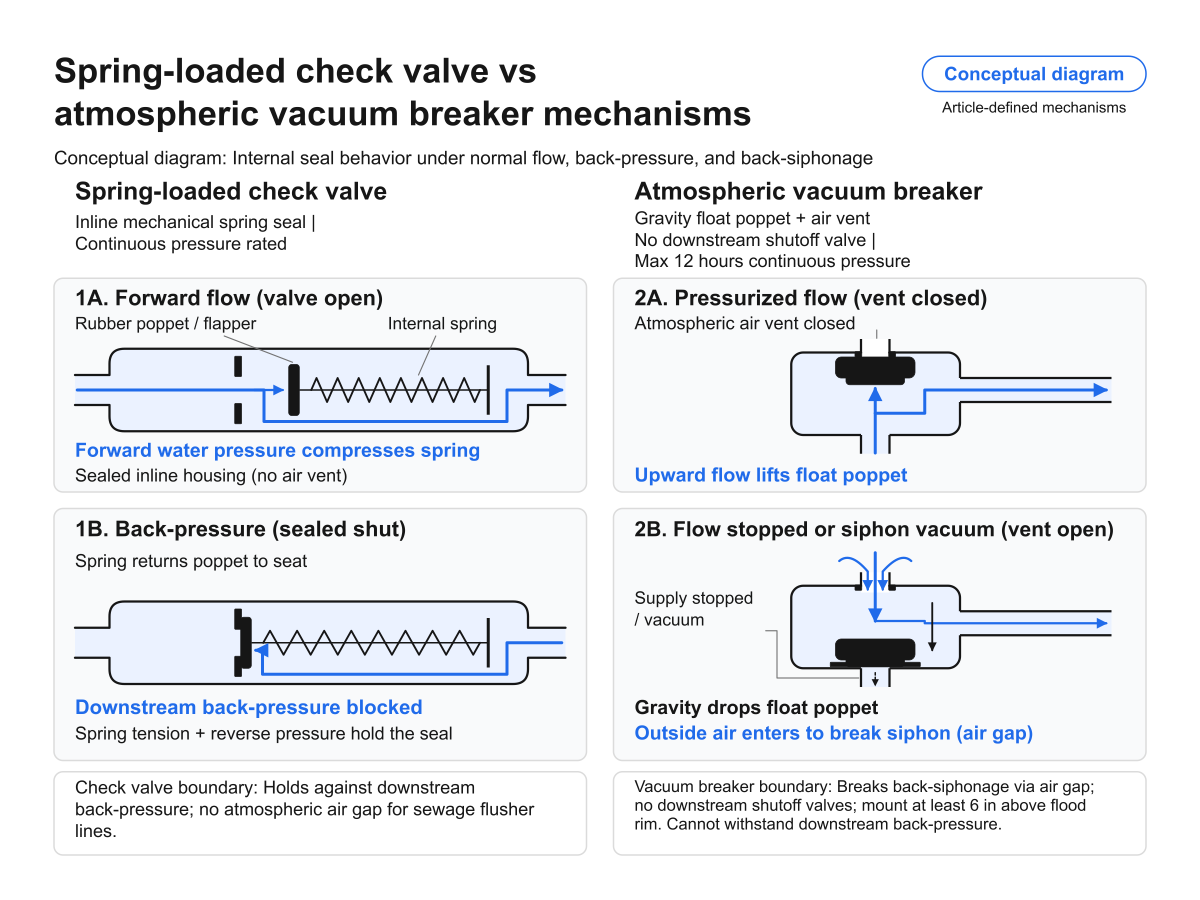
A spring-loaded check valve is an inline mechanical seal containing an internal spring and a rubber flapper or poppet. Forward water pressure compresses the spring to open the flow path, and the spring snaps the poppet shut as soon as forward flow stops or downstream pressure pushes backward. Because closure relies on spring tension rather than gravity or outside air, a check valve operates in continuously pressurized lines without venting water.
An atmospheric vacuum breaker contains a gravity-actuated float poppet inside a vented body. When water flows under normal supply pressure, the upward flow lifts the float poppet against an upper seal, closing the atmospheric vent so water travels downstream. When water flow stops, gravity drops the float poppet away from the vent, opening an air gap that admits air and breaks any siphon.
| Attribute | Spring-Loaded Check Valve | Atmospheric Vacuum Breaker |
|---|---|---|
| Internal mechanism | Internal spring with rubber flapper or poppet for one-way inline flow | Gravity-actuated float poppet with atmospheric air vent |
| Back-pressure resistance | Designed to hold against reverse downstream pressure | Cannot withstand downstream back-pressure |
| Back-siphonage protection | Sealed mechanical closure only; provides no atmospheric air gap | Protects exclusively against back-siphonage via a vented air gap |
| Continuous pressure tolerance | Operates continuously under system pressure | Cannot remain under continuous pressure for more than 12 hours; no downstream shutoff valves permitted |
| Elevation requirement | Operates independently of gravity; no flood-rim height requirement | Must be mounted at least 6 inches above the highest downstream outlet or flood level rim |
| Vent behavior | Closed inline housing; operates without venting or leaking | Vent opens when flow stops; can weep from vent holes if supply pressure is too low to seal the float |
Because a spring-loaded check valve is a sealed inline unit, it can stay pressurized inside an RV’s potable distribution lines. Conversely, an atmospheric vacuum breaker relies on an openable air vent and gravity drop, making it unsuitable for lines with downstream shutoff valves or continuous pump pressure.
Which Valve Fits Each RV Plumbing Circuit?
Every RV plumbing circuit calls for a specific device based on whether the line stays continuously pressurized or connects intermittently to a non-potable receptor. Fresh water distribution and water heater circuits use spring-loaded check valves, whereas the black tank flush circuit uses an atmospheric vacuum breaker.
| RV Circuit | Recommended Device | Role in the Circuit |
|---|---|---|
| City water inlet | Spring-loaded check valve | Stops water from spurting out the exterior city water connection when the 12V water pump runs |
| 12V water pump delivery | Spring-loaded check valve | Prevents pressurized city water from pushing backward through the pump into the fresh water holding tank |
| Water heater hot outlet | Spring-loaded check valve | Prevents RV antifreeze from back-feeding into the water heater tank during winterization |
| Black tank flush line | Atmospheric vacuum breaker | Prevents black tank waste from siphoning back through the flusher hose into the drinking water supply |
The two valve types complement each other across separate circuits and must not be swapped. A standard inline check valve must never replace the atmospheric vacuum breaker on a black tank flush line, because sewage flusher protection requires an atmospheric air gap rather than a sealed mechanical spring alone.
Symptom triage also helps isolate which valve needs attention:
- Fresh water tank filling on its own while connected to campground city water: Points to a stuck-open pump check valve, which allows pressurized city water to push backward through the 12V pump into the fresh water holding tank.
- Water weeping or spurting from vent holes inside an RV cabinet during tank flushing: Points to an atmospheric vacuum breaker operating below its minimum sealing pressure, where incoming flow cannot lift the float poppet firmly against the air vent.
Where Do Placement, Elevation, and Flow Direction Matter?
Correct location and flow orientation determine whether each valve can seal as designed:
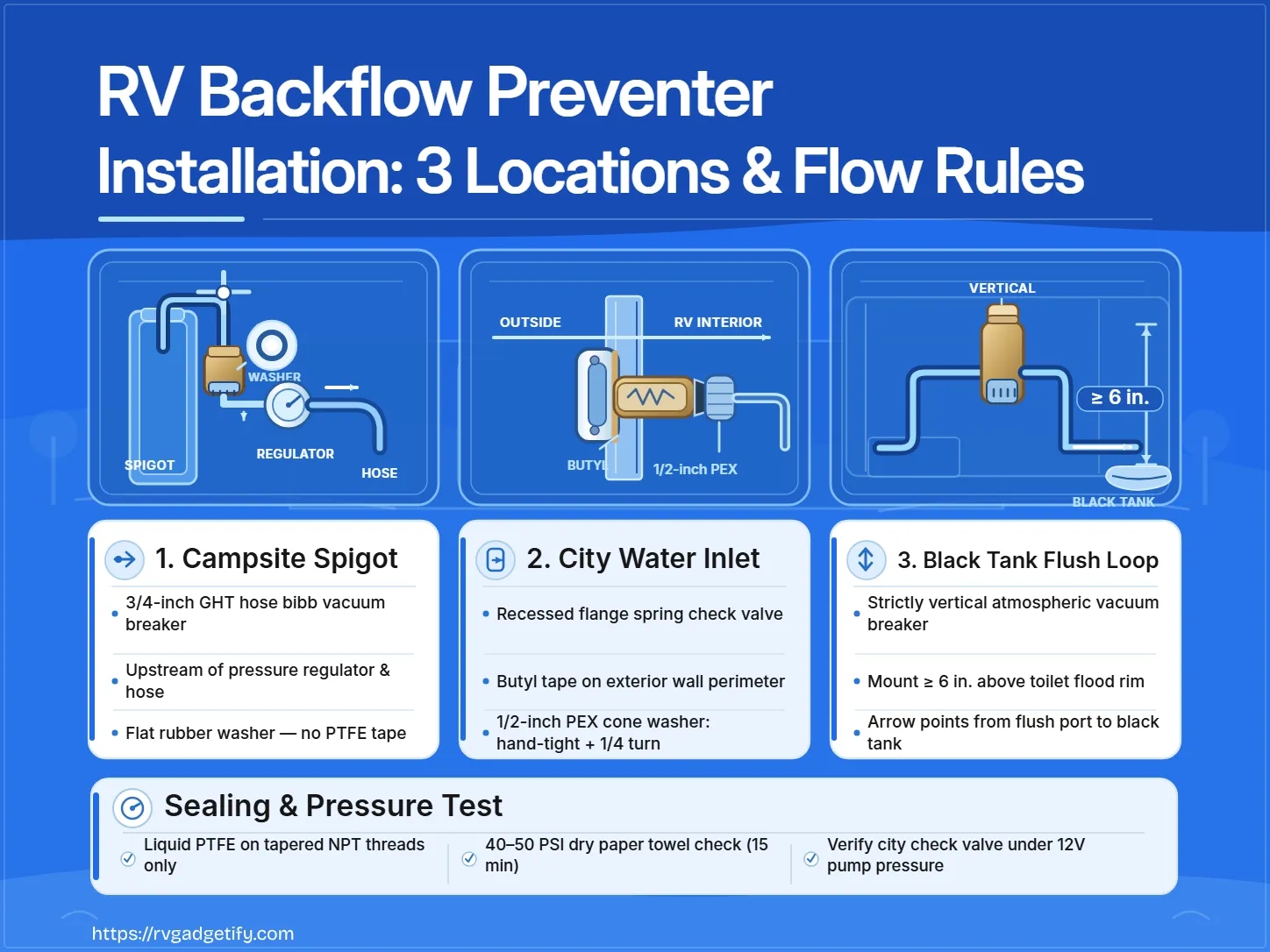
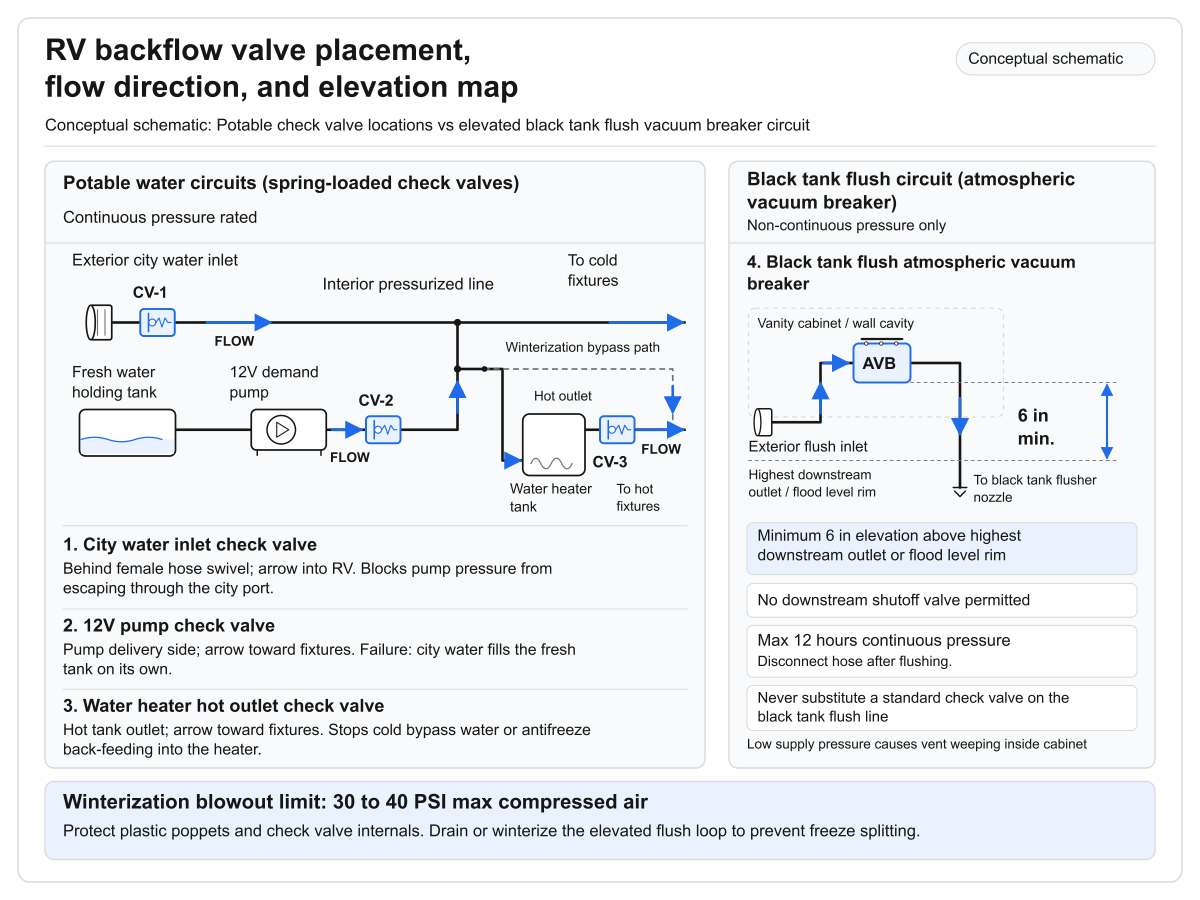
- City water inlet check valve: Mounts directly behind the female garden hose swivel fitting inside the city water inlet flange, oriented to allow incoming water into the RV while blocking reverse flow out the exterior port.
- Water heater check valve: Sits at the hot water tank outlet, oriented to let hot water flow out to the fixtures while blocking reverse flow into the tank during winterization bypass.
- Black tank flush atmospheric vacuum breaker: Mounts inline between the exterior flush inlet and the tank flusher nozzle at least 6 inches above the highest downstream outlet or flood level rim, which is why RV manufacturers typically place this valve high inside a bathroom vanity cabinet or wall cavity. No shutoff valve may be installed downstream of the vacuum breaker.
What Operating and Winterization Limits Apply to Both Valves?
Both backflow devices have pressure, temperature, and material constraints that affect maintenance and seasonal storage:
- 12-hour continuous pressure limit: An atmospheric vacuum breaker must not remain under continuous pressure for more than 12 hours. Always turn off the water supply and disconnect the hose from the black tank flush inlet once flushing is complete.
- Winterization air blowout pressure (30 to 40 PSI): Limit compressed air to 30 to 40 PSI during winterization blowouts, as excess air pressure can crack plastic vacuum breaker poppets and damage internal check valve components.
- Freeze exposure in elevated loops: Because the black tank flush vacuum breaker sits in an elevated loop, often inside an unheated bathroom cabinet or exterior wall cavity, water trapped in the line can freeze and split the housing if the flush line is not winterized alongside the potable system.
- Low-pressure weeping thresholds: Minimum sealing pressure varies across atmospheric vacuum breaker models. Review the valve manufacturer’s minimum working pressure specification and winter air-blowout protocols before modifying the line.
- Plastic versus brass check valve housings: Replacing factory plastic check valves with heavy brass valves helps resist body leaks and sticking caused by thermal heat cycles, though internal seals in any valve remain sensitive to debris or scale.
What Is the Next Step?
Verify your RV’s backflow protection by inspecting each circuit before replacing any fitting:
- Confirm the device matches the circuit: Check that the city water inlet, 12V water pump, and water heater hot outlet use spring-loaded check valves, and confirm that the black tank flush line retains a dedicated atmospheric vacuum breaker.
- Check vacuum breaker elevation and downstream plumbing: Confirm the black tank flush vacuum breaker sits at least 6 inches above the highest downstream outlet or flood level rim and has no shutoff valve installed downstream.
- Verify flow arrows and pressure specs: Match the flow-direction arrow on any replacement valve to the circuit path, and check the manufacturer’s minimum sealing pressure and maximum winterization air-pressure ratings.
Frequently Asked Questions
Can a check valve replace a black tank flush vacuum breaker?
No. The black tank flush line requires an atmospheric vacuum breaker with a vented air gap, and a standard inline check valve must not replace it.
Can an atmospheric vacuum breaker stay on a continuously pressurized line?
No. An atmospheric vacuum breaker cannot be subjected to continuous water pressure for more than 12 consecutive hours and cannot have a downstream shutoff valve.
Why does an RV vacuum breaker weep water inside the cabinet?
Insufficient incoming water pressure can keep the internal float poppet from lifting firmly against the upper vent seal, allowing water to spit or weep from the atmospheric vent ports.
Why does the fresh water tank fill on its own while connected to city water?
A stuck-open check valve on the 12V water pump circuit allows pressurized campground city water to push backward through the pump into the fresh water holding tank.
How high should an RV vacuum breaker be mounted?
An atmospheric vacuum breaker must be installed at least 6 inches above the highest downstream outlet or flood level rim.
How much air pressure is safe for winterization blowout?
Limit regulated compressed air to 30 to 40 PSI (or follow a lower limit if specified by the RV or valve manufacturer) to avoid cracking plastic vacuum breaker poppets and check valve internals.
How do brass check valves compare to factory plastic check valves?
Heavy brass check valve bodies better resist housing distortion, leaks, and sticking caused by thermal heat cycles compared to thin factory plastic valves, though internal seals still require clean, debris-free water lines to seat properly.
Sources:
- Use of Lead Free Pipes, Fittings, Fixtures, Solder, and Flux for Drinking Water – U.S. Environmental Protection Agency, Safe Drinking Water Act Lead-Free Rule and 0.25% weighted average lead statutory requirement.
- How to Identify Lead Free Certified Drinking Water Products – U.S. Environmental Protection Agency Office of Ground Water and Drinking Water, PDF guidance on third-party certification marks, NSF/ANSI 372 testing, and plumbing product labeling.
- ASSE International Plumbing Product Standards – ASSE International, performance requirements and test methods for ASSE 1011 hose connection vacuum breakers and backflow protection.
- Home Water Systems: Backflow Prevention Devices – Colorado State University Extension, technical guidance on cross-connection control, hose-end vacuum breakers, and plumbing backflow protection.