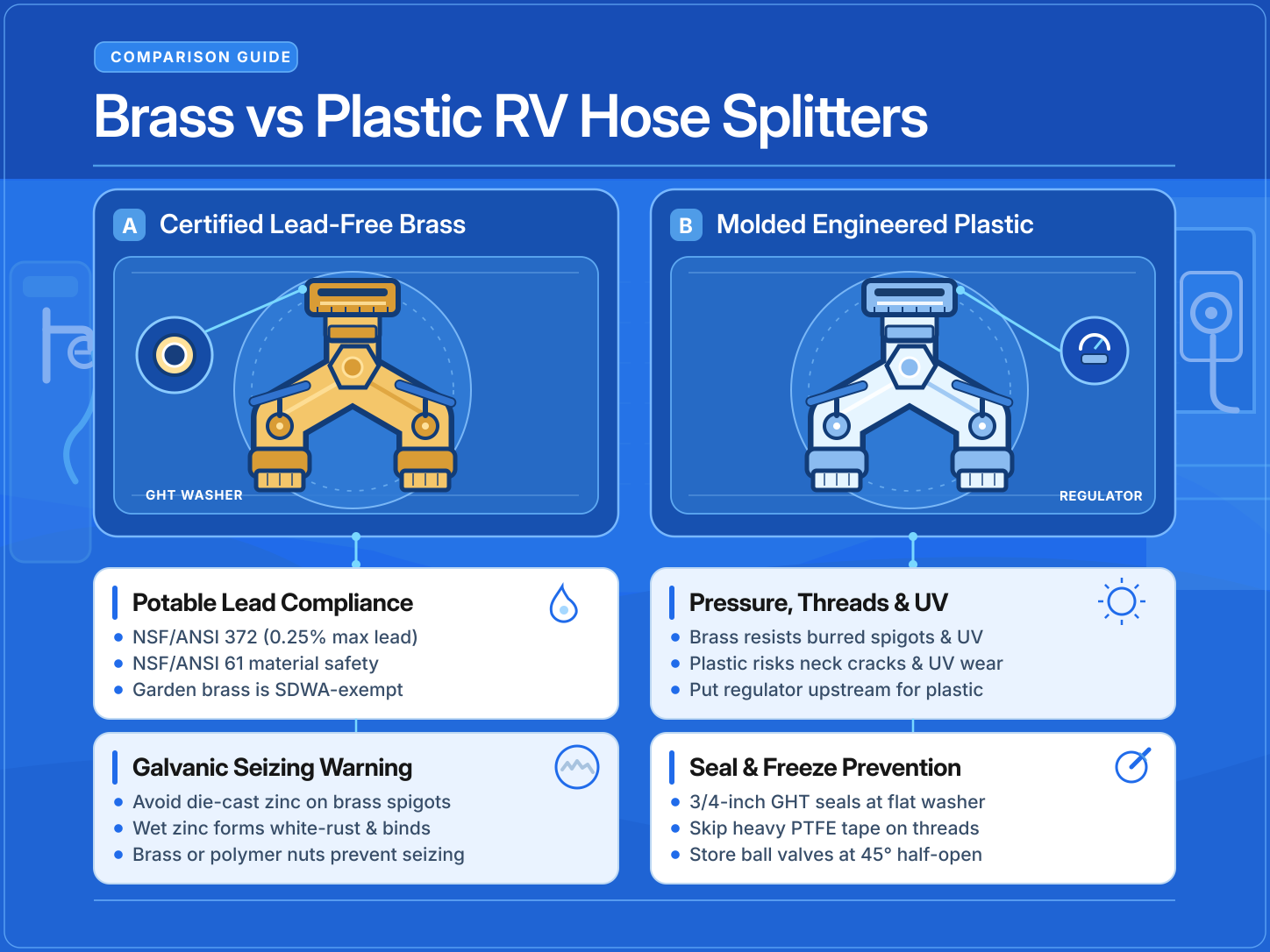

Brass, plastic, and zinc-alloy RV hose splitters differ most in drinking-water lead compliance, thread durability on worn campground spigots, resistance to mechanical stress, and corrosion behavior. For a branch that feeds your RV’s fresh-water inlet, choose a forged or machined brass splitter explicitly certified lead-free under NSF/ANSI 372 (or a polymer splitter certified to NSF/ANSI 61 and 372). Reserve uncertified plastic or standard garden brass splitters for dedicated non-potable utility tasks, and avoid leaving die-cast zinc-alloy splitters threaded onto brass campground faucets where galvanic corrosion can seize the connection.
The choice involves more than picking metal over plastic. Standard hardware-store brass splitters sold for lawn irrigation are exempt from federal potable-water lead limits, and many low-cost “metal” splitters are actually die-cast zinc-alloy plated to resemble brass. When a splitter stays under continuous campground water pressure while supporting the weight of hoses, filters, and regulators, both the alloy or polymer composition and the internal valve seals determine whether the connection stays leak-free.
Key Takeaways
- Check for potable-water certification before connecting: Look for explicit “NSF/ANSI 372” (lead content) and, when available, “NSF/ANSI 61” (material leaching) markings on any splitter supplying your RV’s drinking-water line.
- Do not confuse standard garden brass with lead-free brass: Outdoor irrigation fittings are exempt from the U.S. Safe Drinking Water Act potable-water rules and may use leaded brass alloys unsuitable for drinking water.
- Keep zinc-alloy off brass campground spigots: In wet conditions, dissimilar-metal contact between die-cast zinc and brass causes galvanic corrosion that can bind the threads together during multi-day stays.
- Match material to mechanical and UV exposure: Machined brass resists cross-threading on burred spigots and does not degrade in sunlight, whereas molded plastic threads strip more easily and polymer housings can become brittle after prolonged UV exposure.
- Seal with the hose washer, not thread tape: Garden Hose Thread (GHT) connections seal by compressing a rubber or silicone washer against the flat spigot face; heavy wraps of PTFE tape on straight threads can prevent the swivel nut from seating against the washer.
- Drain and half-open ball valves before freezing weather: Store ball-valve splitters at a 45-degree (half-open) angle after draining so water trapped inside the valve cavity cannot freeze and crack the housing.
How Do Brass, Plastic, and Zinc-Alloy Splitters Compare?
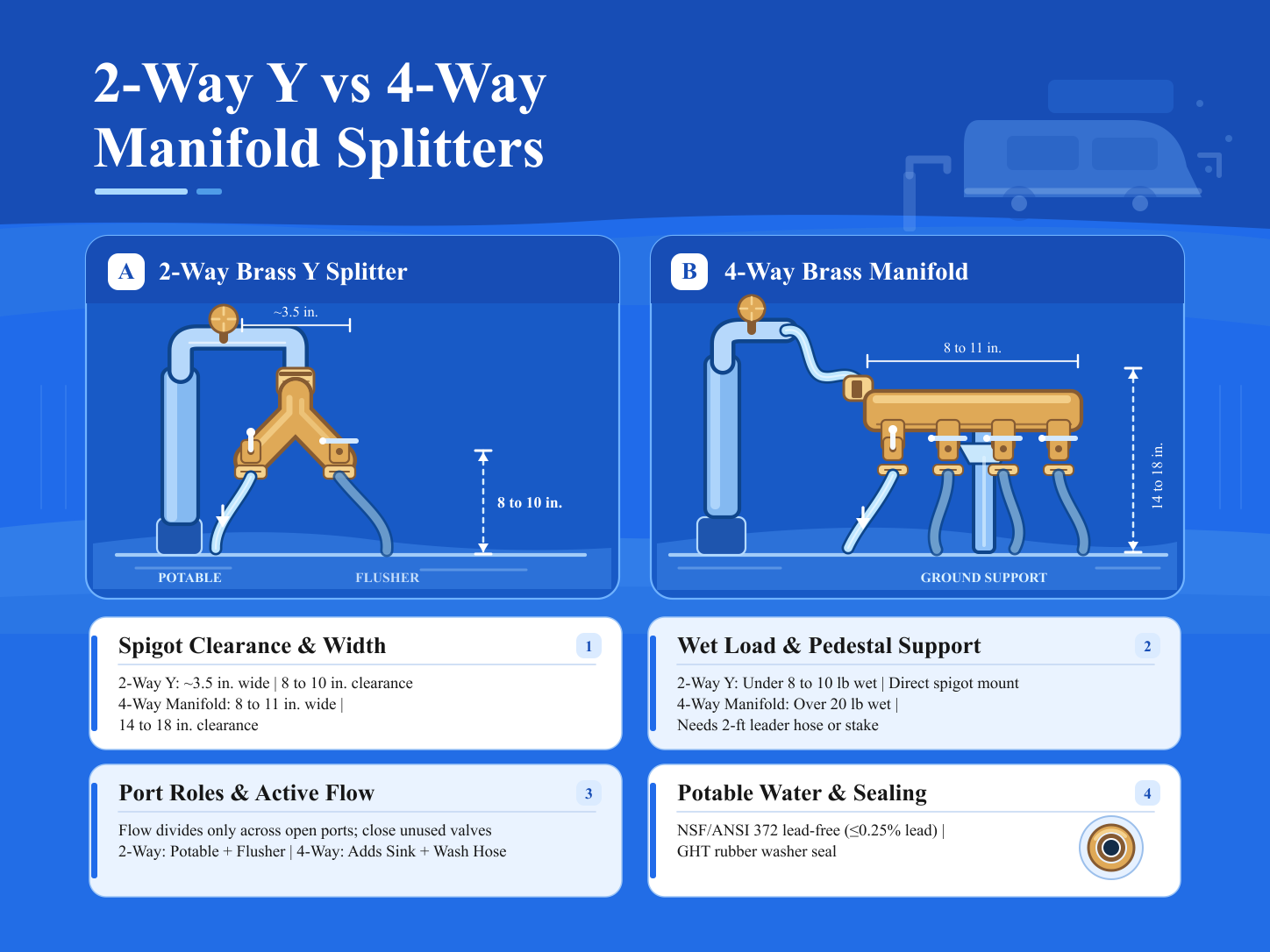
RV owners typically encounter three material classes when shopping for 2-way Y-valves or 4-way manifolds: forged or machined brass, molded engineered plastic (such as ABS, polypropylene, or nylon), and die-cast zinc-alloy (often sold with a thermoplastic rubber grip or a brass-colored finish). While outlet count determines how many hoses you can attach, the housing and valve materials dictate how the splitter handles pedestal stress, sun exposure, and water chemistry.
| Comparison Attribute | Certified Lead-Free Brass | Molded Engineered Plastic | Die-Cast Zinc-Alloy |
|---|---|---|---|
| Potable-water suitability | Suitable when marked compliant with NSF/ANSI 372 (0.25% max weighted average lead) | Suitable only if explicitly marked drinking-water safe (such as NSF/ANSI 61 and 372); standard garden plastic is for utility use | Generally sold for non-potable lawn and garden irrigation; prone to internal white-rust oxidation |
| Pressure & mechanical load | High resistance to housing cracks and bending stress from hanging hoses or regulators (exact PSI limit varies by model and valve seals) | Lower tolerance for pressure spikes and cantilevered hose weight; prone to seam separation or neck cracking under strain | Rigid when new, but thin cast walls weaken over time as internal oxidation and pitting progress |
| Threads on rough spigots | Machined brass threads resist stripping and deformation on weathered or burred campground faucets | Softer molded threads cross-thread and strip easily on damaged metal spigots | Harder than plastic, but oxidized threads can gall or bind on rough brass spigots |
| Galvanic behavior on brass faucets | Compatible metal family; avoids dissimilar-metal galvanic seizing on brass spigots | Non-conductive polymer; immune to galvanic corrosion and thread seizing | Anodic to brass; wet contact triggers galvanic corrosion that can seize the swivel nut onto a brass spigot |
| Sunlight (UV) durability | Metal body is unaffected by UV rays (rubberized valve handles may still weather over time) | Prolonged UV exposure degrades polymers, increasing brittleness and the risk of housing cracks | Metal body is unaffected by UV rays, though exterior plating and plastic levers can degrade |
| Typical failure point | Worn internal stem O-rings, mineral scale on ball seats, or freeze cracking if stored with trapped water | Cracked inlet collar, split mold seams, stripped female threads, or UV embrittlement | Galvanic thread seizure at the spigot, snapped valve levers, or pinhole leaks from white-rust corrosion |
Why Does “Brass” Not Automatically Mean Lead-Free for RV Drinking Water?
Buying a solid brass splitter at a hardware store does not guarantee that it is safe for an RV fresh-water hookup. Under Section 1417 of the U.S. Safe Drinking Water Act (SDWA) and the corresponding NSF/ANSI 372 standard, plumbing fittings intended for human consumption must contain no more than a 0.25% weighted average lead content across their wetted surfaces. Prior to the 2014 federal reduction take-effect date, plumbing brass could contain up to 8% lead and still be labeled “lead-free.”
Crucially, federal law exempts fittings used exclusively for non-potable services such as outdoor lawn watering and garden irrigation. Because manufacturers add lead to traditional brass alloys to make them easier to machine, many standard garden hose splitters still use non-potable leaded brass. You cannot distinguish certified lead-free brass from traditional leaded garden brass by color or weight alone.
Before threading a splitter onto the line that feeds your RV’s fresh-water tank or city-water inlet, check the packaging or valve body for explicit compliance markings:
- NSF/ANSI 372 (or Lead-Free SDWA compliance): Verifies that wetted components meet the 0.25% maximum weighted average lead content requirement.
- NSF/ANSI 61: Evaluates whether chemicals or metallic contaminants leach from the fitting materials (including internal elastomers, lubricants, and polymers) into drinking water at unsafe levels.
- Material verification against plated zinc: Some inexpensive splitters advertise “brass” in the product title when only the inlet nut or surface plating is brass over a die-cast zinc body. Check product specifications to confirm that both the manifold body and internal ball valves are lead-free brass or stainless steel.
How Do Pressure Spikes, Spigot Threads, and Sunlight Affect Each Material?
Campground water pedestals subject hose splitters to tougher operating conditions than a typical residential backyard faucet. Instead of brief garden watering sessions where an open nozzle relieves line pressure, an RV hookup keeps the splitter under static line pressure 24 hours a day while water valves inside the RV open and close.
Working Pressure vs. Campground Pressure Spikes
Every hose splitter has a model-specific maximum working pressure governed by its wall thickness, swivel-nut joint, and internal ball-valve seals. Even among solid brass splitters, manufacturer working-pressure ratings vary widely by design (some heavy-duty brass models are rated for 120 PSI intermittent outdoor service, while others list higher test limits). Molded plastic splitters generally have lower pressure margins and are more vulnerable to sudden failure when campground pressure spikes overnight or when an RV appliance valve snaps shut and creates minor water hammer.
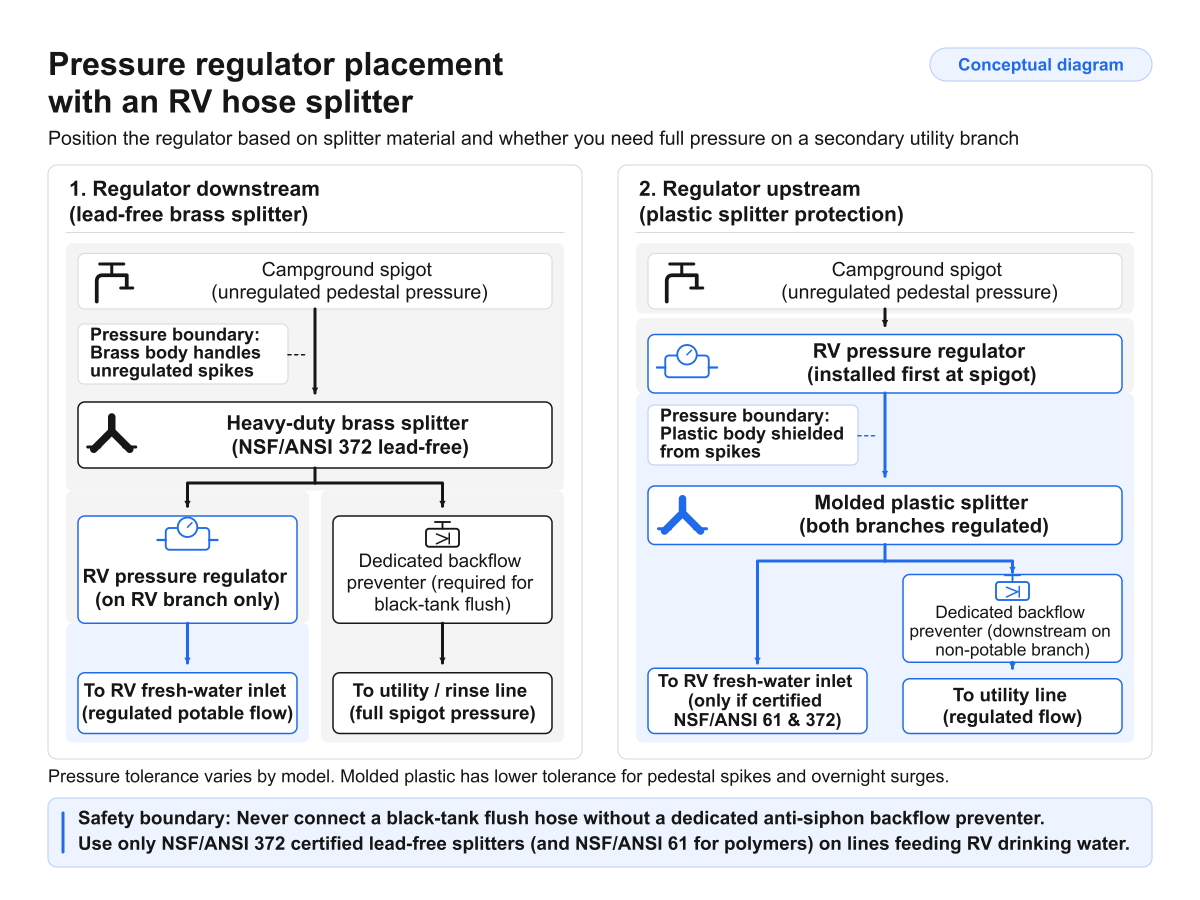
If you use a splitter at a campground with high or unpredictable water pressure, consider where you place your RV water pressure regulator:
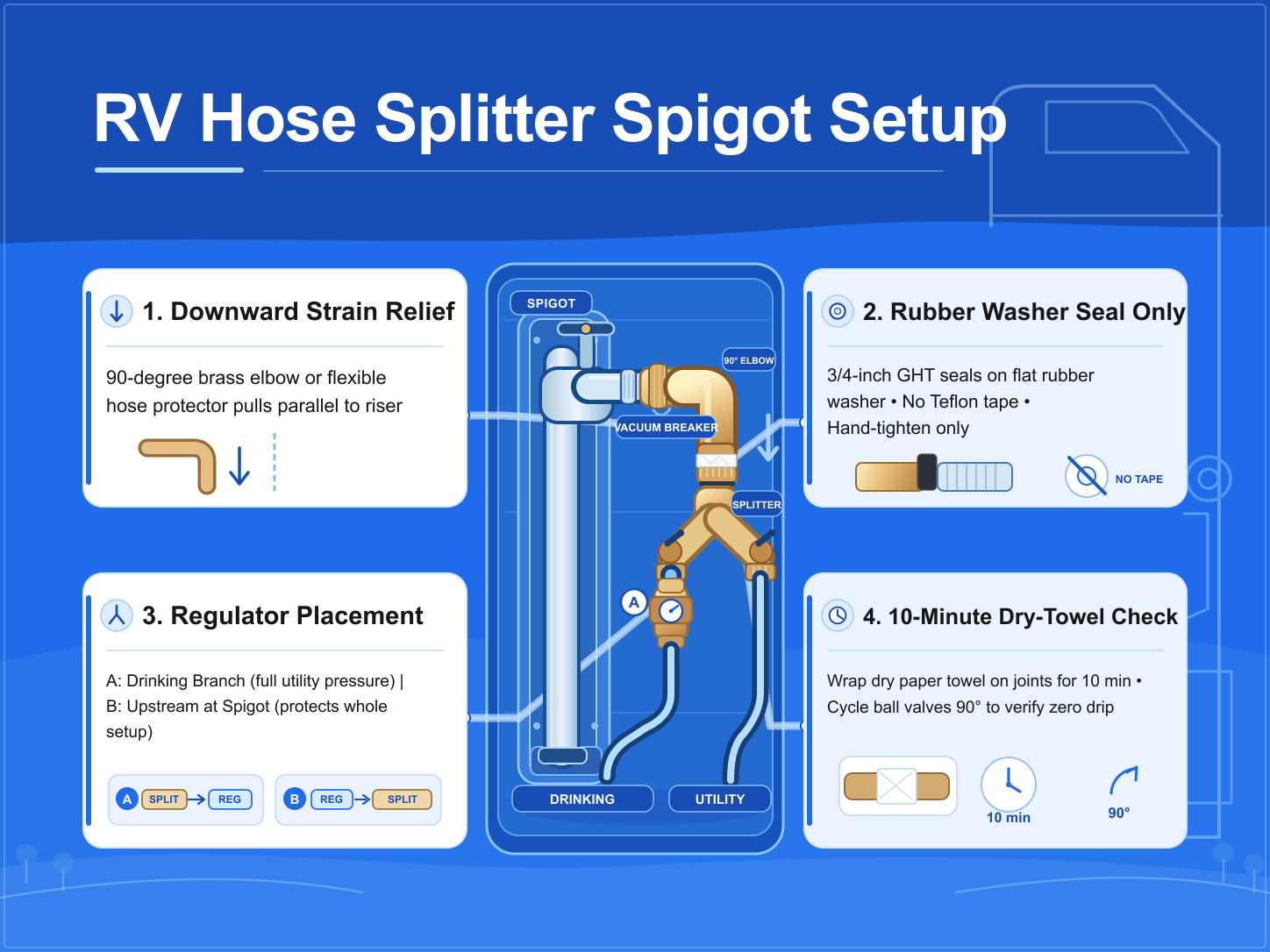
- Regulator downstream of a brass splitter: If you attach a heavy-duty lead-free brass splitter directly to the spigot, you can install your pressure regulator on the outlet branch feeding the RV while leaving the second outlet at full spigot pressure for washing gear or rinsing a sewer hose.
- Regulator upstream at the spigot: If your splitter is plastic, or if you want both branches protected from high pedestal pressure, thread the pressure regulator directly onto the campground spigot first (provided the regulator is only feeding potable paths or is upstream of a dedicated backflow preventer) so the splitter body never sees unregulated main pressure.
Mechanical Strain and Thread Stripping
Campground spigots are frequently nicked, weathered, or slightly out of round from years of campers overtightening fittings with pliers. Soft molded plastic female threads can shave or cross-thread against burred brass faucet threads on the first hookup. Machined brass swivel nuts tolerate rough spigot threads much better.
Weight is the second mechanical hazard. Hanging a splitter, a brass pressure regulator, a canister water filter, and two water-filled hoses directly off an angled splitter outlet creates downward leverage at the swivel neck. Plastic inlet collars can crack under that cantilevered load. Whether you choose brass or plastic, adding a short flexible hose-saver pigtail or supporting the inline filter reduces bending stress on both the splitter neck and the campground riser pipe.
Galvanic Corrosion Between Zinc and Brass
When two dissimilar metals sit in contact inside mineral-bearing water, the more anodic metal corrodes preferentially. Zinc sits far below brass in the galvanic series. When a die-cast zinc-alloy swivel nut stays threaded onto a brass campground spigot for days or weeks, moisture trapped in the threads acts as an electrolyte. The zinc oxidizes into a crusty white deposit that expands inside the thread clearances, which can bind the nut so tightly that removing it requires channel-lock pliers or risks breaking the campground faucet.
Brass-on-brass connections share the same alloy family and avoid galvanic seizing, while plastic swivel nuts are electrically non-conductive and cannot corrode galvanically.Beware of composite splitters that combine a plastic body with a cheap die-cast zinc swivel nut, as they still carry the same seizing risk at the spigot.
Which Splitter Material Fits Your RV Hookup Scenario?
Select your splitter material based on what each outlet feeds, the condition of the campground faucet, and how long you plan to stay connected.
| Campground Scenario | Recommended Splitter Choice | Practical Reason & Setup Condition |
|---|---|---|
| Primary RV fresh-water hookup + secondary line | Forged or machined brass certified to NSF/ANSI 372 | Keeps the potable water path compliant with federal lead limits while handling continuous static pedestal pressure |
| Rough, burred, or weathered brass spigot | Certified lead-free brass | Machined brass female threads resist shaving and cross-threading where molded plastic threads strip |
| Extended or seasonal stay on a brass spigot | Certified lead-free brass (or potable-certified plastic with a non-zinc nut) | Prevents the galvanic thread binding that occurs when die-cast zinc fittings remain wet against brass faucets |
| High-sun desert or summer camping | Certified lead-free brass | Metal housing does not suffer UV polymer breakdown; keep spare washers on hand for heat-aged gaskets |
| Dedicated non-potable utility split (such as rinsing gear) | Molded plastic or standard brass (downstream of backflow protection) | Acceptable when neither branch supplies drinking or cooking water; keep black-tank flush hoses strictly separated with a dedicated anti-siphon backflow preventer |
| Fragile or plastic spigot connection | Lightweight potable-certified plastic or brass supported by a short leader hose | Reduces direct hanging weight on a weak faucet; use a flexible pigtail to take the load off the spigot |
How Do You Prevent Leaks and Freeze Damage on Any Splitter?
Even a well-machined brass splitter will drip at the spigot or split open in winter if installed or stored incorrectly. Two simple maintenance habits prevent the most common failures.
Seal With the Hose Washer, Not PTFE Thread Tape
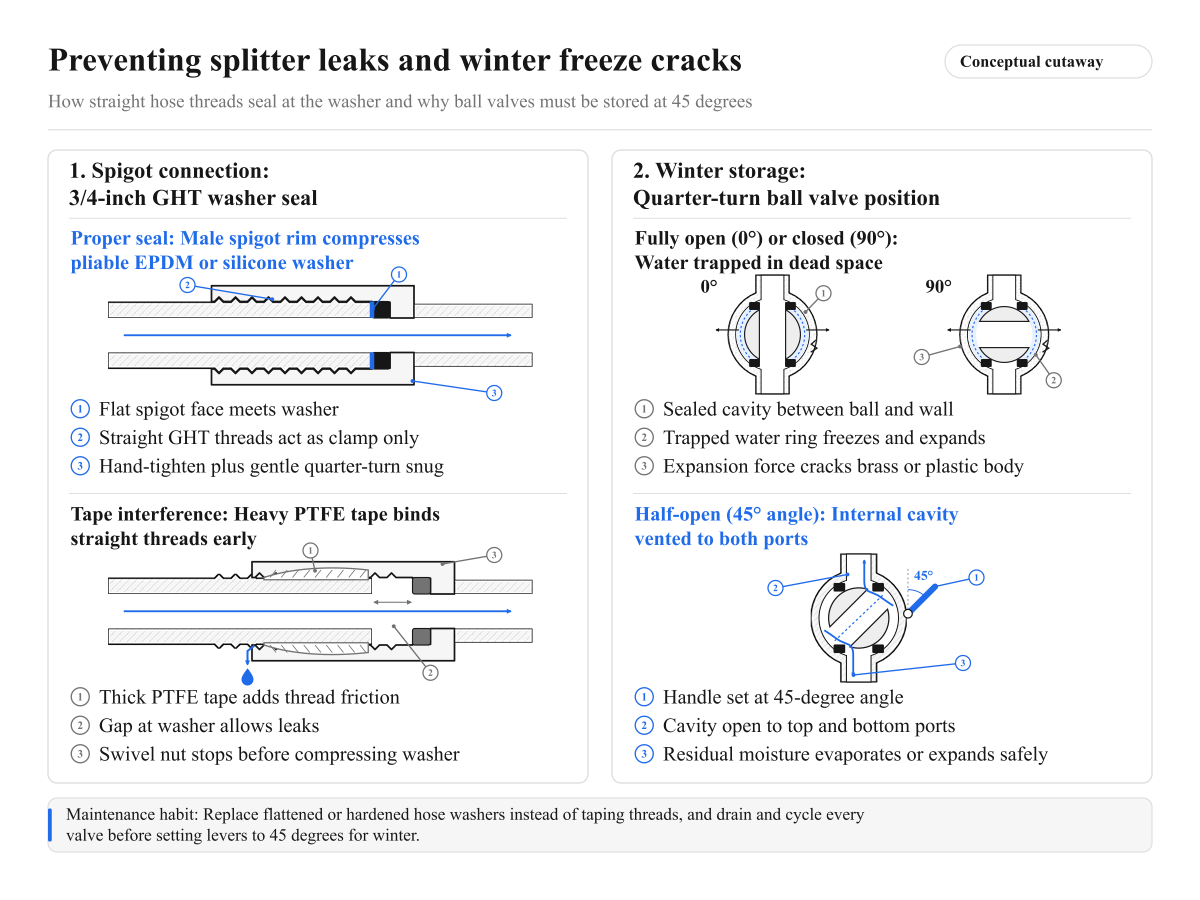
Standard U.S. garden hose connections use 3/4-inch Garden Hose Thread (GHT), which is a straight, non-tapered thread profile. Unlike tapered household pipe threads (NPT), where the male and female threads wedge together to seal, straight GHT threads only serve as a clamp. The actual watertight seal happens when the flat rim of the male spigot presses against the elastomeric hose washer inside the female swivel nut.
If a splitter leaks at the top swivel nut, wrapping thick layers of PTFE (Teflon) tape around the male spigot threads is the wrong fix. Heavy tape wraps add friction on straight threads and can prevent the swivel nut from threading down far enough to compress the washer firmly against the spigot face. Instead:
- Inspect the rubber washer inside the female inlet nut before connecting.
- Replace flattened, nicked, or hardened washers with a fresh EPDM rubber or pliable silicone hose washer.
- Tighten the swivel nut firmly by hand plus a gentle quarter-turn Snug if needed, rather than crushing the washer with wrenches.
Set Ball Valves Half-Open Before Freezing Weather
Forged brass is strong against water pressure, but it cannot resist the expansion force of freezing ice inside a closed cavity. Standard quarter-turn ball valves use a perforated sphere rotating inside tight seats. When a ball valve is stored either fully closed (90 degrees) or fully open (0 degrees), a small ring of water often remains trapped in the dead space between the outer surface of the ball and the valve body wall.
When overnight temperatures drop below freezing, that trapped pocket of water expands and can crack a solid brass or plastic valve body right down the side. Before winter storage or a hard campground freeze:
- Disconnect the splitter from the spigot and hoses.
- Cycle each valve lever open and closed a few times while tilting the body to shake out standing water.
- Leave every ball-valve handle positioned at a 45-degree (half-open) angle. At 45 degrees, the internal cavity between the ball and the housing is vented to both ports, allowing residual moisture to evaporate and giving any remaining water room to expand harmlessly.
Pre-Hookup Checklist at the Campground Spigot
Before buying a splitter or threading it onto a campground water pedestal, run through three quick checks:
- Verify the label and wetted materials: Confirm explicit NSF/ANSI 372 lead-free certification (and NSF/ANSI 61 if listed) on any splitter that will carry drinking water into your RV, and verify that the swivel nut is brass rather than plated die-cast zinc.
- Inspect the inlet washer and internal ball: Check that a pliable rubber or silicone washer is seated flat inside the top swivel nut, and look through the ports to see whether the internal shutoff ball is brass or stainless steel rather than thin plastic.
- Plan your pressure and backflow protection: Place your RV water pressure regulator so neither your RV plumbing nor a low-pressure splitter is exposed to unregulated campground spikes, and always use an atmospheric vacuum breaker or backflow preventer on any branch connected to a black-tank flush inlet.
Frequently Asked Questions
Can a plastic RV hose splitter handle campground water pressure?
It depends on the specific splitter’s manufacturer rating and the campground’s water pressure. While many molded plastic splitters work at normal household pressures, high static pressure or overnight surges at campground pedestals can cause plastic housings to crack at the mold seam or leak around the swivel neck. If you use a plastic splitter, install an RV water pressure regulator upstream at the spigot so the plastic body only sees regulated pressure.
Why do some metal hose splitters get stuck on brass campground faucets?
Metal splitters made from die-cast zinc-alloy undergo galvanic corrosion when threaded onto a brass faucet in the presence of water. Because zinc is more electrically active than brass, it corrodes and forms white oxide deposits inside the threads, which can bind the swivel nut tightly to the spigot during multi-day stays. Using a brass swivel nut on a brass faucet prevents dissimilar-metal seizing.
Is every solid brass hose splitter safe for RV drinking water?
No. Under the U.S. Safe Drinking Water Act, outdoor garden and irrigation fittings are exempt from potable-water lead restrictions and may be machined from traditional leaded brass. For an RV fresh-water connection, choose a splitter explicitly certified lead-free under NSF/ANSI 372, which restricts wetted surfaces to a maximum weighted average of 0.25% lead.
Why is my hose splitter leaking from the top swivel nut even with thread tape?
Garden hose connections use straight threads (3/4-inch GHT) that seal by pressing the internal rubber washer against the tip of the faucet, not by sealing along the threads. Wrapping PTFE tape on straight faucet threads can stop the swivel nut from tightening far enough to compress the washer. Remove the tape and install a new, pliable EPDM or silicone hose washer inside the swivel nut.
Should I store my RV hose splitter open or closed for the winter?
Store ball-valve splitters with the levers set at a 45-degree, half-open angle after draining. Leaving a ball valve fully open or fully closed can trap a thin pocket of water between the ball and the inner body wall, which can freeze, expand, and crack even a solid brass housing.
Sources:
- Use of Lead Free Pipes, Fittings, Fixtures, Solder, and Flux for Drinking Water – U.S. Environmental Protection Agency, Safe Drinking Water Act Lead-Free Rule and 0.25% weighted average lead statutory requirement.
- How to Identify Lead Free Certified Drinking Water Products – U.S. Environmental Protection Agency Office of Ground Water and Drinking Water, PDF guidance on third-party certification marks, NSF/ANSI 372 testing, and plumbing product labeling.
- ASSE International Plumbing Product Standards – ASSE International, performance requirements and test methods for ASSE 1011 hose connection vacuum breakers and backflow protection.
- Galvanic Corrosion in Hose Fittings: Causes, Prevention, and Easy Repairs – Eley Hose Reels Technical Engineering Guide, mechanical and electrochemical analysis of galvanic corrosion between dissimilar zinc and brass hose fittings.