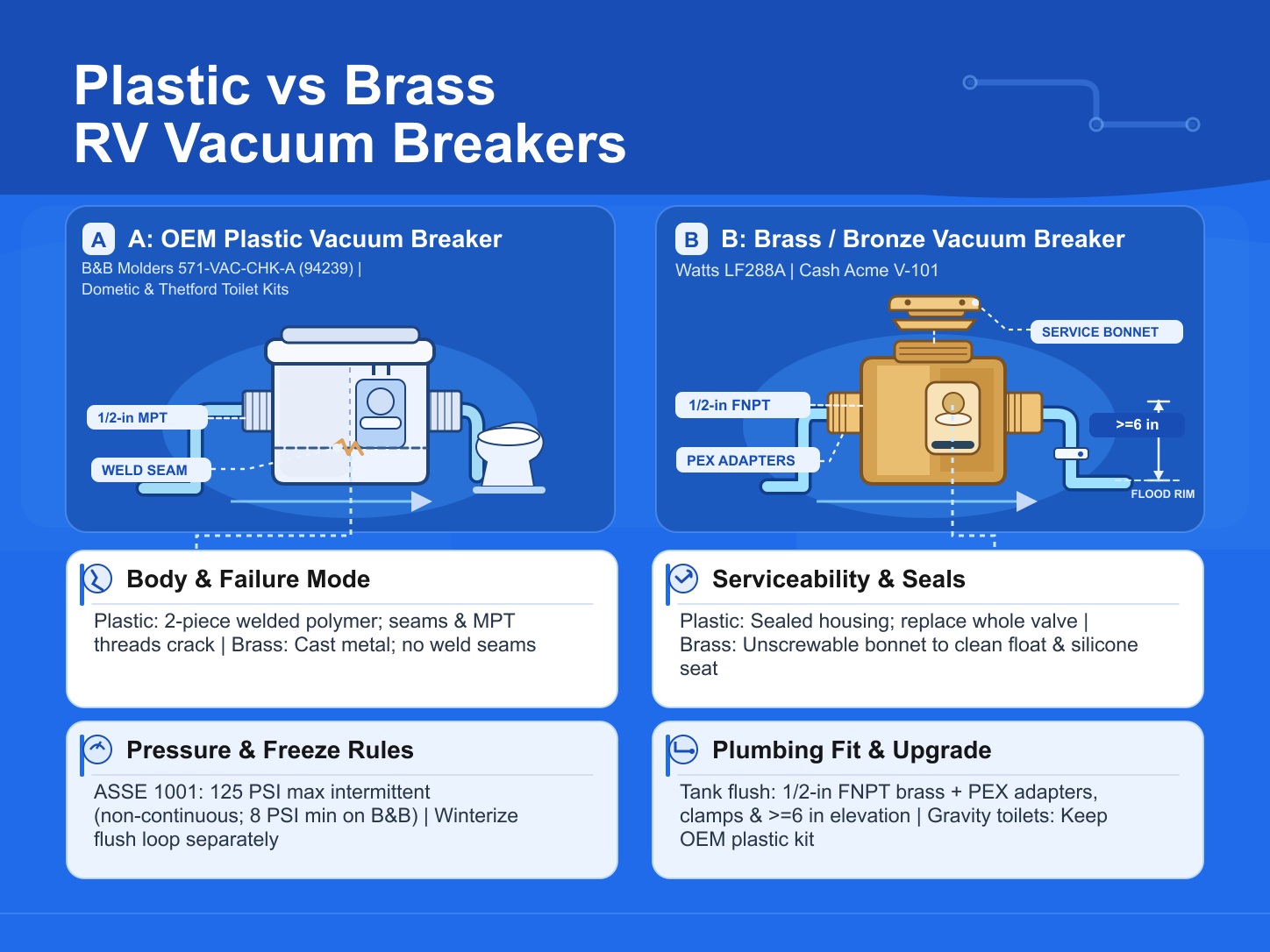
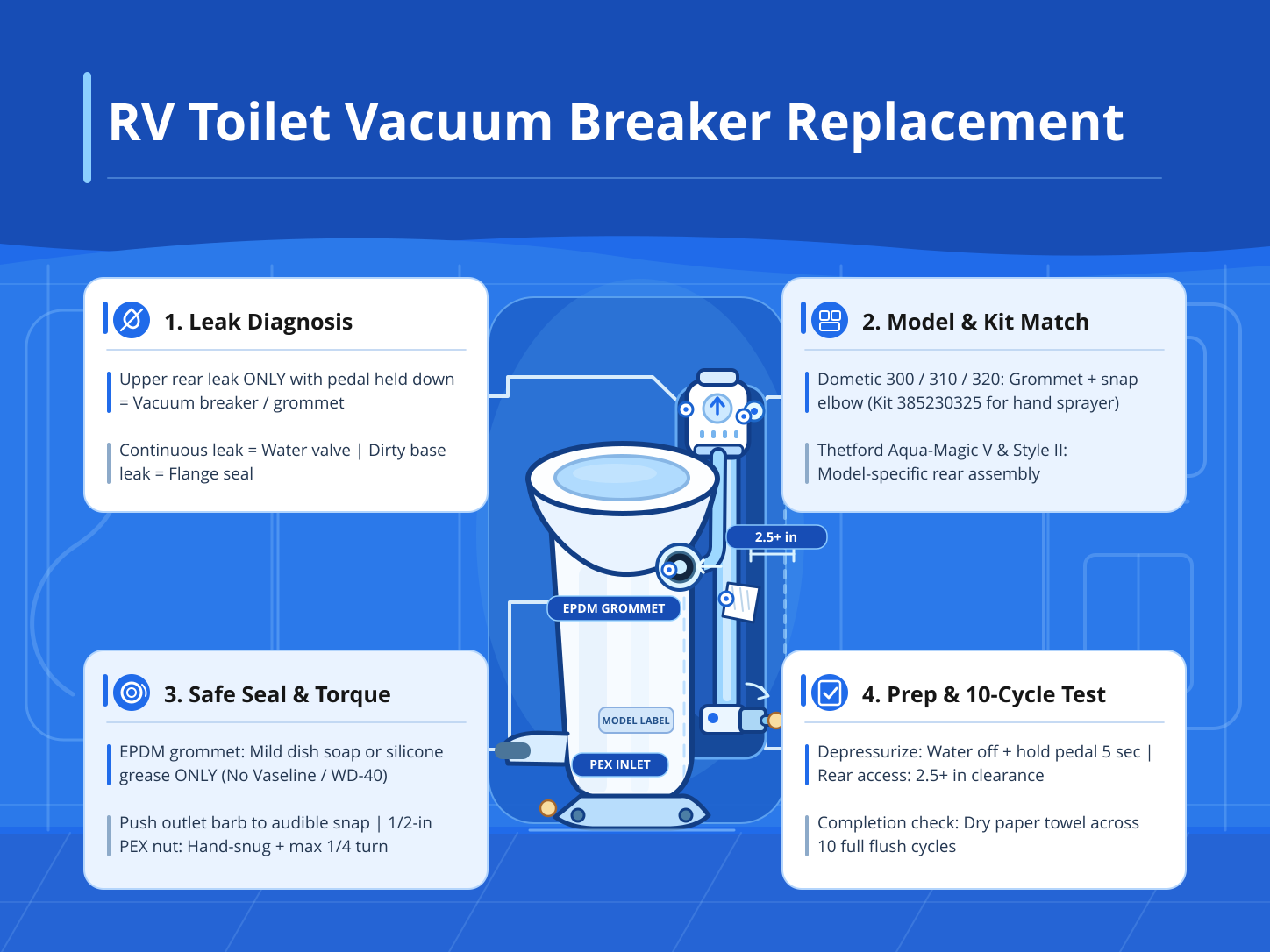

Aftermarket lead-free brass or bronze atmospheric vacuum breakers are the stronger upgrade for 1/2-inch NPT black tank flush lines because their cast or machined metal bodies eliminate the ultrasonic weld seams and plastic male threads that commonly crack on factory plastic valves. However, OEM plastic vacuum breaker kits remain necessary for RV gravity toilets (such as Dometic and Thetford models) that rely on model-specific barbed tubes and proprietary rim mounts. Neither material is freeze-proof or rated for continuous pressure: both plastic and metal ASSE 1001 atmospheric vacuum breakers are limited to intermittent operation up to 125 PSI and require dedicated compressed-air blowout or antifreeze winterization before subfreezing weather.
Key Takeaways
- Match the valve to the plumbing interface: Upgrade to a 1/2-inch NPT brass or bronze atmospheric vacuum breaker on threaded black tank flush lines, but keep OEM plastic replacement assemblies on gravity toilets with proprietary bowl-rim connections.
- Respect the ASSE 1001 non-continuous pressure rule: Both OEM plastic tank-flush breakers (such as the B&B Molders 571-VAC-CHK-A) and commercial metal breakers (such as the Watts LF288A and Cash Acme V-101) are rated for a maximum intermittent pressure of 125 PSI and must never be installed under continuous pressure or upstream of a shutoff valve.
- Address the real failure points: Metal housings eliminate split plastic weld seams and stripped plastic threads, while serviceable bonnets allow you to clean or replace internal silicone seat discs instead of discarding the entire valve.
- Plan for thread and support differences: Switching from a male-threaded OEM plastic flush valve to a female-threaded commercial brass valve requires compatible PEX-to-NPT adapters and solid pipe clamping to prevent vibration fatigue on the road.
- Winterize the black tank flush line separately: Brass housings resist splitting better than brittle polymers during brief cold snaps, but trapped ice can still deform internal poppet floats and silicone seats.
What Is the Difference Between Plastic and Brass RV Vacuum Breakers?
Plastic and brass RV vacuum breakers differ in housing construction, thread configuration, internal serviceability, and where they fit inside an RV plumbing system. Factory RV plumbing uses two distinct styles of atmospheric vacuum breakers: inline 1/2-inch NPT valves on black tank flush lines (most commonly the plastic B&B Molders 571-VAC-CHK-A, also sold under part number 94239) and proprietary toilet vacuum breakers integrated into Dometic or Thetford gravity-flush toilets.
| Comparison Attribute | OEM Plastic Vacuum Breakers (Inline & Toilet Kits) | Aftermarket Brass / Bronze Vacuum Breakers (Inline) |
|---|---|---|
| Typical examples | B&B Molders 571-VAC-CHK-A (94239) for tank flush; Dometic 385316906 or Thetford Aqua-Magic kits for toilets | Watts LF288A (lead-free brass); Cash Acme V-101 (bronze / lead-free brass) |
| Body construction | Two-piece injection-molded polymer (typically ABS or acetal/POM) with welded seams | Cast or machined metal body with a threaded service bonnet and screw-on vent hood |
| Pressure rating (ASSE 1001) | Up to 125 PSI intermittent working pressure (8 PSI minimum on B&B Molders inline models); non-continuous only | Up to 125 PSI maximum intermittent pressure; non-continuous only (maximum 12 of 24 hours) |
| Plumbing connections | 1/2-inch male NPT (MPT) on inline tank-flush valves; proprietary barbs or snap-fit rim mounts on toilets | 1/2-inch female NPT (FNPT) on standard inline replacements (male-threaded direct RV replacements also exist) |
| Water hammer & stress tolerance | Vulnerable to seam splitting and thread stress cracking if over-tightened or exposed to unregulated hose surges | Metal walls and female threads resist housing rupture, mechanical binding, and hydraulic shock |
| Freeze behavior | Polymer stiffens in freezing temperatures; trapped ice frequently splits the welded seam or threads | Metal shell resists cracking in minor freezes, though ice can still deform the internal float or silicone seat |
| Maintenance & repair | Sealed, non-serviceable housing; full valve replacement required if the float sticks or leaks | Removable hood and unscrewable bonnet allow float cleaning and seat/O-ring repair kit installation |
| Best RV application | Gravity toilet bowl rims and direct factory-fit replacements where plumbing cannot be modified | Black tank flush lines subject to unregulated campground hose pressure or repeated plastic valve leaks |
RV manufacturers install molded plastic inline vacuum breakers on black tank flush systems to minimize weight and production cost. While both plastic and brass inline atmospheric vacuum breakers meet ASSE 1001 back-siphonage standards and carry a 125 PSI maximum intermittent working pressure rating, their real-world durability diverges under mechanical stress, unregulated campground water pressure, and seasonal temperature swings.
How Do Plastic and Brass Vacuum Breaker Bodies Fail?
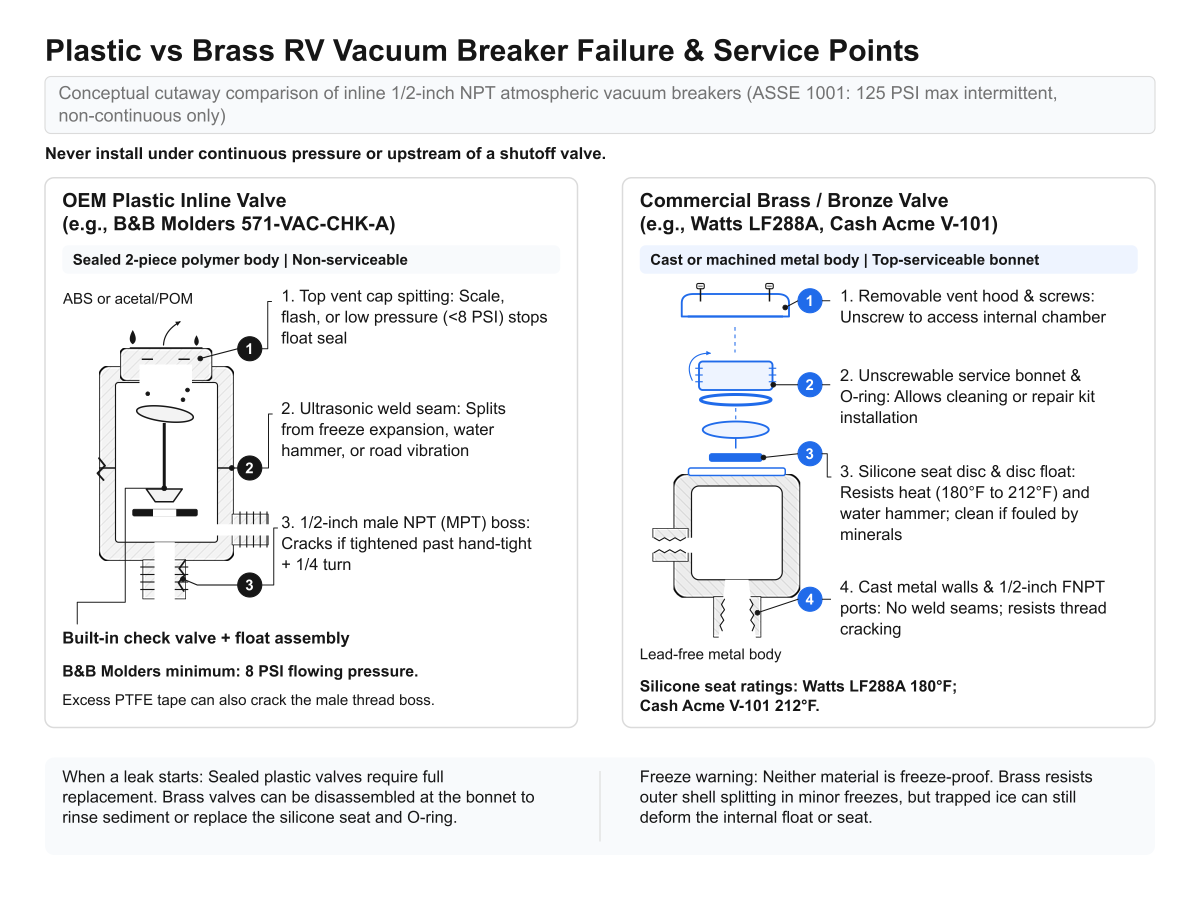
Plastic RV vacuum breaker bodies most often fail through structural cracking along molded weld seams or threaded ports, whereas brass and bronze valves primarily experience serviceable internal seal wear or mineral fouling.
Factory plastic inline vacuum breakers are molded in separate polymer sections and joined by ultrasonic or spin welding. In RV service, three mechanical stressors commonly cause these housings to leak:
- Thread stress cracking: B&B Molders specifies tightening swivel fittings onto plastic male threads to hand-tight plus 1/4 turn. Over-tightening a PEX swivel nut or using excessive PTFE tape introduces hoop stress that cracks the plastic inlet or outlet boss.
- Plumbing bind and road vibration: If the attached PEX tubing pulls the valve at an angle without proper clamping nearby, constant road vibration fatigues the molded neck and weld seam.
- Atmospheric vent spitting: When water flow starts or stops, the internal float rises to seal the top vent and drops when pressure is removed. If hard-water scale, plastic flash, or debris prevents the float from sealing squarely, water sprays out of the top vent cap during tank flushing.
Commercial brass and bronze vacuum breakers (such as the Watts LF288A and Cash Acme V-101) use a cast or machined metal body without ultrasonic plastic weld seams. Because the metal housing resists splitting and thread distortion, failures in brass valves are rarely structural. Instead, leaks on brass units typically occur when mineral deposits or debris foul the internal silicone seat disc, or when the bonnet O-ring ages. Unlike sealed plastic valves that must be thrown away when they leak from the top cap, commercial metal valves let you remove the hood screws, unthread the bonnet, and clean or replace the internal float and silicone disc.
How Do Pressure Ratings and Water Hammer Affect Each Material?
Both OEM plastic and aftermarket brass atmospheric vacuum breakers are rated for a maximum intermittent pressure of 125 PSI under ASSE 1001, but metal housings and silicone seat discs handle unregulated water hammer surges and mechanical line stress with a wider structural safety margin.
A widespread misconception in RV maintenance is that commercial brass atmospheric vacuum breakers are rated for continuous water pressure while plastic valves are limited to 40 to 60 PSI. Official manufacturer specifications show a different distinction:
- Non-continuous pressure limit on both materials: Atmospheric vacuum breakers rely on air entering the top vent whenever water flow stops. Both the plastic B&B Molders 571-VAC-CHK-A and metal valves like the Watts LF288A and Cash Acme V-101 are rated for intermittent pressure up to 125 PSI (with B&B Molders also requiring at least 8 PSI of flowing pressure to lift and seal the internal check/float assembly). Watts explicitly restricts the LF288A to non-continuous service (pressurized no more than 12 hours per 24-hour period) with no downstream shutoff valves.
- Why black tank flush lines see harsher spikes: While an RV’s main fresh water inlet is usually protected by a 40 to 60 PSI pressure regulator, owners frequently connect a separate garden hose directly from a campground spigot to the black tank flush inlet without a regulator. High static campground pressure combined with rapid shutoff at a hose nozzle or ball valve creates hydraulic shock waves (water hammer).
- Material response to hydraulic shock: Watts equips the LF288A with a lightweight disc float and a silicone seat disc specifically engineered for high heat (up to 180°F) and water hammer shock resistance, while the Cash Acme V-101 uses a bronze body and silicone seat rated up to 212°F. When a sudden pressure spike hits the line, a thick cast brass or bronze housing absorbs the mechanical shock without splitting, whereas a thin-walled plastic housing already stressed by tight fittings or aging polymer can fracture along its weld line.
To protect either valve material on a black tank flush line, attach an inline water pressure regulator to the flush hose and open the water spigot gradually so the internal float seats smoothly without slamming.
Does Brass Prevent Freeze Damage Better Than Plastic?
Brass and bronze vacuum breaker bodies resist splitting during mild freezes far better than brittle plastic housings, but neither material makes the valve freeze-proof or eliminates winterization.
When water remains trapped inside an RV vacuum breaker during subfreezing weather, ice expansion affects plastic and metal assemblies differently:
- Plastic housing fracture: Molded ABS and acetal polymers lose impact strength as temperatures drop below freezing. Even a small pocket of water trapped around the float chamber or inlet check valve can split the ultrasonic weld seam or crack the threaded base, causing an immediate leak behind the wall or vanity the next time you flush the tank or toilet.
- Brass internal component distortion: Brass and bronze have higher ductility and wall strength than molded plastic, allowing the outer metal shell to survive minor cold snaps that crack plastic bodies. However, ice trapped inside a brass valve can still crush or warp the lightweight internal disc float, damage the silicone seat disc, or compromise the bonnet O-ring. Furthermore, ice expansion can still split the adjacent PEX tubing or plastic swivel adapters connected to the brass valve.
Because the black tank flush line is completely isolated from the RV’s onboard fresh water tank and water pump, winterizing your sinks and shower does not clear water out of the black tank flush vacuum breaker. Before freezing temperatures arrive, you must separately connect a blowout plug and regulated compressed air (or pump non-toxic RV antifreeze) directly through the exterior black tank flush inlet until the line and vacuum breaker are cleared.
Where Should You Use Brass vs Plastic in an RV?
Choose a 1/2-inch NPT lead-free brass or bronze atmospheric vacuum breaker for accessible black tank flush lines, and retain OEM plastic vacuum breaker kits for gravity-flush RV toilets that use model-specific rim and water-valve connections.
| RV Plumbing Location | Recommended Material | Technical Reason |
|---|---|---|
| Black tank flush line (inline 1/2-inch NPT) | Lead-free brass or bronze (or direct OEM plastic if keeping factory fittings) | Uses standard 1/2-inch pipe threads; metal body eliminates weld-seam splits and allows internal float/seat servicing |
| Gravity toilet bowl rim / pedal valve loop (Dometic, Thetford) | OEM plastic replacement kit | Toilet assemblies use model-specific barbed tubing, expansion gaskets, or snap-fit rim mounts that cannot accept threaded pipe valves |
Black Tank Flush Lines
Most RV builders route the 1/2-inch PEX line from the exterior black tank flush inlet up to an inline vacuum breaker mounted under the bathroom sink, behind a vanity removable panel, or inside a utility bay, and then down to the spray nozzle on the black waste tank. Because this loop uses standard 1/2-inch NPT connections, upgrading a leaking plastic valve to a commercial 1/2-inch brass or bronze atmospheric vacuum breaker is straightforward once you account for thread style and mounting support.
Gravity Toilet Assemblies
On gravity-flush RV toilets (such as the Dometic 300, 310, and 320 series using kit 385316906, or Thetford Aqua-Magic models), the vacuum breaker sits immediately downstream of the foot-pedal water valve and feeds the bowl rim wash channel. These assemblies use custom-molded plastic bodies, rubber expansion seals, and proprietary snap-in mounts contoured to fit inside the rear recess of the toilet pedestal. A threaded brass plumbing valve cannot mate to these proprietary toilet ports. When a toilet vacuum breaker leaks from the back of the pedestal, replace it with the exact OEM plastic kit specified for your toilet model.
What Installation Rules Apply When Upgrading to a Brass Vacuum Breaker?
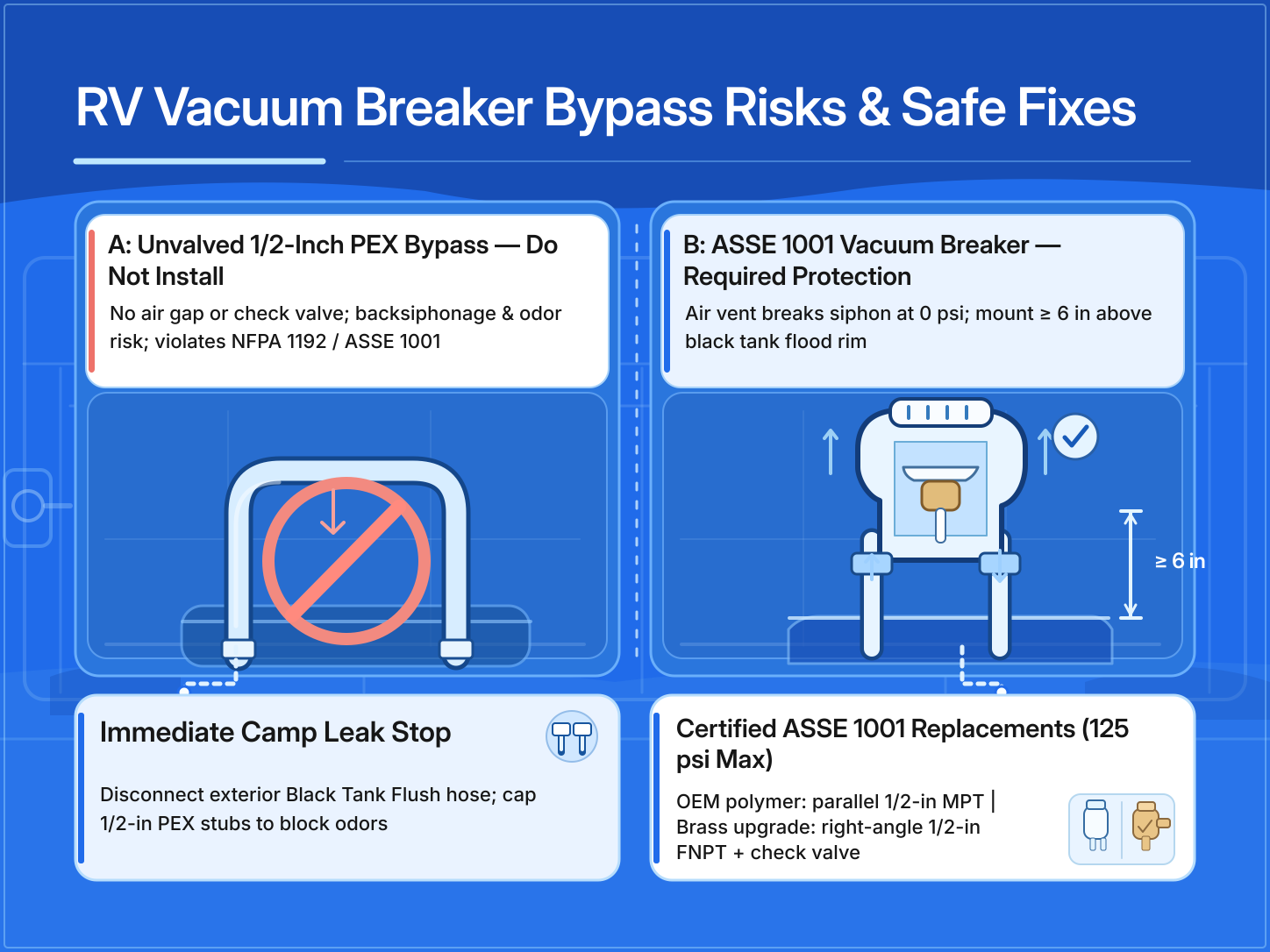
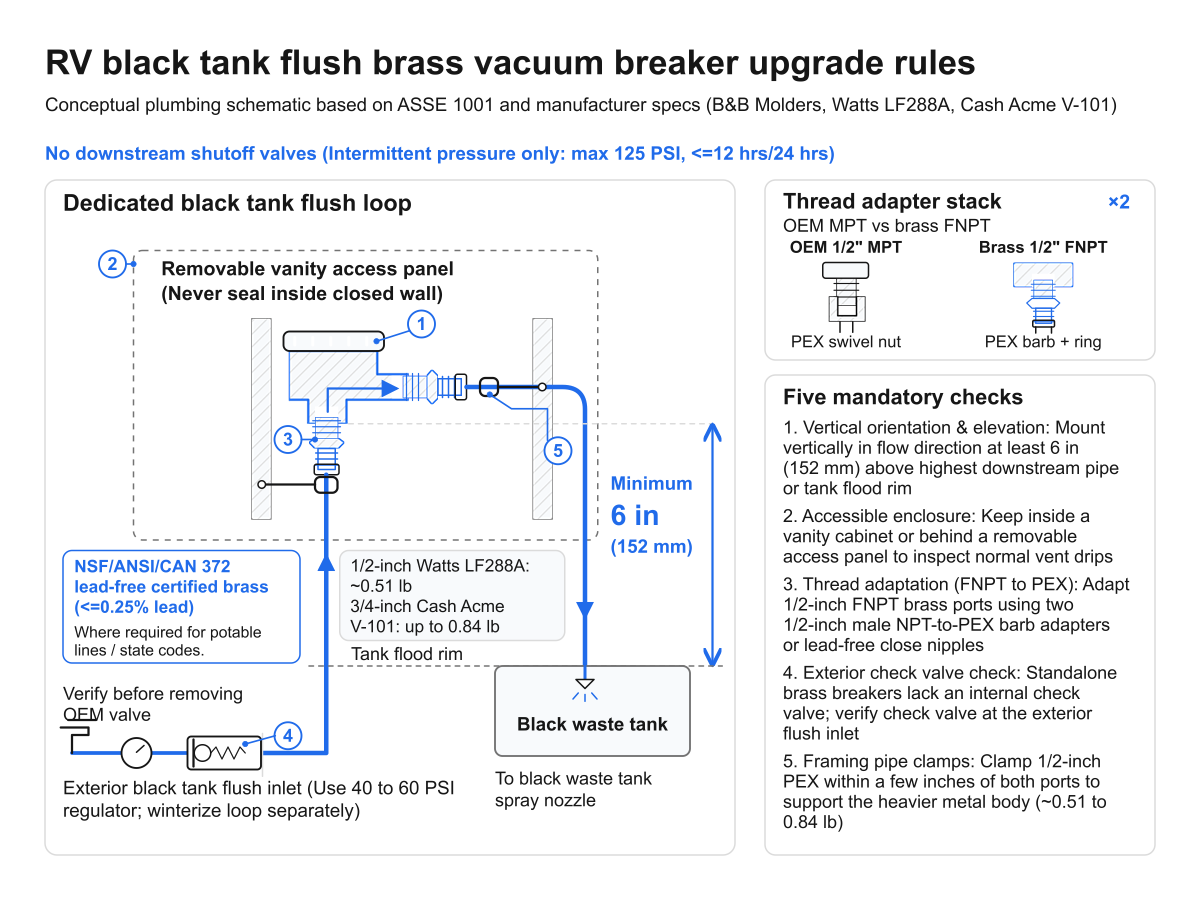
Installing a brass atmospheric vacuum breaker on an RV black tank flush line requires maintaining a minimum 6-inch elevation above the tank flood rim, keeping the valve accessible in case of normal vent drips, adapting female NPT threads to PEX, and supporting the heavier metal body.
Before replacing a factory plastic inline valve with a commercial metal model such as the Watts LF288A or Cash Acme V-101, verify five plumbing requirements:
- Elevation and vertical orientation: Both ASSE 1001 and manufacturer manuals (B&B Molders, Watts, and Cash Acme) require installing the vacuum breaker vertically in the marked direction of flow, at least 6 inches (152 mm) above the highest point of the downstream piping or the flood rim of the waste tank. Installing the valve sideways, upside down, or backward will cause it to block flow or leak continuously out of the vent.
- Accessibility and vent spillage protection: Atmospheric vacuum breakers open to outside air whenever water pressure drops, and both B&B Molders and Watts warn that these devices can spill small amounts of water during normal shutoff or low-flow conditions. Never seal an atmospheric vacuum breaker inside an inaccessible wall cavity where routine vent drips could soak insulation or subfloor plywood. Ensure the valve sits behind a removable access panel or inside a vanity cabinet where you can inspect it while flushing.
- Thread adaptation (MPT vs FNPT): The factory plastic B&B Molders 571-VAC-CHK-A uses 1/2-inch male NPT (MPT) threads that thread directly into female PEX swivel nuts. In contrast, commercial valves like the 1/2-inch Watts LF288A and Cash Acme V-101 feature 1/2-inch female NPT (FNPT) ports (or require an aftermarket brass RV replacement specifically machined with 1/2-inch male threads). If you install a female-threaded commercial valve, you will need two 1/2-inch male NPT-to-PEX barb adapters (and crimp/cinch rings) or lead-free brass close nipples to connect your existing PEX lines.
- Built-in check valve consideration: The OEM B&B Molders 571-VAC-CHK-A is a combination atmospheric vacuum breaker and check valve, whereas standalone commercial atmospheric vacuum breakers (like the Watts LF288A and Cash Acme V-101) rely solely on an atmospheric air vent and float poppet unless paired with a separate upstream check valve at the exterior water inlet. Verify whether your exterior black tank flush inlet housing already contains an integral check valve before removing the OEM combination valve.
- Pipe clamping and lead-free certification: A 1/2-inch Watts LF288A weighs approximately 0.51 lb (and a 3/4-inch Cash Acme V-101 weighs up to 0.84 lb), which is heavier than a molded plastic valve. Secure the PEX tubing to solid framing with pipe clamps within a few inches of both ports so road bounce does not stress the fittings. For any valve connected to potable water lines or subject to state lead-free plumbing codes, choose a model certified to NSF/ANSI/CAN 372 (which limits lead content to a maximum weighted average of 0.25% across wetted surfaces, such as the Watts LF288A or Cash Acme 17383-0000LF).
Frequently Asked Questions
Can I install a brass atmospheric vacuum breaker on a continuously pressurized RV water line?
No. Both plastic and brass ASSE 1001 atmospheric vacuum breakers are designed strictly for intermittent, non-continuous pressure (Watts specifies no more than 12 hours of pressurization per 24-hour period) with no shutoff valves downstream. Under continuous pressure, the internal float can stick against the upper vent seat and fail to open when a vacuum occurs.
Why does water spray out of the top of my RV vacuum breaker when flushing the black tank?
A brief burp of water when turning the hose on or off can occur as the internal float rises or drops. Continuous spraying during flushing indicates either that incoming water pressure is too low to lift and seal the float against the upper silicone seat (B&B Molders specifies a minimum of 8 PSI), the valve is mounted out of vertical alignment, debris is holding the float open, or the plastic housing has cracked.
Do brass vacuum breakers require a pressure regulator on the black tank flush hose?
Yes. Although commercial brass vacuum breakers like the Watts LF288A and Cash Acme V-101 are rated up to 125 PSI intermittent pressure, the 1/2-inch PEX tubing, crimp fittings, and plastic spray nozzle inside the RV black tank are safer when protected by a 40 to 60 PSI inline pressure regulator at the spigot.
How can I clean a sticking brass vacuum breaker without replacing it?
Turn off the water supply, unscrew the top hood screws to lift off the protective canopy, and unthread the brass bonnet from the valve body. Rinse any mineral scale or sediment off the lightweight float poppet and silicone seat disc, inspect the bonnet O-ring, and reassemble.
Next Steps for Your RV Plumbing Upgrade
- Inspect your current valve location: Locate your black tank flush vacuum breaker (typically under the bathroom vanity or behind an access panel near the toilet) and check whether it uses 1/2-inch NPT inline fittings or is part of the toilet pedestal.
- Choose the matching replacement: If a gravity toilet vacuum breaker is leaking at the rear of the bowl, order the exact OEM plastic replacement kit for your Dometic or Thetford model. If an inline 1/2-inch NPT black tank flush valve is cracked or leaking, select either a direct OEM replacement or a lead-free 1/2-inch brass/bronze atmospheric vacuum breaker (such as the Watts LF288A or Cash Acme V-101LF).
- Prepare adapters and support: Check whether your replacement brass valve has female NPT threads (requiring 1/2-inch male PEX adapters) or male NPT threads, mount the valve vertically at least 6 inches above the tank flood rim in an accessible spot, clamp the PEX lines securely, and test the flush line with a pressure regulator attached before closing the access panel.
Sources:
- Use of Lead Free Pipes, Fittings, Fixtures, Solder, and Flux for Drinking Water – U.S. Environmental Protection Agency, Safe Drinking Water Act Lead-Free Rule and 0.25% weighted average lead statutory requirement.
- How to Identify Lead Free Certified Drinking Water Products – U.S. Environmental Protection Agency Office of Ground Water and Drinking Water, PDF guidance on third-party certification marks, NSF/ANSI 372 testing, and plumbing product labeling.
- ASSE International Plumbing Product Standards – ASSE International, performance requirements and test methods for ASSE 1011 hose connection vacuum breakers and backflow protection.
- Home Water Systems: Backflow Prevention Devices – Colorado State University Extension, technical guidance on cross-connection control, hose-end vacuum breakers, and plumbing backflow protection.