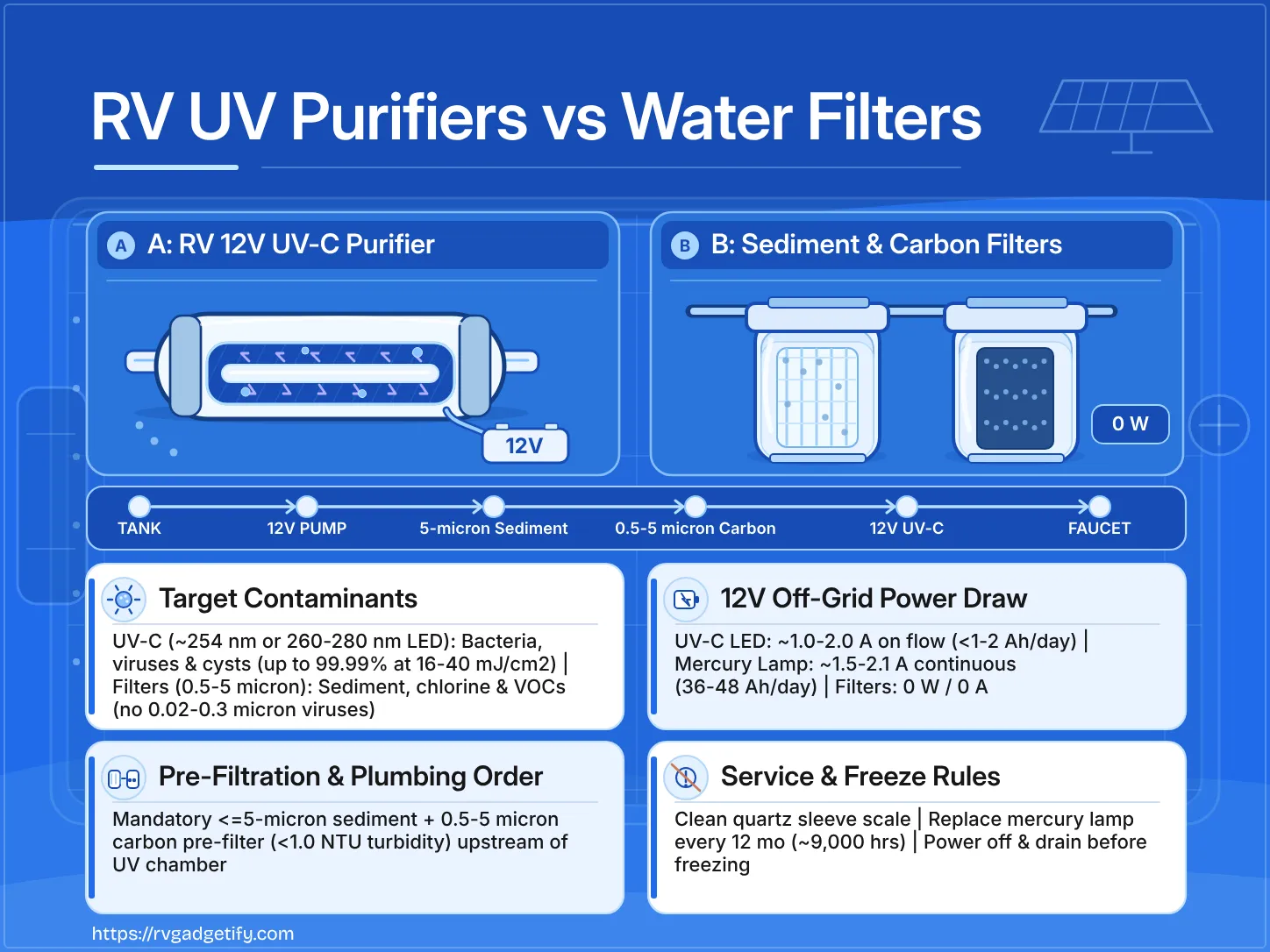

RV UV water purifiers and mechanical water filters solve two different water-quality problems: ultraviolet (UV-C) purifiers inactivate microorganisms such as bacteria, viruses, and protozoan cysts using germicidal light, whereas mechanical sediment and carbon block filters physically trap particulates and adsorb chlorine, chemical odors, and bad tastes. Because UV light cannot remove dirt or chemicals and standard carbon blocks cannot stop viruses, the most complete off-grid RV setup pairs upstream sediment and carbon pre-filtration with a downstream 12V UV-C chamber.
Key Takeaways
- Separate disinfection from filtration: Use UV-C to inactivate biological pathogens (bacteria, viruses, and cysts) and mechanical or carbon filters to remove rust, sand, silt, chlorine, VOCs, and foul tastes.
- Always install a 5-micron or finer sediment filter before UV: Suspended silt and cloudiness (turbidity above 1.0 NTU) cast microscopic optical shadows that shield microbes from UV-C rays.
- Calculate your 12V battery budget: RV 12V UV purifiers draw roughly 10 to 25 watts (about 0.8 to 2.1 amps). Continuous mercury-vapor lamps draw power 24/7 while switched on (36 to 48 amp-hours per day), whereas flow-activated UV-C LED units draw power only while a faucet is open.
- Clean quartz sleeves and replace mercury lamps on schedule: Hard-water mineral scale blocks UV light transmission through the quartz sleeve, and low-pressure mercury-vapor lamps must be replaced every 12 months (or roughly 9,000 hours) even if the bulb still glows blue.
- Power down and drain before freezing weather: Never energize a drained UV chamber, and completely drain both filter housings and the UV quartz chamber before winter temperatures arrive.
What Separates RV UV Water Purifiers From Mechanical Filters?
RV UV water purifiers neutralize living microorganisms optically without altering water chemistry, while mechanical and activated-carbon filters physically strain out particles and chemically adsorb dissolved contaminants.
Low-pressure mercury-vapor UV lamps emit germicidal light at approximately 254 nanometers (nm) (with UV-C LED systems operating in the adjacent 260 to 280 nm germicidal band). That radiation penetrates microbial cell walls and scrambles DNA and RNA so pathogens cannot replicate or cause infection. However, whatever enters a UV chamber still exits the chamber: silt, rust flakes, dead microbes, chlorine, and dissolved metals pass straight through unless a physical filter traps them.
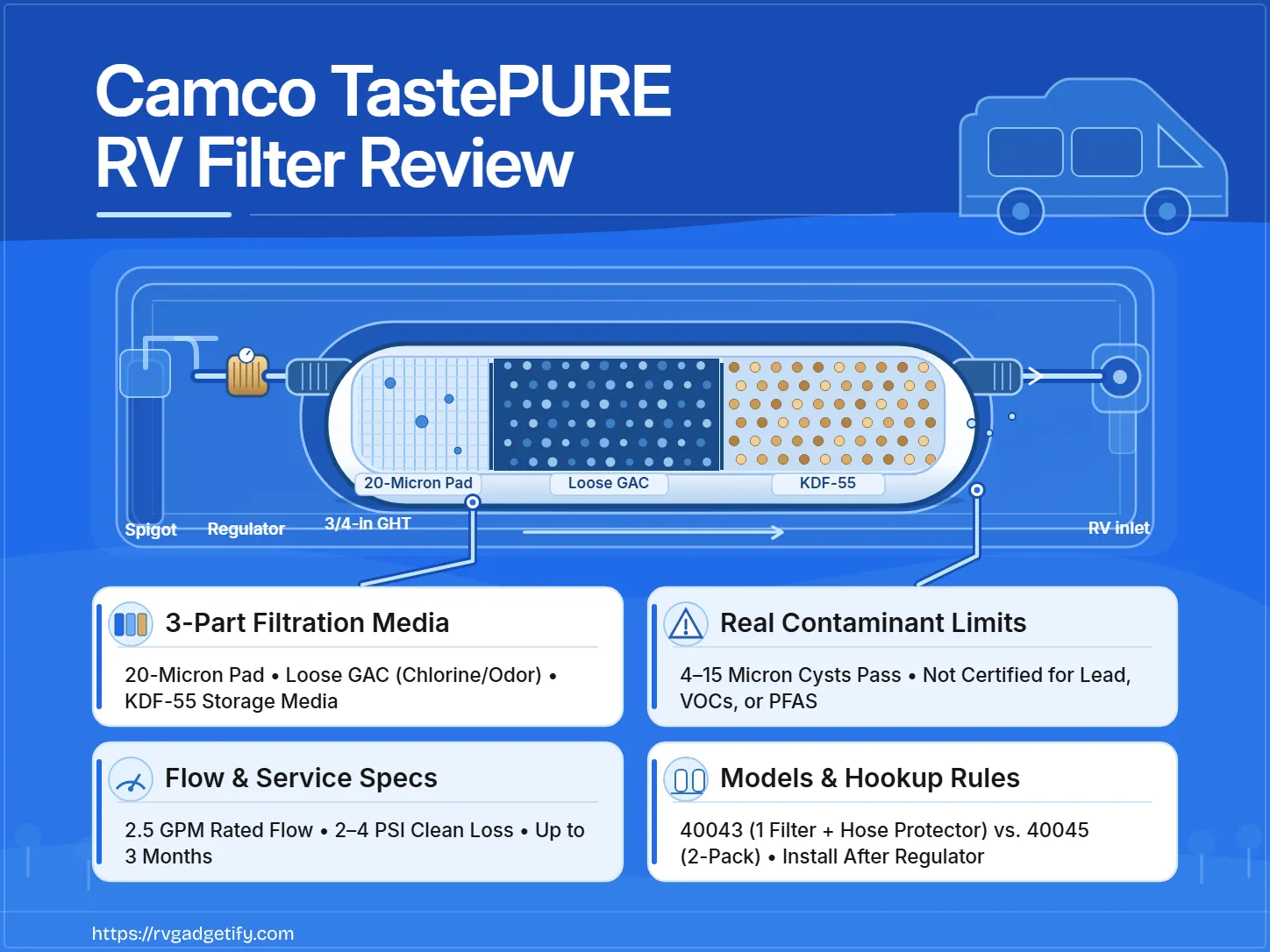
Mechanical and carbon block filters work passively through water pressure alone. Polypropylene sediment media traps sand, silt, and pipe scale, while activated carbon adsorbs chlorine, chloramines, volatile organic compounds (VOCs), and swampy tastes. However, standard 0.5- to 5-micron sediment and carbon cartridges have pores far too large to sieve out waterborne viruses, which measure only 0.02 to 0.3 microns.
| Attribute | RV UV-C Water Purifiers | Mechanical Sediment & Carbon Block Filters |
|---|---|---|
| Primary mechanism | Germicidal UV-C irradiation (~254 nm mercury lamp or UV-C LED) that disrupts microbial DNA and RNA | Physical particle sieving plus activated-carbon chemical adsorption |
| Target contaminants | Bacteria, viruses, and protozoan cysts (Giardia and Cryptosporidium) in clear water | Sediment, sand, rust, chlorine, chloramines, VOCs, and taste or odor compounds |
| Viral protection | Achieves up to 4-log (99.99%) reduction at a rated 16 to 40 mJ/cm2 dose in clear water | Standard 0.5- to 5-micron carbon and sediment filters do not stop 0.02- to 0.3-micron viruses |
| Particle & chemical removal | None (leaves sediment, chlorine, heavy metals, and odors unchanged) | Removes particulates down to rated micron size and adsorbs chlorine and organic chemicals |
| 12V electrical draw | Approximately 10 to 25 watts (0.8 to 2.1 amps on 12V DC) | Zero electrical draw (operates passively on water line pressure) |
| Feed-water prerequisite | Requires clear water (<1.0 NTU turbidity) and a mandatory 5-micron or finer upstream pre-filter | Works directly on turbid or chlorinated water (stepped micron stages recommended for heavy silt) |
How Does 254 nm UV-C Disinfection Work?
Germicidal UV-C light around 254 nm penetrates the cell walls of bacteria, viruses, and protozoan cysts and causes adjacent thymine (or uracil) bases in their DNA and RNA strands to fuse into dimers. Once its genetic code is cross-linked, a microorganism can no longer replicate or infect a host.
When a UV reactor is matched to the faucet’s maximum flow rate and delivers a UV dose (fluence) of at least 16 to 40 mJ/cm2 in clear water, it can achieve a 4-log (99.99%) reduction of bacteria, viruses, and chlorine-resistant protozoan cysts such as Cryptosporidium and Giardia without adding chemical disinfectants or disinfection byproducts to your drinking water.
Because UV-C provides instant optical exposure rather than residual chemical protection, disinfection happens only inside the stainless steel reactor chamber. If water flows through the chamber faster than the unit’s rated GPM, or if the water is murky, exposure time and UV intensity drop below the required dose.
Why Is Sediment Pre-Filtration Mandatory Before UV?
Every RV UV purifier must be preceded by a 5-micron or finer sediment pre-filter (and ideally a 0.5- to 5-micron carbon block) because suspended particles block UV-C light from reaching microorganisms.
In water treatment, this phenomenon is called optical shadowing. When water contains rust flakes, clay, or silt particles larger than 5 microns, or when cloudiness (turbidity) exceeds 1.0 NTU, bacteria and viruses can cling to the downstream side of a particle. The particle acts like an umbrella, casting a shadow that shields the microbe as it passes through the UV chamber.
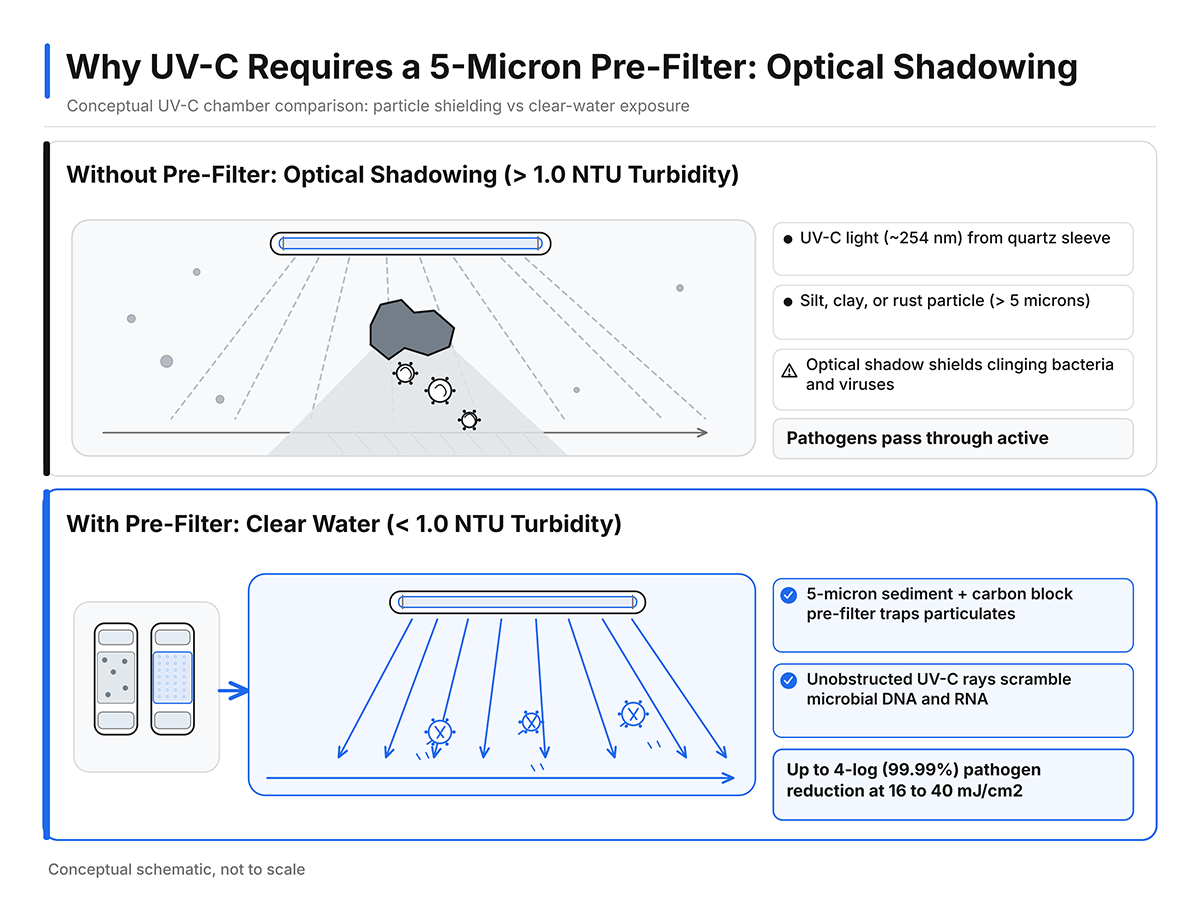
Adding a carbon block stage between the 5-micron sediment pre-filter and the UV reactor also removes dissolved organic compounds and iron or tannins that tint the water and absorb UV-C wavelengths, keeping UV transmittance high inside the chamber.
A carbon block stage ahead of the reactor usually lives in a canister stand, and heavy-duty multi-stage canister systems are compared in our guide to the 10 best multi-stage RV water filter systems.
How Much 12V Power Does an RV UV Purifier Use?
RV-specific 12V DC UV purifiers typically draw 10 to 25 watts (roughly 0.8 to 2.1 amps at 12V) while energized, but the real-world impact on your boondocking battery bank depends entirely on whether the system uses a traditional mercury-vapor lamp or a flow-activated UV-C LED array.
| UV Technology | Operating Behavior | Typical 12V Current Draw | Daily Off-Grid Battery Impact |
|---|---|---|---|
| Flow-activated UV-C LED | Instant-on internal flow switch powers the LEDs only while a faucet is open | ~1.0 to 2.0 amps only during water flow | Under 1 to 2 Ah per day (assuming 30 to 60 minutes of total daily faucet use) |
| Continuous mercury-vapor lamp | Remains energized continuously because mercury lamps need minutes to warm up and degrade if cycled frequently | ~1.5 to 2.1 amps constant draw while switched on | 36 to 48 Ah per day if left running 24 hours a day |
For dry campers running off standard deep-cycle lead-acid or small lithium battery banks, leaving a 1.5 to 2.0 amp mercury-vapor UV ballast switched on 24 hours a day consumes 36 to 48 amp-hours every single day, rivaling a 12V compressor refrigerator. Because mercury-vapor bulbs require several minutes of warm-up to reach germicidal temperature, you cannot simply wire them to cycle on and off with your 12V water pump.
By contrast, flow-activated UV-C LED purifiers reach full germicidal output in milliseconds. An internal flow sensor turns the LEDs on the instant you open the drinking faucet and shuts them off the moment you close it, making LED-based UV the practical choice for solar and battery-constrained boondocking.
RVGadgetify / Off-Grid Water Systems
RV 12V UV Water Purifier Daily Battery Draw Calculator
Compare the daily house-battery impact of a flow-activated UV-C LED purifier with a mercury-vapor lamp that stays energized while in service. Use your own device rating and daily operating time.
Estimated daily 12V power budget
Daily 12V Battery Draw
Amp-hours drawn from the nominal 12V house battery per day.
Daily Energy Consumption
Watt-hours per day at nominal 12V DC.
Active Current & Power
Daily Usage Interpretation & Comparison
Which Setup Fits Your Camping Style and Water Source?
Use the decision matrix below to match your typical water source and 12V power budget to the right filtration and disinfection setup.
| Camping Scenario & Water Source | Recommended Setup | Why It Fits | Key Requirement to Verify |
|---|---|---|---|
| Full-hookup parks on chlorinated municipal water | Multi-stage sediment and carbon block filters (no UV needed) | Municipal water is already disinfected; sediment and carbon stages strip pipe rust, silt, and chlorine taste/odor with zero battery draw | Verify that local water is treated municipal supply and not under a boil-water advisory |
| Boondocking with a small battery bank (filling tank from city taps) | Passive sediment and carbon filtration (or 0.2-micron / UF mechanical barrier) | Canister filters run entirely on water pressure and draw 0 amps from your 12V house batteries | Keep a trace chlorine residual in the fresh tank and filter chlorine out at the kitchen sink |
| Filling from rural wells, springs, or non-chlorinated sources off-grid | 5-micron sediment + carbon block pre-filtration followed by a flow-activated 12V UV-C LED purifier | Pre-filters clarify the water so the instant-on UV-C LED unit can disinfect viruses, bacteria, and cysts without a 24/7 battery drain | Confirm water turbidity is clear (<1.0 NTU) after pre-filtration and size the UV unit to your faucet GPM |
| Sanitizing water drawn from the RV onboard fresh tank (large solar/lithium bank) | Post-pump 5-micron sediment + carbon block followed by a 12V UV-C chamber | Disinfects stagnant tank water right before it reaches the faucets | If using a continuous mercury lamp, shut the unit off whenever the RV is unoccupied or parked |
How Do Mechanical Filters and UV Systems Work Together in an RV?
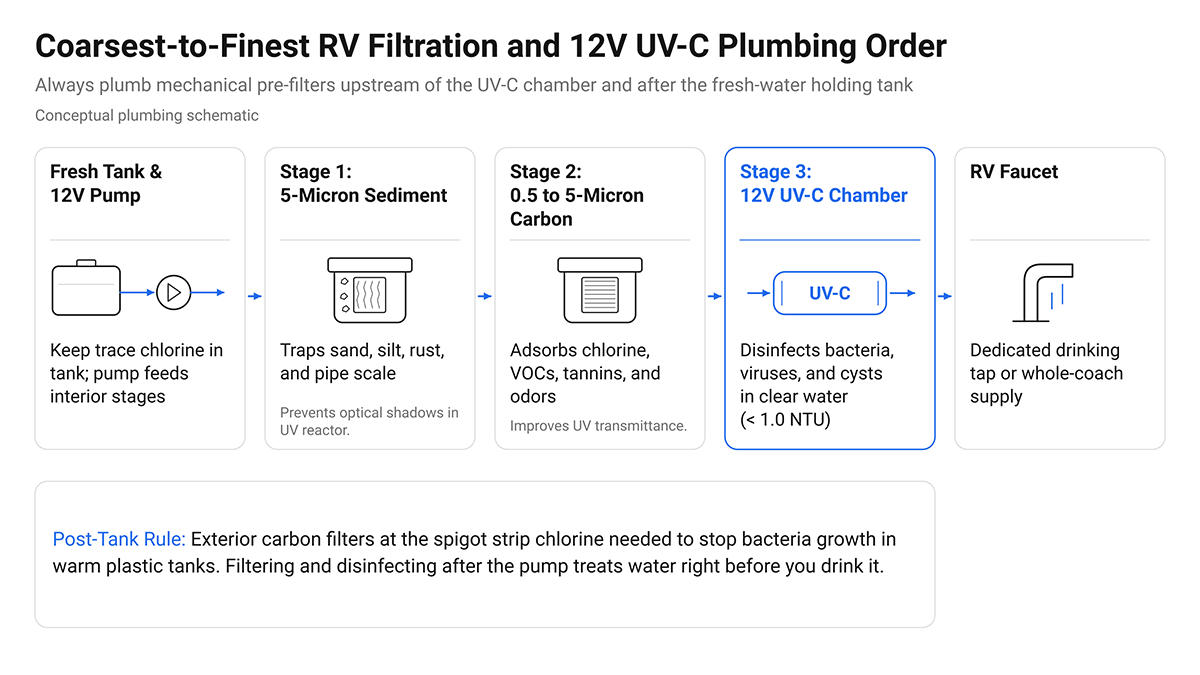
When combining mechanical filters with a UV-C purifier, always plumb the components from coarsest to finest, ending with the UV chamber last:
- Stage 1: 5-Micron (or Stepped) Sediment Pre-Filter: Traps sand, silt, rust, and pipe scale so particulates cannot enter the carbon bed or cast optical shadows inside the UV reactor.
- Stage 2: 0.5- to 5-Micron Carbon Block Filter: Adsorbs chlorine, VOCs, tannins, and bad tastes, improving water clarity and UV light transmittance.
- Stage 3: 12V UV-C Disinfection Chamber: Installed downstream of the sediment and carbon filters (either under the kitchen sink for a dedicated drinking tap, or after the RV’s 12V water pump and interior filters for whole-coach protection) so only clear, pre-filtered water passes over the quartz sleeve.
Why post-tank placement matters in an RV: If you use an exterior carbon filter at the campground spigot to fill your RV’s onboard fresh-water holding tank, that carbon filter strips the municipal chlorine that normally stops bacteria from growing inside the plastic tank during warm weather. Installing an interior sediment/carbon filter plus a 12V UV-C purifier after the fresh tank and water pump (or under the galley sink) ensures that water stored in your tank is disinfected right before you drink it.
What Maintenance and Winterization Rules Apply to RV UV Systems?
Adding a UV purifier introduces four maintenance and seasonal-storage tasks that do not apply to passive filter canisters:
| Maintenance Area | What Happens Inside the Unit | Required Action |
|---|---|---|
| Quartz-sleeve mineral scaling | Hard-water calcium, magnesium, and iron coat the glass quartz sleeve surrounding the lamp | Inspect the quartz sleeve periodically and soak or wipe it with white vinegar or a mild citric-acid solution to restore optical clarity |
| Mercury-vapor lamp aging | Germicidal UV-C output decays over time even while the bulb continues to emit visible blue light | Replace low-pressure mercury-vapor lamps every 12 months (or ~9,000 operating hours); UV-C LED arrays last significantly longer based on flow hours |
| Dry-chamber overheating | Energizing a UV lamp when the chamber is drained empty of water causes rapid heat buildup | Always disconnect 12V power to the UV controller before draining RV plumbing lines, and shut off continuous lamps when no water will be used for extended periods |
| Winter freeze damage | Trapped water inside the stainless UV chamber expands when frozen | Completely drain the UV reactor, remove the fragile quartz sleeve and lamp for indoor storage if recommended by the manual, and never pump pink RV antifreeze through a UV chamber unless the sleeve is removed or the unit is bypassed |
How to Decide What Your RV Needs Next
Start by checking where you fill your fresh-water tank and how much 12V battery capacity you have to spare:
- If you camp exclusively on treated city-water hookups or fill your tank from verified municipal spigots: Stick with a multi-stage sediment and 0.5-micron carbon block filter setup. You will get clean, chlorine-free water and cyst protection with zero 12V power draw.
- If you draw from private wells, rural spigots, international sources, or want biological protection for water stored in your fresh tank: Pair a 5-micron sediment and carbon block pre-filter with a 12V UV-C purifier mounted downstream. Choose a flow-activated 12V UV-C LED model if you boondock on batteries so you only draw power while dispensing water.
Frequently Asked Questions
Do RV UV water purifiers remove sediment, chlorine, or bad tastes?
No. UV-C light only inactivates microorganisms by disrupting their DNA and RNA. It does not physically remove dirt, rust, chlorine, heavy metals, or chemical odors, which is why a sediment and carbon block filter must be paired with it.
Can standard carbon or sediment water filters remove viruses?
No. Standard mechanical sediment and carbon block cartridges (typically rated at 0.5 to 5.0 microns) cannot trap waterborne viruses, which measure only 0.02 to 0.3 microns. Protecting against viruses requires UV-C disinfection, a 0.02-micron ultrafiltration membrane, or specialized 0.2-micron electropositive media.
Why does an RV UV purifier require clear, pre-filtered water?
Suspended silt, rust, and cloudiness (turbidity above 1.0 NTU) block UV light and cast microscopic optical shadows inside the reactor chamber. Microbes hiding behind particles larger than 5 microns can pass through the UV light unharmed.
What micron rating is required for a pre-filter before an RV UV system?
Install at least a 5-micron or finer sediment pre-filter upstream of the UV chamber. Many RVers pair a 5-micron sediment stage with a 0.5- to 5-micron carbon block ahead of the UV unit to remove both particulates and organic discoloration.
How much 12V battery power does an RV UV purifier use?
Most RV 12V UV purifiers draw 10 to 25 watts (about 0.8 to 2.1 amps) while active. A continuous mercury-vapor lamp left on 24/7 consumes roughly 36 to 48 amp-hours per day, whereas a flow-activated UV-C LED purifier draws power only during the minutes a faucet is actually open.
How often should you replace an RV UV lamp?
Low-pressure mercury-vapor UV lamps must be replaced every 12 months (or approximately 9,000 hours of operation) because their germicidal 254 nm output drops below safe thresholds long before the bulb burns out. Flow-activated UV-C LED modules are rated by cumulative flow hours and typically last several years.
How do you clean hard-water scale off a UV quartz sleeve?
Turn off the 12V power supply, depressurize and drain the UV chamber, carefully slide out the quartz sleeve (handling it with a soft cloth so skin oils do not mar the glass), and soak or wipe away calcium and magnesium film using household white vinegar or a citric-acid solution before rinsing and reinstalling.
What happens if an RV UV water purifier freezes?
Water trapped inside a UV chamber expands when frozen, which can shatter the fragile quartz sleeve, crack seals, and split the stainless steel reactor body. Always disconnect 12V power, bypass the UV unit before pumping RV antifreeze, and completely drain the chamber before sub-freezing weather arrives.
Sources:
- Use of Lead Free Pipes, Fittings, Fixtures, Solder, and Flux for Drinking Water – U.S. Environmental Protection Agency, Safe Drinking Water Act Lead-Free Rule and 0.25% weighted average lead statutory requirement.
- How to Identify Lead Free Certified Drinking Water Products – U.S. Environmental Protection Agency Office of Ground Water and Drinking Water, PDF guidance on third-party certification marks, NSF/ANSI 372 testing, and plumbing product labeling.
- ASSE International Plumbing Product Standards – ASSE International, performance requirements and test methods for backflow prevention and water filtration system assemblies.
- Home Water Systems: Backflow Prevention Devices – Colorado State University Extension, technical guidance on cross-connection control, plumbing backflow protection, and filtration system integrity.