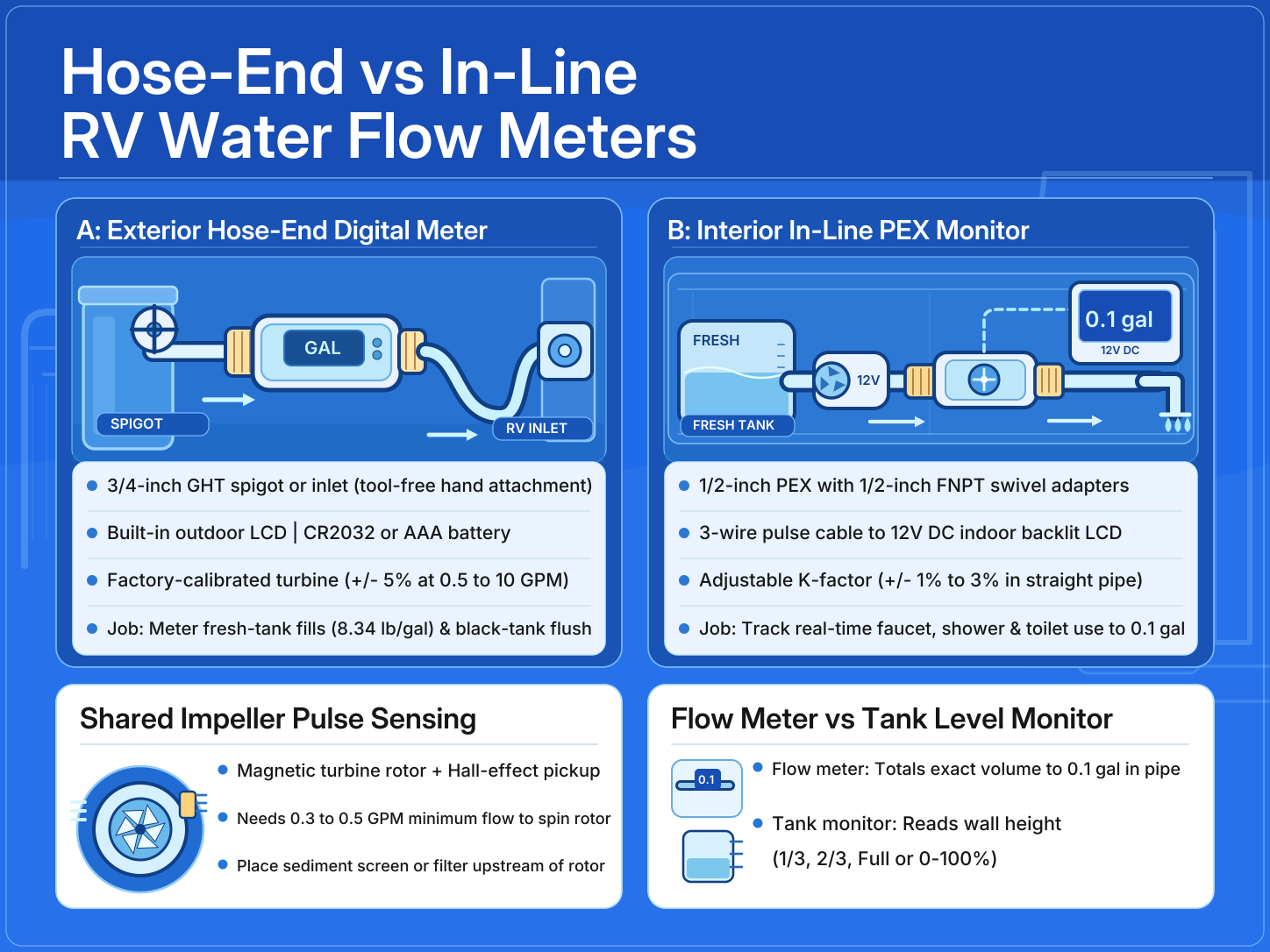

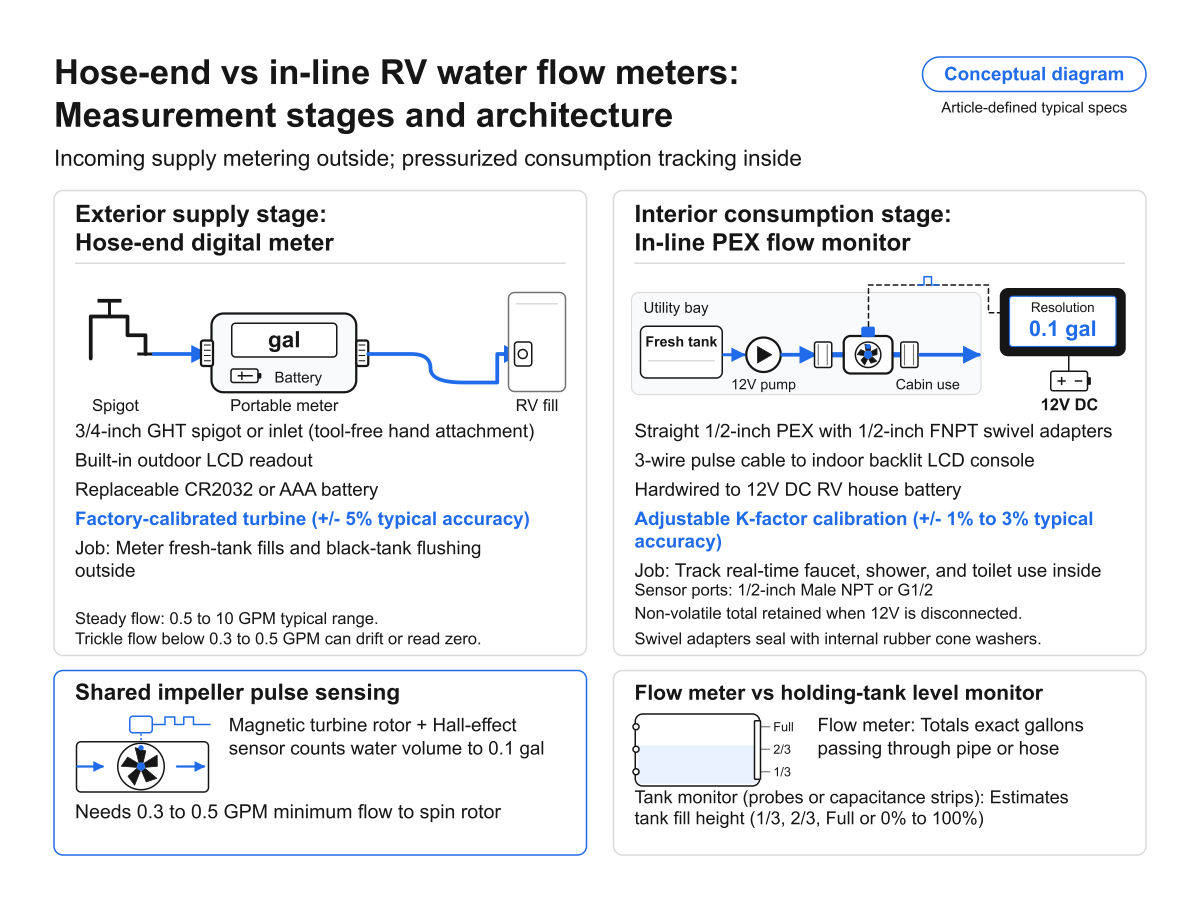
Hose-end digital RV water flow meters and in-line PEX water flow monitors measure water at two different stages of your camping setup. A hose-end meter threads onto the exterior 3/4-inch garden hose connection to measure how many gallons enter your fresh-water tank or black-tank flusher at the spigot. An in-line PEX flow monitor is plumbed permanently into your RV’s interior 1/2-inch water lines and wired to 12V DC power to track how many gallons you draw through your faucets, shower, and toilet while camping.
Choose a portable hose-end meter if you want a tool-free way to meter partial fresh-tank fills for towing-weight control or prevent black-tank overflows during flushing. Choose a permanent in-line PEX monitor if you boondock frequently and want a cabin-mounted readout showing exactly how much fresh water remains from every shower and dishwashing session.
Key Takeaways
- Match the meter to the measurement point: Hose-end meters track incoming supply outside at the campground spigot; in-line monitors track outgoing consumption inside the RV plumbing.
- Both rely on impeller pulse sensing, not tank floats: Most digital hose-end meters and wired 1/2-inch in-line sensors use an internal magnetic turbine rotor paired with a Hall-effect sensor that counts revolutions as water flows through the chamber.
- In-line sensors hold tighter calibration in rigid pipe: Straight 1/2-inch PEX runs and adjustable pulse calibration (K-factor) help in-line monitors reach roughly plus or minus 1% to 3% accuracy, whereas portable hose-end meters typically operate within plus or minus 5% under normal spigot flow.
- Factor in plumbing and 12V wiring effort: A hose-end meter attaches in seconds by hand; an in-line monitor requires cutting into 1/2-inch PEX, installing threaded swivel adapters, and routing 12V DC power to an interior display screen.
- Protect impellers from grit and freezing: Both architectures can jam if well-water sand enters the rotor or crack if residual water freezes inside the housing over winter.
How Do Hose-End and In-Line RV Water Flow Meters Compare?
Although both devices count gallons using a spinning internal rotor and a magnetic Hall-effect pickup, their housings, power sources, and mounting locations create very different ownership trade-offs.
Note that flow meters also differ from holding-tank level monitors (such as factory 4-probe panels or external capacitance strips like Garnet SeeLeveL). Tank-level monitors estimate how full a tank is by sensing water height against the tank wall, whereas a water flow meter totals the exact volume of water (down to a tenth of a gallon) passing through a pipe or hose.
| Comparison Attribute | Hose-End Digital Flow Meter | In-Line PEX Flow Monitor |
|---|---|---|
| Mounting location | Exterior 3/4-inch GHT spigot, hose, or RV fill inlet | Interior 1/2-inch PEX line (typically after the 12V water pump) |
| Sensing & calibration | Factory-calibrated magnetic turbine impeller with integrated pickup | Magnetic impeller with wired Hall-effect pulse sensor and programmable K-factor |
| Typical accuracy tolerance | Roughly plus or minus 5% under steady flow (can drift more at low trickle flows) | Roughly plus or minus 1% to 3% when calibrated in a straight pipe run |
| Display location | Built-in outdoor LCD screen on the meter body | Wired remote LCD console mounted on an interior cabin wall |
| Power source | Replaceable CR2032 coin cell or AAA batteries | Hardwired to the RV 12V DC house battery system |
| Installation scope | Tool-free hand tightening onto 3/4-inch GHT fittings | Cut 1/2-inch PEX, attach 1/2-inch NPT swivel adapters, and wire 12V DC power |
| Weather & UV exposure | Exposed to sunlight, rain splash, and outdoor temperature swings | Sheltered inside the climate-controlled RV cabin and utility bay |
| Primary RV job | Metering fresh-tank fills and black-tank flush volumes at the pedestal | Tracking real-time cabin water usage during off-grid boondocking |
How Do Hose-End Digital Flow Meters Work at the Spigot?
A hose-end digital water flow meter (exemplified by portable units from brands such as Save a Drop, Restmo, and RainPoint) combines a 3/4-inch Garden Hose Thread (GHT) housing, an internal turbine wheel, a small battery compartment, and an LCD readout in one handheld unit. Because it requires no tools or permanent modifications, you can move it between different hoses depending on the task.
Controlling Fresh-Tank Weight Before Towing
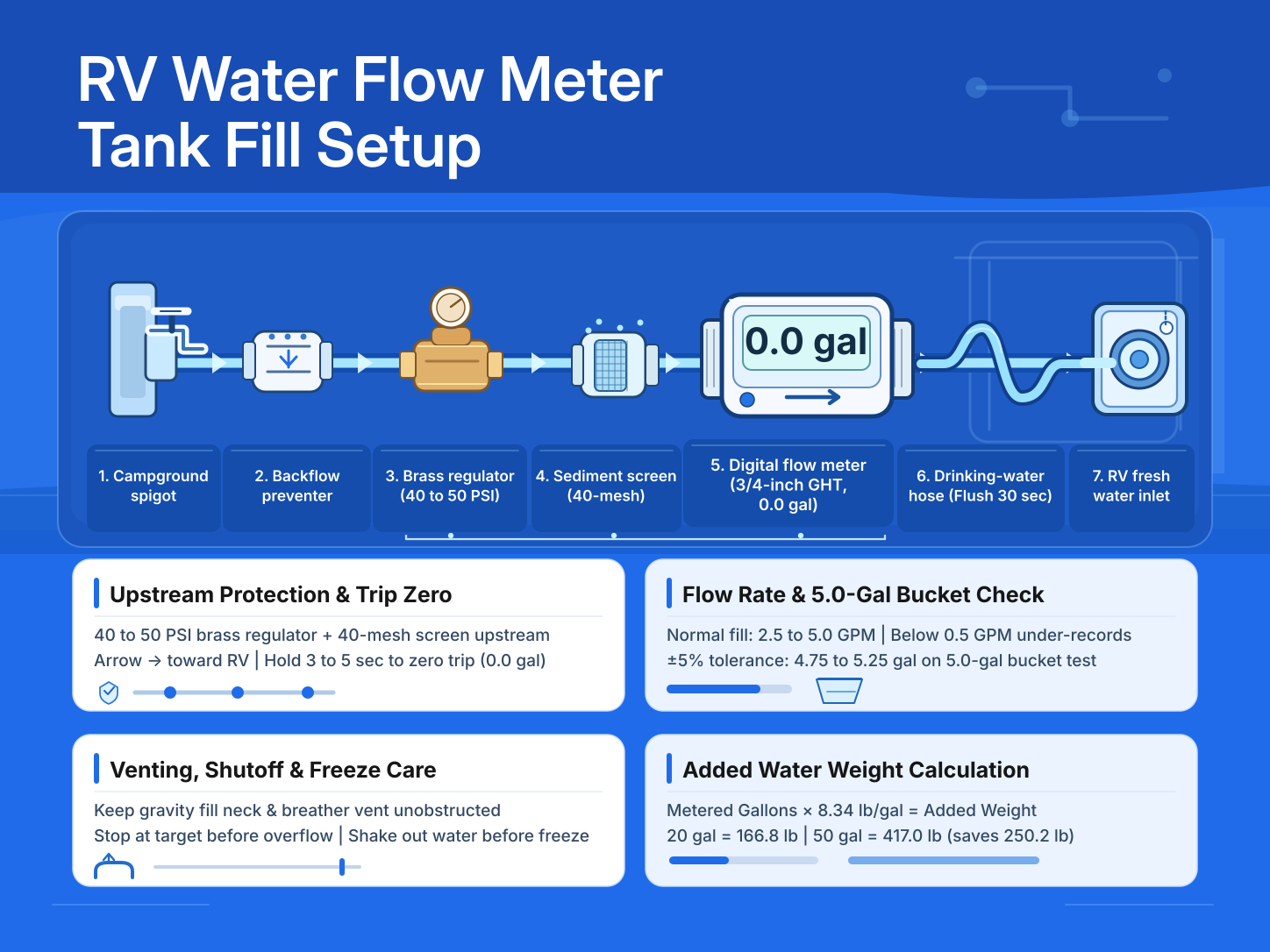
Factory RV tank gauges typically display levels in coarse fractions (1/3, 2/3, Full) that cannot tell you whether you have added 15 gallons or 28 gallons. Because fresh water weighs 8.34 pounds per U.S. gallon, carrying unnecessary water reduces available cargo carrying capacity and increases tongue weight.
- Worked example: Filling a 40-gallon fresh-water tank halfway (20 gallons) adds 166.8 pounds (about 167 pounds) of water weight, compared to 333.6 pounds when full.
- Threading a hose-end meter onto your potable drinking hose lets you watch the digital counter and shut off the spigot as soon as your target gallon count enters the gravity fill or tank-fill valve.
Fresh-water planning tool
RV fresh-tank partial fill and water weight calculator
Calculate exact spigot shutoff gallons, fresh-water weight at 8.34 lb/gal, and meter tolerance ranges.
Your fill estimate
Calculate to view the result.
Gallons to meter at spigot
0.0gal
Total water in tank
0.0 gal0.0 lb (about 0 lb)
Full tank weight
0.0 lbWeight saved vs full tank
0.0 lbEstimated starting water: 0.0 gal (0.0 lb).
Meter tolerance comparison
Illustrative ranges for the water added at the spigot, not for the tank’s estimated starting water. Volumes are shown to 0.01 gal and weights to 0.1 lb.
| Meter type | Tolerance | Actual delivered volume (gal) | Added weight (lb) |
|---|---|---|---|
| Hose-End Digital Meter | +/- 5% | 0.00 to 0.00 | 0.0 to 0.0 |
| In-Line PEX Monitor | +/- 3% | 0.00 to 0.00 | 0.0 to 0.0 |
| In-Line PEX Monitor | +/- 1% | 0.00 to 0.00 | 0.0 to 0.0 |
Preventing Black-Tank Overflows During Flushing
When using an onboard black-tank flusher without a clear sewer adapter, it is easy to lose track of how much rinse water has entered the holding tank. Attaching a hose-end meter to your dedicated utility flush hose (downstream of your anti-siphon vacuum breaker) lets you stop the flow well before the volume approaches your black tank's capacity.
- Sanitation rule: Never move a flow meter used on a non-potable black-tank flush hose back onto your potable drinking-water hose. Either keep the meter upstream of the backflow preventer on the potable supply side or dedicate a separate meter strictly to your utility flush hose.
Accuracy and Outdoor Limitations
Portable hose-end meters generally publish a measurement tolerance of plus or minus 5% within their normal operating flow range (typically 0.5 to 10 GPM), though sharp hose bends right at the inlet or very low trickle flows can allow water to slip past the impeller blades uncounted.
Because the unit lives outdoors when connected, it has three practical limitations:
- Battery upkeep: Most models run on a single CR2032 button cell or two AAA batteries that require periodic replacement during the camping season. Cold morning temperatures temporarily lower lithium button-cell voltage, which can cause the outdoor LCD screen to dim.
- Sun and splash exposure: While outdoor meters are built to handle rain and faucet splashes, leaving a plastic LCD screen in direct desert sun for months at a time can darken the liquid crystal display and make the polymer housing brittle.
- Potable-water material check: Many garden hose meters are built for lawn irrigation using standard brass or uncertified plastics. If you thread a meter onto your RV drinking-water line, verify that its wetted parts use lead-free brass (NSF/ANSI 372) or food-grade, BPA-free polymers.
How Do In-Line PEX Water Flow Monitors Work Inside the RV?
An in-line PEX water flow monitor (commonly built around a 12V digital counter controller and a 1/2-inch threaded Hall-effect flow sensor, such as Digiten's DFC series) separates the plumbing sensor from the display screen. The brass or food-grade plastic sensor splices into your interior 1/2-inch PEX plumbing, while a thin 3-wire cable carries pulse signals to a backlit display panel mounted inside the living area.
Where to Plumb the Sensor in an RV Water System
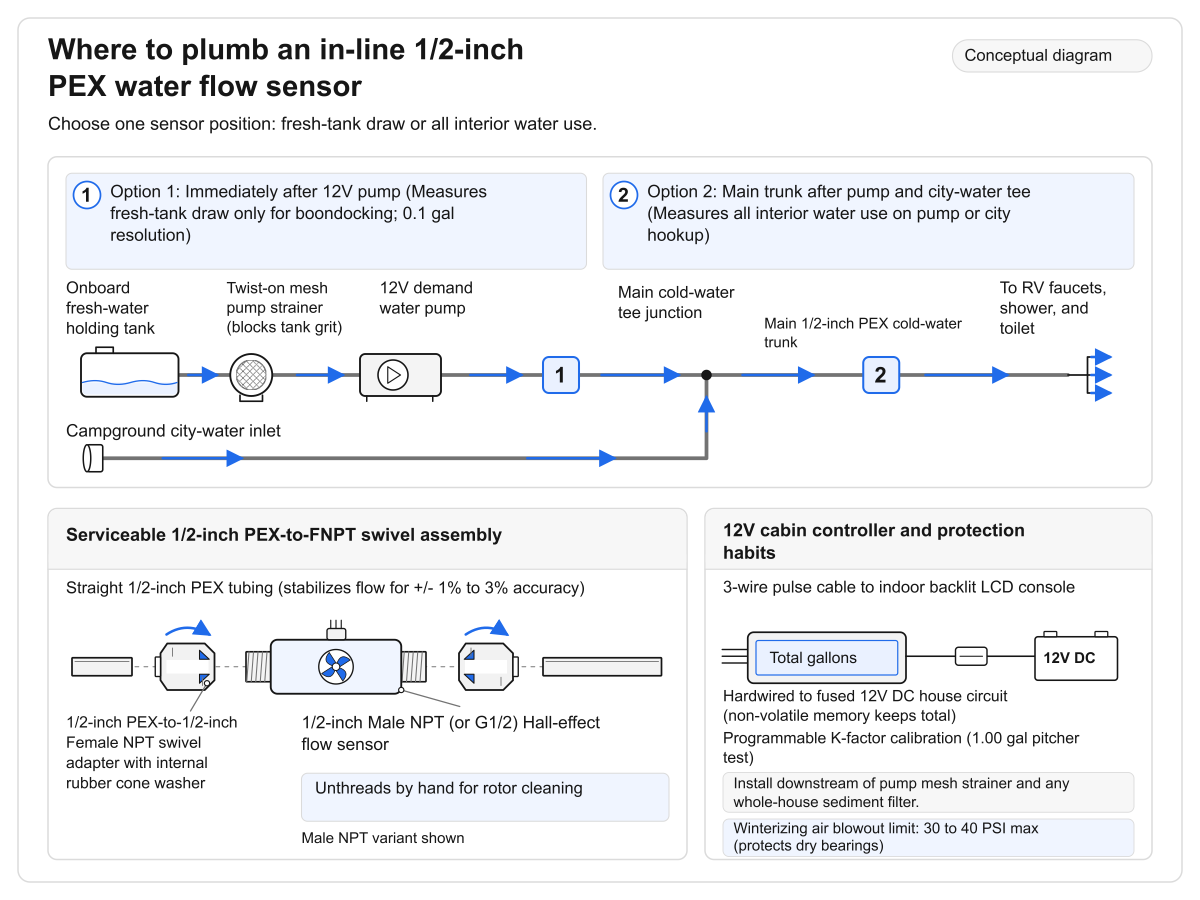
Where you splice the 1/2-inch flow sensor into your PEX lines determines what the cabin console measures:
- Option 1: Immediately downstream of the 12V water pump (Boondocking setup): Installing the sensor on the outlet side of your 12V demand pump measures every tenth of a gallon pumped out of your onboard fresh-water tank. If you start a dry-camping trip with 40 gallons in the tank, you can either count up from zero or set a batch alarm on the controller to track exactly how many gallons remain.
- Option 2: On the main cold-water trunk after the pump and city-water tee: Installing the sensor downstream of the point where the 12V pump outlet and the city-water inlet join allows the display to measure total interior water use (showers, sinks, and toilet flushes) whether you are boondocking on the pump or hooked up to a campground pedestal.
Why In-Line Sensors Achieve Tighter Accuracy
In-line Hall-effect flow sensors installed in 1/2-inch piping typically achieve an accuracy tolerance of plus or minus 1% to 3% for two reasons:
- Stabilized pipe geometry: Unlike a flexible garden hose that coils and hangs at an angle off a spigot, rigid 1/2-inch PEX keeps water entering the sensor chamber straight and uniform.
- Adjustable pulse calibration (K-factor): Most 12V digital flow controllers allow you to fine-tune the pulse-per-gallon calibration constant. You can pump exactly 1.0 gallon of water into a calibrated pitcher at your kitchen sink and adjust the controller setting until the screen reads
1.00 gal.
Installation and Power Requirements
Unlike a screw-on garden hose meter, an in-line PEX monitor is a permanent DIY or technician upgrade:
- Plumbing connections: Standard 1/2-inch in-line flow sensors have 1/2-inch Male NPT (or G1/2 parallel) threaded ends rather than PEX barbs. Instead of cementing or crimping directly to the sensor, crimp or push-fit two 1/2-inch PEX-to-1/2-inch Female NPT swivel adapters onto your cut PEX ends. Using swivel adapters with internal rubber cone washers lets you unthread the sensor by hand if you ever need to clean debris from the rotor.
- 12V DC house power: The display console wires into a fused 12V DC circuit from your RV house battery bank. Because it draws continuous low-voltage power from the coach batteries, you never have to open a battery cover, and controllers equipped with non-volatile memory retain your cumulative gallon total even if you shut off the main 12V battery disconnect switch.
Which Flow Meter Architecture Fits Your Camping Scenario?
Use this decision matrix to match the meter type to how you camp and how comfortable you are modifying PEX plumbing.
| Camping Scenario | Best Meter Choice | Practical Reason |
|---|---|---|
| Metering partial fresh-tank fills to save towing weight | Hose-end digital meter | Threads onto the fill hose at the spigot so you can shut off the water at your exact target gallon and weight limit |
| Monitoring water volume during black-tank flushing | Hose-end digital meter (dedicated utility unit) | Tracks exact gallons entering the exterior black-tank flush port from outside the RV |
| Multi-day off-grid boondocking on the fresh tank | In-line PEX flow monitor | Tracks every shower, toilet flush, and dish rinse from an indoor backlit screen without stepping outside |
| Campers who do not want to cut PEX or run 12V wires | Hose-end digital meter | Connects by hand to any 3/4-inch GHT faucet or inlet in seconds |
| Full-time RVers who both boondock and use partial fills | Both meter types | A portable hose-end meter controls how much water goes into the tank at the dump/fill station; the in-line monitor tracks how fast you use it inside |
How to Protect Both Meter Types From Grit and Freeze Damage
Because both hose-end meters and in-line PEX sensors rely on a small spinning turbine rotor with tight internal clearances, two preventative habits are essential for reliable readings:
1. Place a Sediment Filter or Screen Upstream
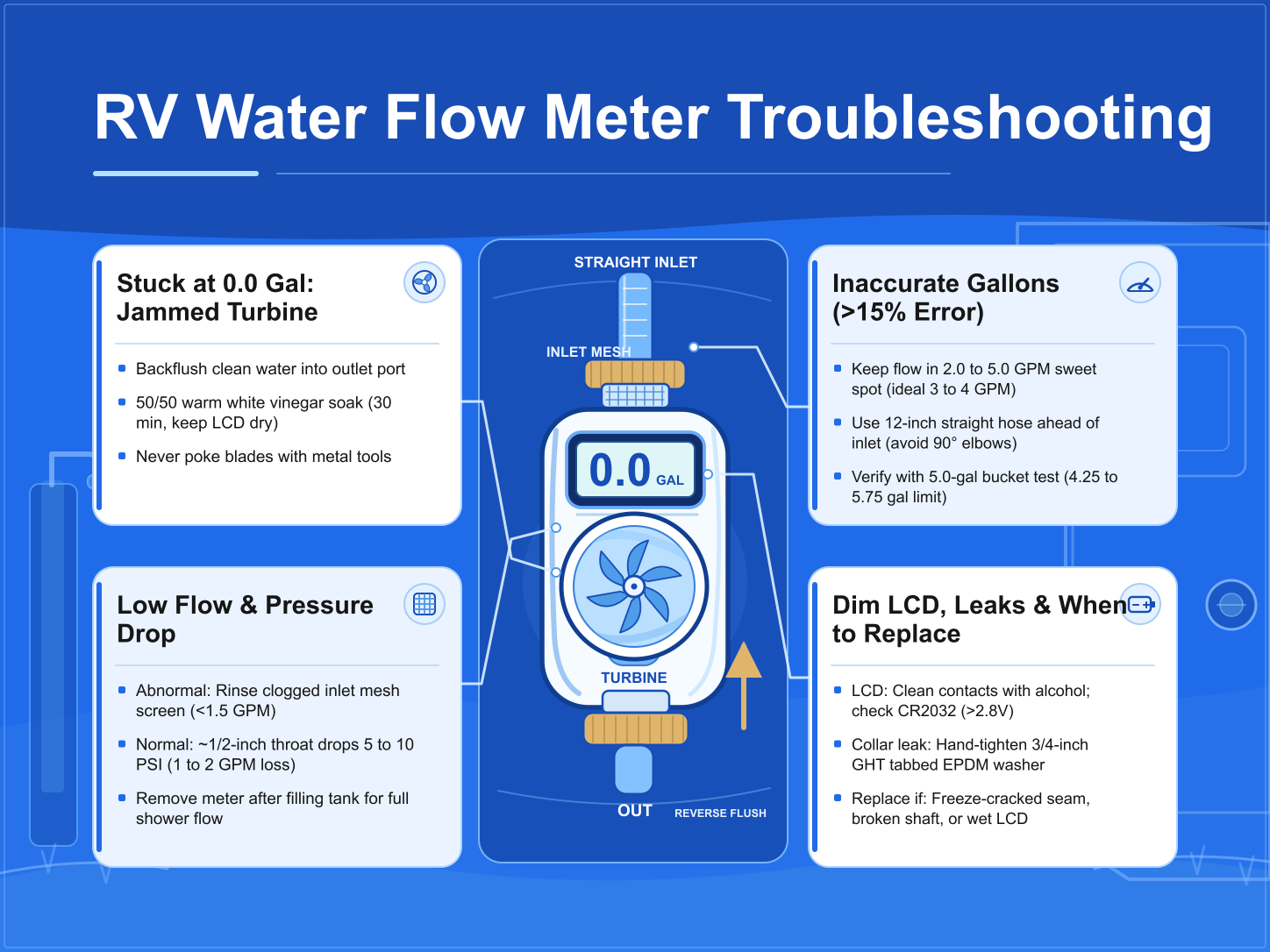
Fine sand, pipe scale, or well-water mineral grit can wedge between the impeller blades and the chamber wall, causing the meter to read zero even while water is flowing.
- For hose-end meters: Always install a wire-mesh hose screen washer inside the female inlet nut, or connect the flow meter downstream of your exterior inline RV water filter so only filtered water passes through the turbine.
- For in-line PEX monitors: Install the sensor downstream of the 12V water pump's twist-on mesh strainer (and any interior whole-house sediment filter) so debris from the fresh-water holding tank cannot foul the rotor.
2. Purge Trapped Water Before Freezing Temperatures
Water trapped inside a narrow turbine chamber expands as it freezes and can split a plastic housing, deform a brass sensor body, or snap the impeller shaft.
- For hose-end meters: Never leave a portable flow meter attached to a campground spigot during an overnight freeze. Disconnect the meter, shake out all standing water, blow gently through the inlet to clear the rotor, and store the unit inside the heated RV cabin.
- For in-line PEX monitors: When winterizing your RV with compressed air or non-toxic pink RV antifreeze, make sure the winterizing flow passes through the branch where your in-line sensor is mounted. If you use the compressed-air blowout method, keep air pressure regulated to 30 to 40 PSI and avoid blasting dry high-pressure air through the sensor for prolonged periods, which can overspin the dry impeller bearings.
Frequently Asked Questions
Why does my RV water flow meter read zero when a faucet is barely cracked open?
Turbine and Hall-effect impeller meters require a minimum flow rate (typically around 0.3 to 0.5 gallons per minute, depending on the sensor size) to overcome rotor friction and start spinning. If you open a sink faucet to a slow trickle or have a tiny pinhole drip in your plumbing, water can slip past the stationary impeller blades without registering on the display.
How is an in-line PEX flow monitor different from a SeeLeveL tank monitor?
An in-line PEX flow monitor splices into your 1/2-inch pressurized water pipe and counts the exact gallons flowing past an internal spinning rotor. A tank-level system like Garnet SeeLeveL uses electronic sensing strips attached to the outside wall of your holding tanks to read water height as a percentage (0% to 100%). A flow meter tells you exactly how many gallons you just used for a shower (for example, 2.4 gallons), while a tank-level sender tells you the overall fill level of fresh, gray, and black tanks.
Can I install an in-line flow sensor without cutting my RV's PEX pipes?
Only if you attach it at an existing threaded joint, such as threading a 1/2-inch NPT flow sensor directly onto the 1/2-inch male threaded outlet port of your 12V RV water pump (between the pump outlet and the existing female PEX swivel hose). If you mount the sensor further down a continuous 1/2-inch PEX run, you will need to cut the PEX tubing and install two 1/2-inch PEX-to-FNPT swivel adapters.
Can I use the same hose-end flow meter for filling my fresh tank and flushing my black tank?
Do not share the same meter between a black-tank flush hose and a drinking-water hose if the meter sits downstream of the backflow preventer, as contaminated water could touch the internal chamber. To stay safe, either leave the flow meter attached upstream at the clean spigot (before your hose splitter and backflow preventer) or buy a second, clearly labeled hose-end meter dedicated exclusively to your black-tank utility hose.
Sources:
- Use of Lead Free Pipes, Fittings, Fixtures, Solder, and Flux for Drinking Water - U.S. Environmental Protection Agency, Safe Drinking Water Act Lead-Free Rule and 0.25% weighted average lead statutory requirement.
- How to Identify Lead Free Certified Drinking Water Products - U.S. Environmental Protection Agency Office of Ground Water and Drinking Water, PDF guidance on third-party certification marks, NSF/ANSI 372 testing, and plumbing product labeling.
- ASSE International Plumbing Product Standards - ASSE International, performance requirements and test methods for ASSE 1011 hose connection vacuum breakers and backflow protection.
- Home Water Systems: Backflow Prevention Devices - Colorado State University Extension, technical guidance on cross-connection control, hose-end vacuum breakers, and plumbing backflow protection.